UT’s Resident Theatre Company Makes Art Its Own Way
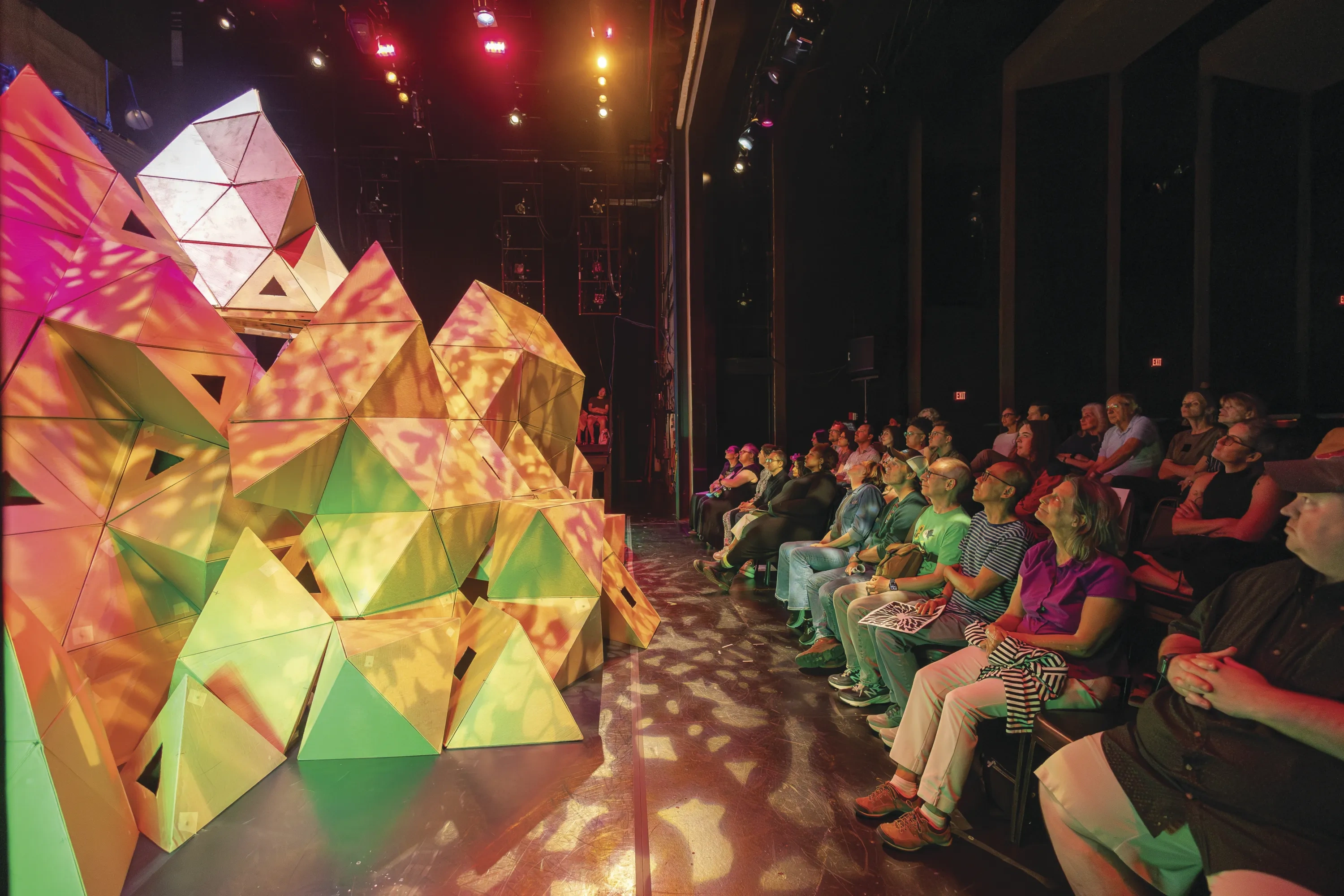
In April 2026, a theatre company called Rude Mechanicals produced a play called Not Every Mountain at UT’s B. Iden Payne Theater as part of the Fusebox Festival. Using string, cardboard, and magnets, the play invited the audience to witness the collective effort of making and unmaking a series of interlocking mountain ranges as an exploration of change, permanence, and our place in the natural world.
The University of Texas Department of Theatre and Dance—one of the largest and highest-acclaimed programs of its kind in the country—is a beloved artistic institution whose alumni have collected their own mountain of Tonys, Emmys, Oscars, and even a Pulitzer Prize. So, how does a homegrown team of experimental DIY theatre artists, sprung from ’90s Austin slacker culture, find their way to the Forty Acres as the University’s resident theatre company?
Rude Mechanicals Theatre Collective (aka Rude Mechs, see also “the Rudes”) co-founder and celebrated playwright Kirk Lynn, MFA ’04, Life Member, is also a professor in UT’s Department of Theatre and Dance, spearheading the Playwriting and Directing program. Surrounded by overflowing bookshelves that frame his office in the Winship Drama Building like scaffolding, he explains that the current chapter of Rude Mechs’ story was far from predictable.
“When we were just starting out as a local theatre company, it was in a UT syllabus that theatre students had to go see theatrical work in person,” Lynn says, and that Rude Mechs didn’t count. “They couldn’t come see us. We wouldn’t count because we weren’t professional. I mean, there’s a funny part of that, but it truly did also hurt our feelings—like, we’re trying really hard to become professional, while we certainly have an attitude that in theatre might be akin to punk rock in some way.”
Looking back over the years, that aforementioned punk rock ethos combined with a fierce dedication to the production of new works has shone as a north star for Rude Mechs. Pinballing an unprecedented path across Austin’s theatre and performance scene, they seem to actively seek out daunting artistic feats, such as adapting rock critic Greil Marcus’ historical tome about punk rock, Lipstick Traces: A Secret History of the 20th Century, into a critical hit. Like many other Rude Mechs’ joints, Lipstick Traces toured nationally and internationally—which is a moonshot for most independent theatre companies. They later created a graphic novel based on the play, but one of the company’s six artistic directors had to teach herself how to draw first.
The Rudes don’t produce the old chestnuts that one might find in repertory theatre companies—or on other less artistically adventurous University campuses. Their ensemble-based work is challenging, irreverent, and often experimental—striving to create “mentally nervy and physically ecstatic shows” for curious theatregoers.
Also on the list of things that brought the work of the Rude Mechs to grander spotlights and University audiences is, simply, longevity. This year marks the 30th season for the Rudes—a number that places them well beyond the standard life expectancy for independent art organizations, particularly those that headbutt artistic boundaries as a way of being.
“If you keep going and stay dedicated to your craft, almost by the law of averages, some of the work is going to matter to people at the University and that helps build the relationship,” Lynn explains.
Company co-founder Madge Darlington, BA ’90, MFA ’04, joined Lynn on the UT Department of Theater and Dance faculty in 2016. As a professor who teaches a class required by all incoming majors, she imparts hard-earned Rude Mechs’ philosophies into her curriculum.
“Limitations make you more creative,” Darlington says. “We use whatever is available to us, whatever is in the room. Often, that is just people. But it can also be, ‘There’s an old film cart, and it rolls, and we can use it to get something onstage. We like the aesthetic of the junky old film cart.’”
Lynn’s students also receive their fair share of battle-tested Rude lessons. “A frequent thing I do is take freshmen to go see theater in the community, and then we come back to the classroom, and I ask, ‘How much did that show cost?’ They throw out a number of five grand, and I say, great—let’s spend that money. And we keep re-budgeting, and eventually they get closer to an understanding of what it takes to put on a show.”
If art was science, and we were in a lab attempting to classify the Rude Mechs, in many categories they behave more like a band than a theatre company. And perhaps at the core of their superpowers lies a loyalty to the fundamentals that they adopted in their earliest days, performing shows at a downtown Austin music venue in the early hours before the bands rolled up to claim the stage for their amps and drums. The Rudes would set up the show, sell out the show, perform the show, strike the show, and take their seats at the bar by the downbeat of the night’s first band. They practiced how to set adrift all that was unnecessary, and they learned from their peers: The musicians, artists, performers, and producers who also populated 1990s Austin.
One of the musicians who shared those stages is frequent Rude Mechs collaborator and critically acclaimed composer Peter Stopschinski, BM ’95. “DIY music and theater were very comfortable for me,” Stopschinski says. “I came up simultaneously in the concert hall and in the nightclub. I was studying classical composition at UT and touring with an eight-piece punk/noise band at the same time. Composing for theatre taught me that every sound is created in service to the narrative.”
As part of their process, each year the Rudes check in with each other and ask themselves if they are still happy. Are they discovering new things and doing what they want to do as a company? They continue to commit to each other and the work. They explore their own gritty, genre-busting, Austin-based universe while showcasing their work on UT’s biggest stages. They provide affordable space for emerging artists to work and perform in a 50-person East Austin black box theater space called Crash Box, which is frequented by UT students making their first shows.
“There’s always somebody doing something weird there, which is great,” Lynn says. “We love working in big, beautiful theaters, but we always want to have a dirty place where we can break things, light things on fire.”
What’s next for Rude Mechs? Where does UT’s resident theatre company focus its attention after three decades of productions? At press time, Lynn’s recent adaptation of Thornton Wilder’s The Emporium just finished an off-Broadway run. Not Every Mountain is gearing up for tours. But mostly, we can expect the Rudes to do what the Rudes do, an important part of which is taking their own advice.
“The advice that we give all the time as Rude Mechs is don’t wait,” Darlington says. “Don’t wait to be cast. Don’t wait to be hired. If you’re not making the art you want to be making, you just have to grab some people you trust and love and start. Start making it yourself.”
CREDIT: Robert Silver