The Life Science Library and Other Alumni Favorite Study Spots
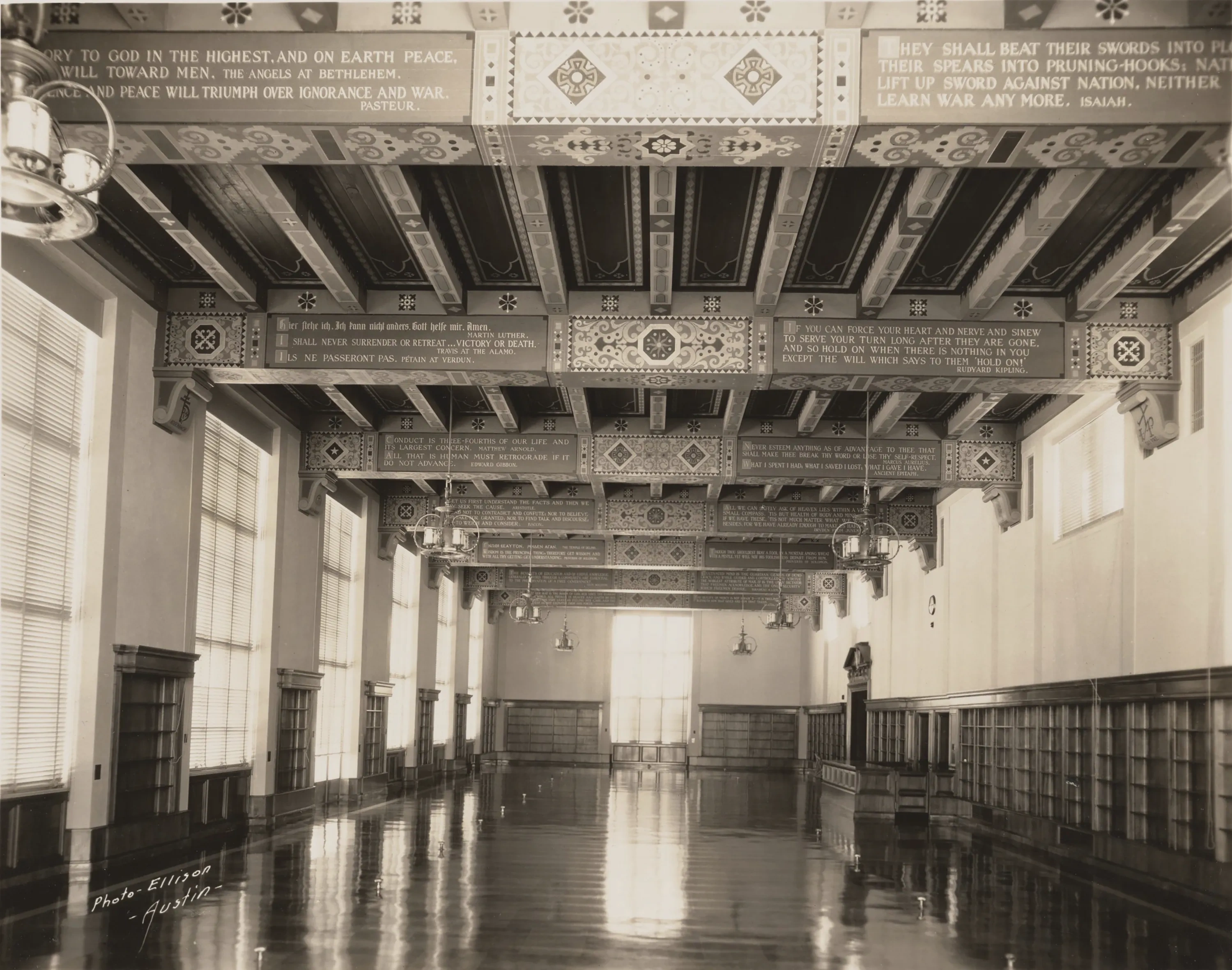
On a Tuesday afternoon in early June, a time of year when the campus is at its quietest, eight people sit silently in the Life Science Library’s Hall of Texas. Evenly distributed throughout the massive, ornate reading room, they sit at tables and carrels looking at their laptops, most with headphones on or earbuds in. This reporter quietly asks if he can have a word.
Two of them, when asked what they think of the library, independently call it the same thing. “This is a hidden gem, in my opinion,” says Alec Hari, a neuroscience senior from Memphis. A few minutes later, recent graduate Emma Grace Alvey, BA ’26, who is studying for the LSAT, says, “This is one of my hidden gems.”
The “gem” part is easy to see; just look around at the intricately painted ceiling beams, chandeliers, and original walnut furniture. But why do they and so many others consider it “hidden”? For that, we must look back at the library’s nearly century-long history.
There was a time when the heart and soul of a university—the truest expression of its commitment to learning—was its library. Naturally, this feeling has waned in the internet age, but not so long ago, a university was considered exactly as good as its library. And, true to the Texas ethos, bigger was better. A 27-story library was a play for academic world dominance.
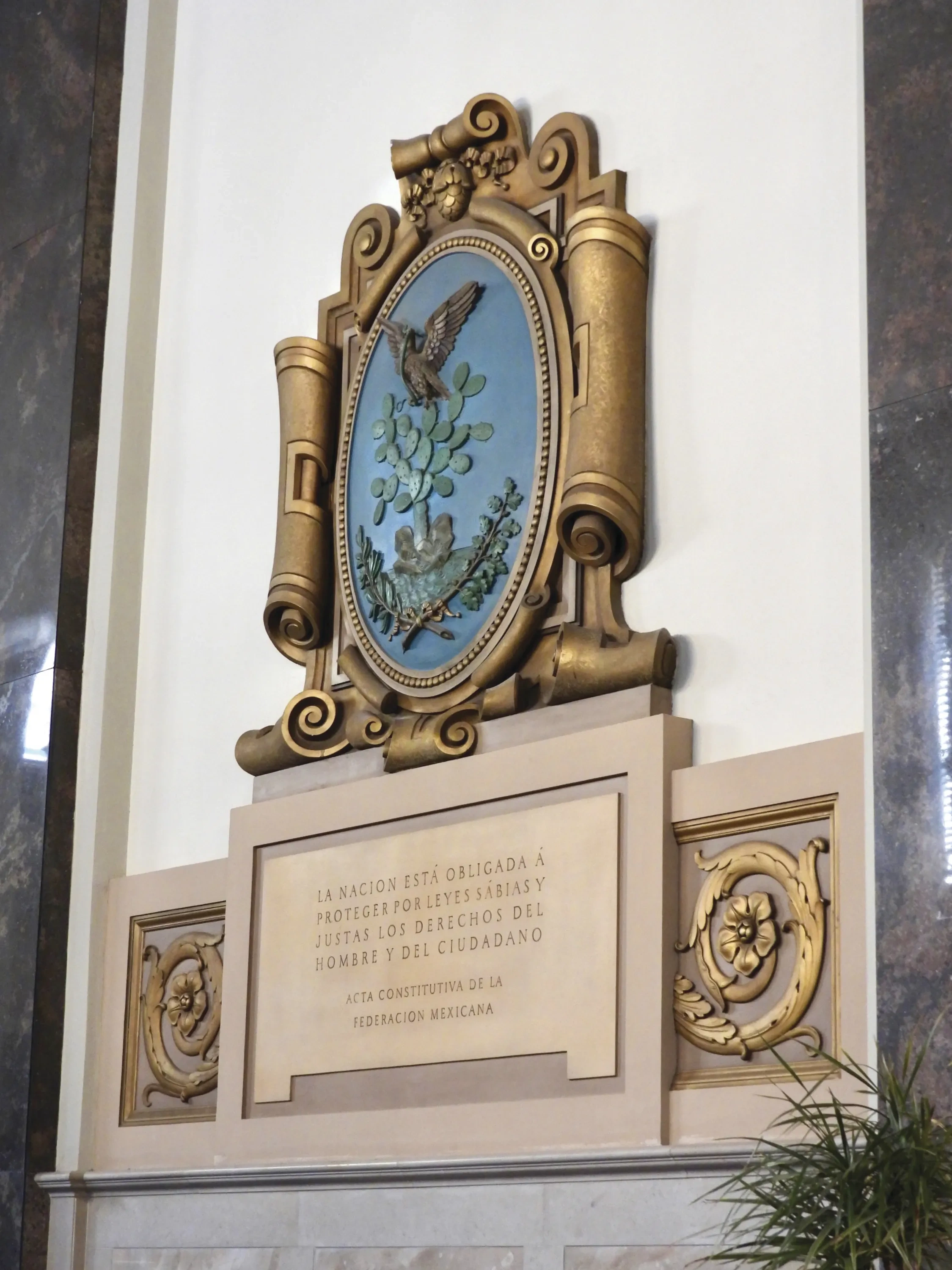
Hall of the Six Coats of Arms.
Starting in 1934, this was The University of Texas Library. This was The University of Texas.
More than 90 years on, any VIP or recruitment tour of UT Austin must include what now is known as the Life Science Library on the second floor of the Main Building.
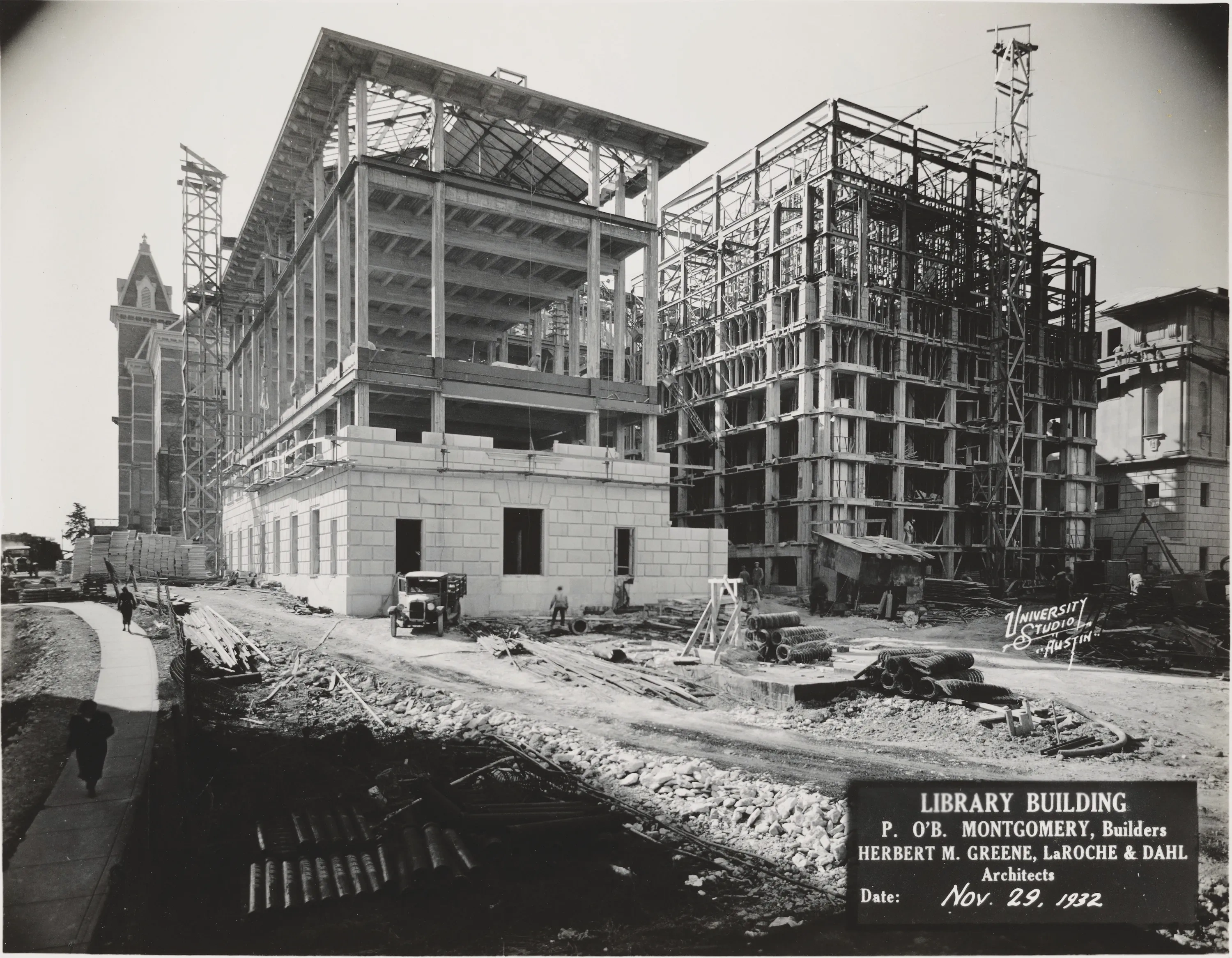
The cavernous library with high, ornate ceilings, large windows, and rich woodwork was the central part of the first section of the Main Building and Tower to be completed. It was opened as the Library Extension.
Where the grand central staircase ends at the second floor, a complex of three rooms served as the heart of the Library Building. The majestic Hall of the Six Coats of Arms greets visitors, who can pass through it to the Hall of Noble Words on the east or the Hall of Texas on the west. Directly north of this center room are the stacks, constructed to hold the library’s thousands of books. In the beginning, these stacks would form the 10 lowest levels of the Tower, those that don’t protrude above the Main Building.
Once the library opened, students would start their quest for knowledge by consulting card catalogs on the south side of the Loan Room, also known as the Hall of the Six Coats of Arms. Copying the call number onto a slip of paper, each student would then go to the loan desk and submit it to a librarian, who would send it via pneumatic tubes to the proper floor.
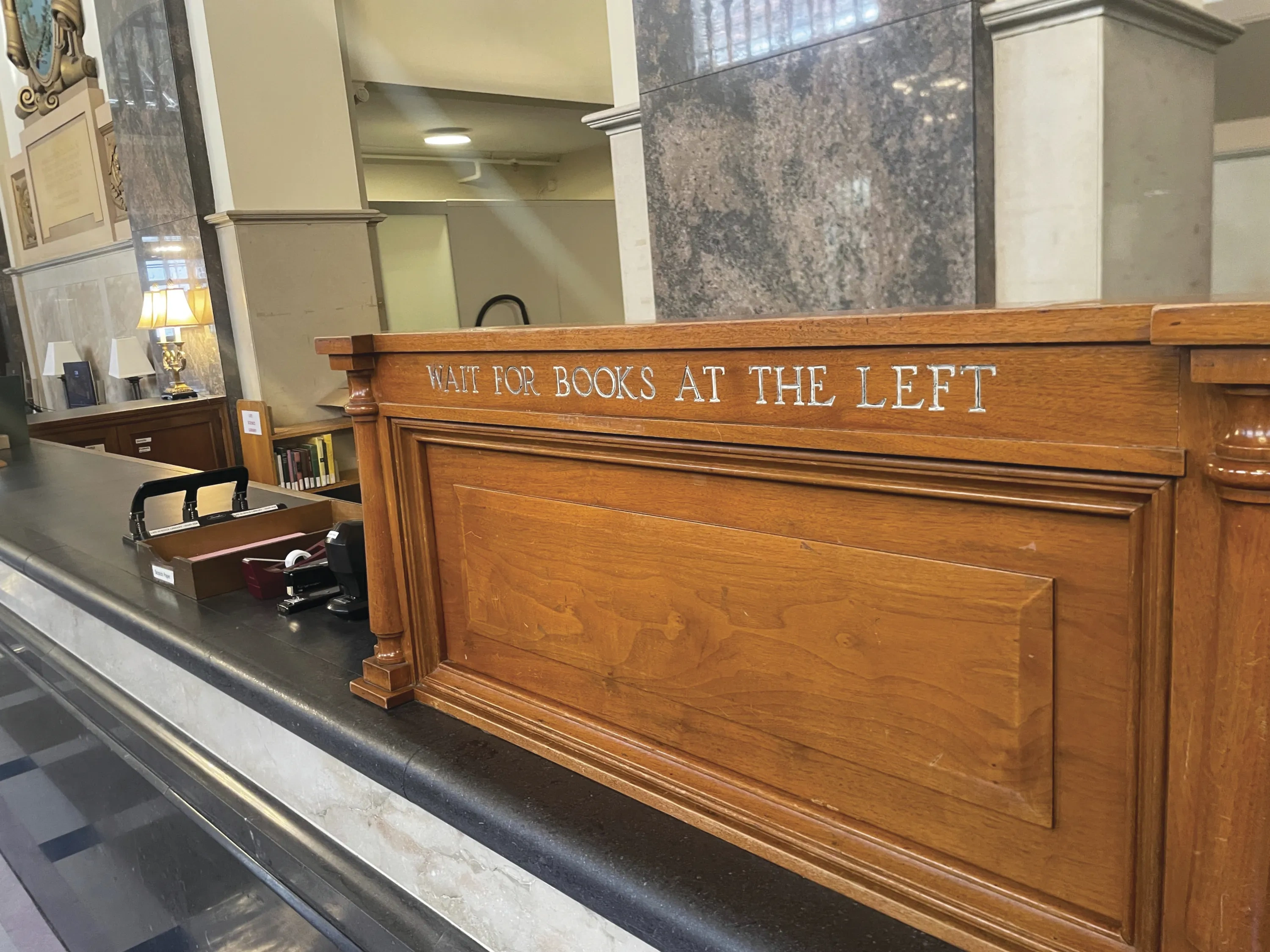
There, student workers, the sportier ones on roller skates, would take the number, find the book and send it down the book elevator, known as the dumbwaiter. When the elevator returned to the Loan Room, another librarian would call the waiting student and help them check the book out. The book elevator, still in operation, might not fit the typical Downton Abbey understanding of a dumbwaiter, as it is powered electrically—thank goodness—and can fit a rolling book cart and one person.
A few years ago, a marble wall in the northeast corner of the Loan Room was in need of cleaning. The facilities department was called and proceeded to remove a bulletin board that was against the wall. When workers removed the board, they found a large, recessed area with angled metal tubes 2 inches wide. On each tube was taped a tiny card with a handwritten number on it. Like archaeologists hitting the mother lode, they had uncovered the heart and soul of the library, or, more accurately, the spinal column.
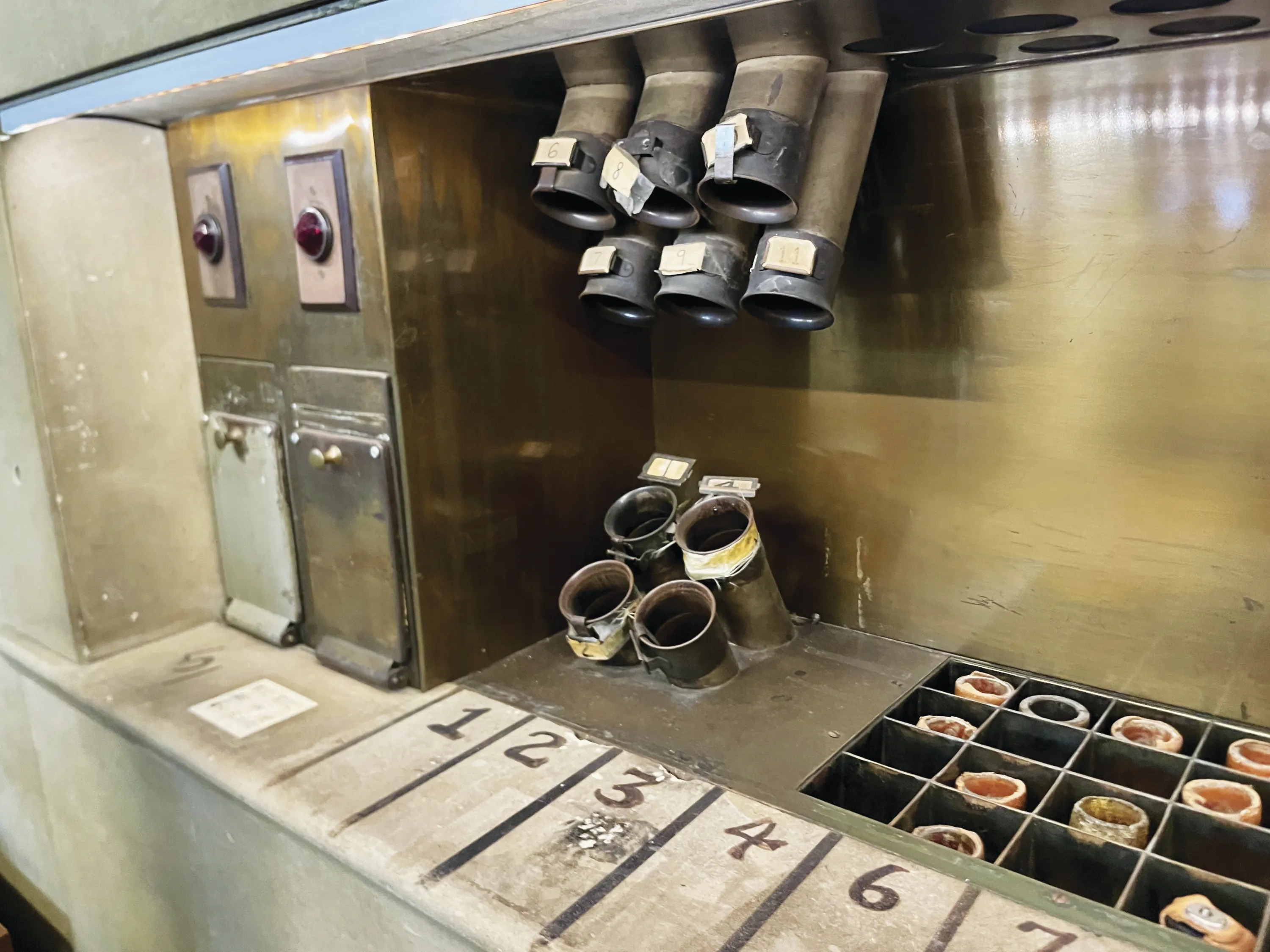
stacks, carrying call numbers for book requests.
This was the console where, for 40 years, hundreds of thousands of slips of paper had been inserted into cardboard cylinders, then sent up or down in the pneumatic copper tubes in the stacks. “We didn’t even know that this still existed,” says Jennifer Lee, BA ’96, MS ’00, director of research, discovery and collections for The University of Texas Libraries.
The library was undoubtedly magnificent in many ways and audacious in its aspiration. But it did have critics among its users. The heat and the lighting had been addressed, but it was the third complaint that spelled the end of the Tower as the University’s main library: the waiting.
In 1960, UT had about 20,000 students. By 1970, it had grown to 35,000. The wait times for books had become untenable, routinely 30 minutes. The standing crowds of students had worn the linoleum floors down to nothing, with patches of bare concrete showing through. As a relief valve, in 1963, the University opened the Undergraduate Library, which had open stacks and was geared toward what leaders felt undergraduates should be reading at their level of scholarship.
In the summer of 1977, the main collection was moved into the newly finished Perry-Castañeda Library with great effort. Yet there was no practical way to convert the library in the Main Building into open stacks. Rather, it would live on as a reminder of how all major libraries used to be.
In 1978, the Biology and Pharmacy libraries were combined to create the Science Library, which included two floors of stacks. The collection, which served the College of Pharmacy and the departments of botany, microbiology, and zoology, included more than 77,000 books.
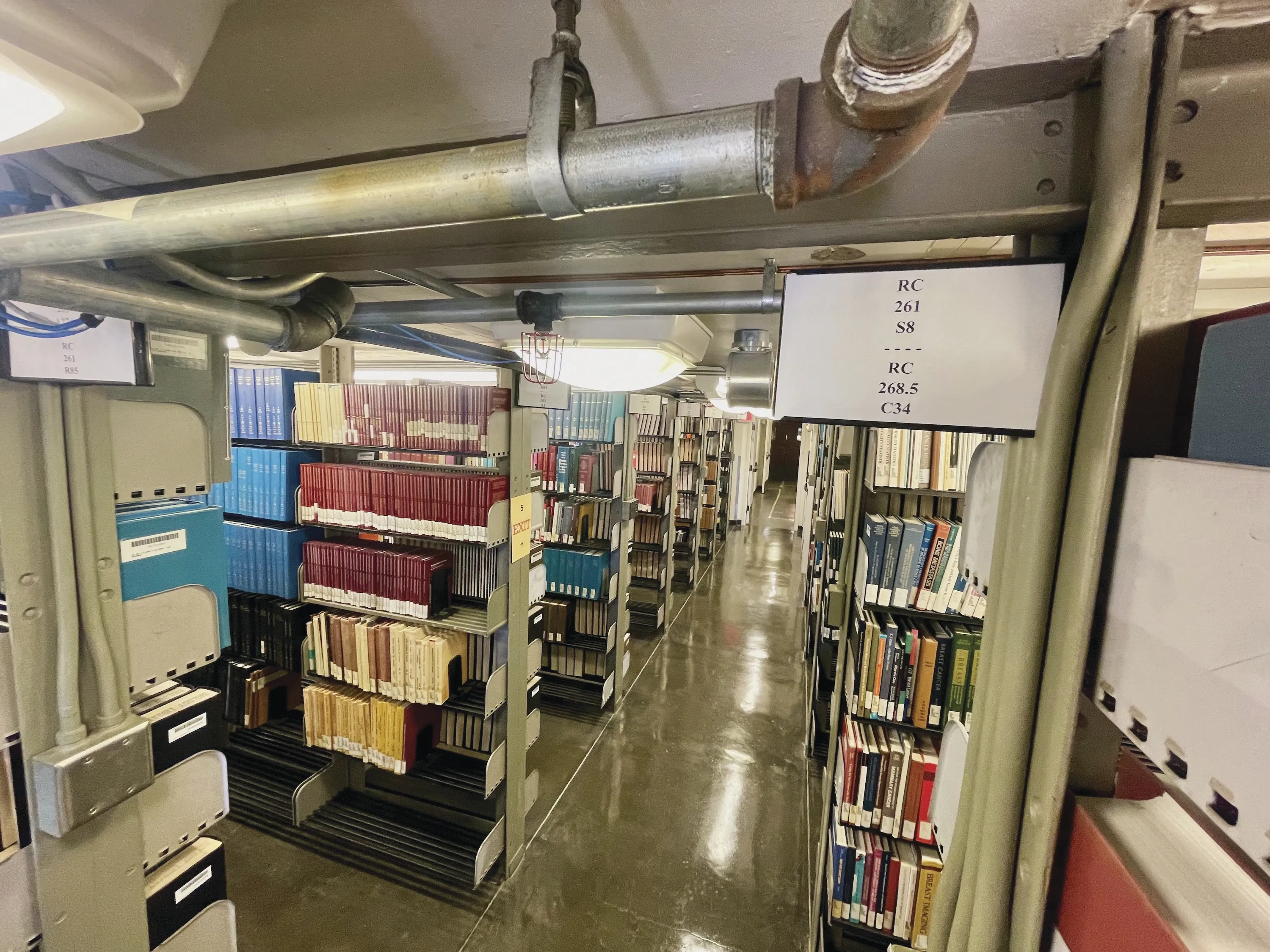
Today, the Life Science Library holds some 172,000 volumes on three stories within the Tower stacks. The second floor of the Main Building, home to the grand public spaces, is level with the fifth floor of the Tower. The stacks occupy Tower floors 4 through 6.
Books also reside in the reading rooms, which had not always been the case. Even in the 1950s, journals and other periodicals were kept on the shelves, but not books. When Lee was given charge of the library, “neither room had many books on the shelves, even the one that was open to the public, which I just thought was such a shame,” she says. Lee remembers wondering how many people had popped in, seen empty shelves, “and then just thought libraries are sad. I really wanted to put books on the shelves.”
In 1984, large partitions went up in the Hall of Texas to house the Plant Resources Center. For more than three decades, it turned the hall into something other than a library. The room itself, though its historical ceiling still showed, was a strange version of its former self.
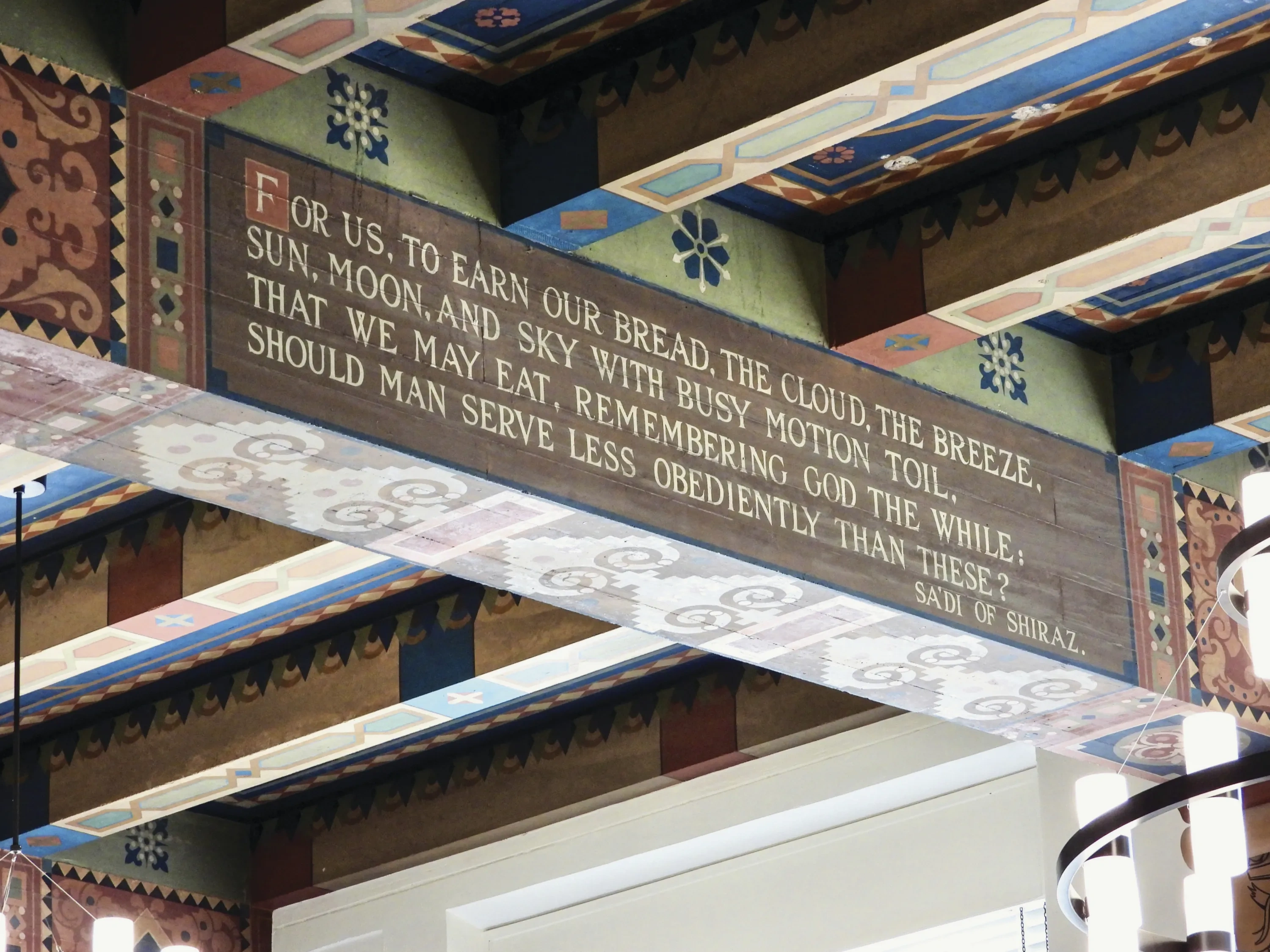
In 2017, shortly after Lee took on her current role, the Provost’s Office proposed returning the Hall to a reading room. Lee walked over from library headquarters at the PCL and sat at a table in the sliver of the room that still belonged to the library and, with a project team, began to brainstorm. Fortunately, when the partitions went in, workers had been careful not to damage or alter the walls.
Two years later, the Hall of Texas began its resurrection. A loan desk, which no longer served a purpose, was removed from inside the Hall of Texas. They also installed outlets in the large wooden tables—original to the rooms—so that students could plug in their laptops.
The windows have been replaced, and the venetian blinds are being repaired. The fluorescent lights were removed, but in many spots the paint left with the fixtures, and the ceiling still bears the scars. Perhaps in another round of restoration, that can be restored as well. When the fluorescent fixtures came down, the architectural firm charged with restoring the Hall of Texas had chandeliers custom made to return the hall to a library space. The style: “regal library reading rooms.”
During his sophomore year, Hari, the neuroscience senior, was telling a friend he needed a good study spot on campus, and without pausing, the friend declared, “Life Sciences Library.”
“I’m someone who’s very much shaped by my environment,” Hari says. “I need a nice, clean, aesthetic environment, and the Life Science Library provides that. It really affects my motivation.” Asked what it reminds him of, he says with a chuckle, “Low-key, it’s kind of like Harry Potter.” Many students would agree that, in Gen Z parlance, “It’s giving Hogwarts.”
According to a gate that automatically counts visitors, the Life Science Library was visited more than 87,000 times during the past school year. Alvey, the LSAT prepper, was responsible for about 52 of those, as she estimates she averaged one visit a week during her four years of undergraduate study.
As a freshman, she tried to go to the PCL, but it didn’t click. “The walls are very boring,” she says of the modern, six-story behemoth. “I was just exploring one day and thought, I wonder what’s in the Tower. I realized there was a library here, and it became one of my favorite spots on the entire campus. It gets me in the right mindset for sure. It feels like you’re in a college library rather than just some massive building,” she says. “No shade to the PCL; I have friends who love it. But this one is more for me.”
Alvey says, “If I ever had a break between classes—I think this room is so beautiful, I’d come here,” sitting in whichever of the two reading rooms was less crowded. “When I come here, I feel like I am studying at The University of Texas. You couldn’t replicate this at another university.”
This space helped her earn a government degree, and she’s hoping more time here will help her get into UT Law. “That’s the dream.”
And so, the Life Science Library, once UT’s main library, lives on—a regal reminder of the value of grandeur, a 93-year-old monument to our aspiration to greatness, and a quiet, spacious sanctuary for students—past, present, and future all here this afternoon.
Favorite Study Spots
The Life Science Library
“The Life Science Library in the Main Building. Big, wide tables with almost no one there, except for the bats.” —Laurie Bell Dworkin, BS ’84, Life Member
“The comfy chairs were amazing for studying (and napping).” —Jennifer Schaper, BA ’05
“The stacks in the Tower. Flip the light switch on, and certain sections you’d have all to yourself.” —Mike Vance, BBA ’76, Life Member
“I loved the silence and being able to look at students walking by the turtle pond on their way to class.” —Jillian Davis, BA ’25, Life Member
“I even got to see the Goodyear blimp go by from the carrels.” —Wendy Brien, BA ’74
The Perry-Castañeda Library
“I studied at the Perry-Castañeda Library which was right across the street from where I lived in Jester Hall. I would pack my Peanut M&Ms and Diet Coke in my backpack, pull out my snack stash, and eventually get busted by the library staff that patrolled each floor. ‘Get rid of that!’ echoed behind my back.” —Lydia Hollingsworth Mrzlak, BS ’85, Life Member
“I loved all the magazines as a reward for studying.” —Denice Bradbury Powell, BFA ’96
The Benson Collection
“The Benson Latin American Collection, snuggled in one of those big, red, comfy armchairs by the window!” —Regina Allen Dooley, BA ’85
The Main Plaza
“On a Sunday when it was quiet, just sitting outside the Main Building under the flags. So many great memories!” —Stephanie Sauder-Andrade, BS ’89
The Listening Lab
“In 1970, the library had a listening lab where you could listen to music or Shakespeare. With the library’s headphones, I’d listen to Sgt. Pepper’s Lonely Hearts Club Band.” —Bill Hollis, BA ’73
“They would write your selection on a chalkboard when it came up. I would listen to Chuck Mangione.” —Cheryl Hoxie, BBA ’83, Life Member
“Judy Collins. Between classes.” —Molly White, BA ’70, MLS ’72
“I frequently requested the Beach Boys.” —Beth Bergman, BS ’90, Life Member
“Abbey Road was my choice.” —Beth Malone, BS ’78
The Architecture Library
“The Architecture Library, while my roommate was getting her projects critiqued (aka destroyed) by her professors.” —Tiffany Hayden, BS ’96, Life Member
The Fine Arts Library
“Plopped down in the middle of the drama section at the Fine Arts Library, 10 different plays in my lap.” —Nicole Schiro Magee, BFA ’95, Life Member
Kerbey Lane Cafe
“Kerbey Lane in the middle of the night.” —Laura Williams, BA ’03, Life Member
An Elevator
“I knew two girls in Kinsolving Dormitory that put a small couch in the elevator and sat there and studied as they went up and down.” —Pamela Weinberg Graves, BS ’81
Surprise!
“Wait. We were supposed to study?!” —Nancy Seliger, BBA ’83, Life Member
CREDITS: From top, courtesy of the University (2); Avrel Seale (3); courtesy of the University; Avrel Seale (2)