Looking Back on a Historic Fundraising Campaign
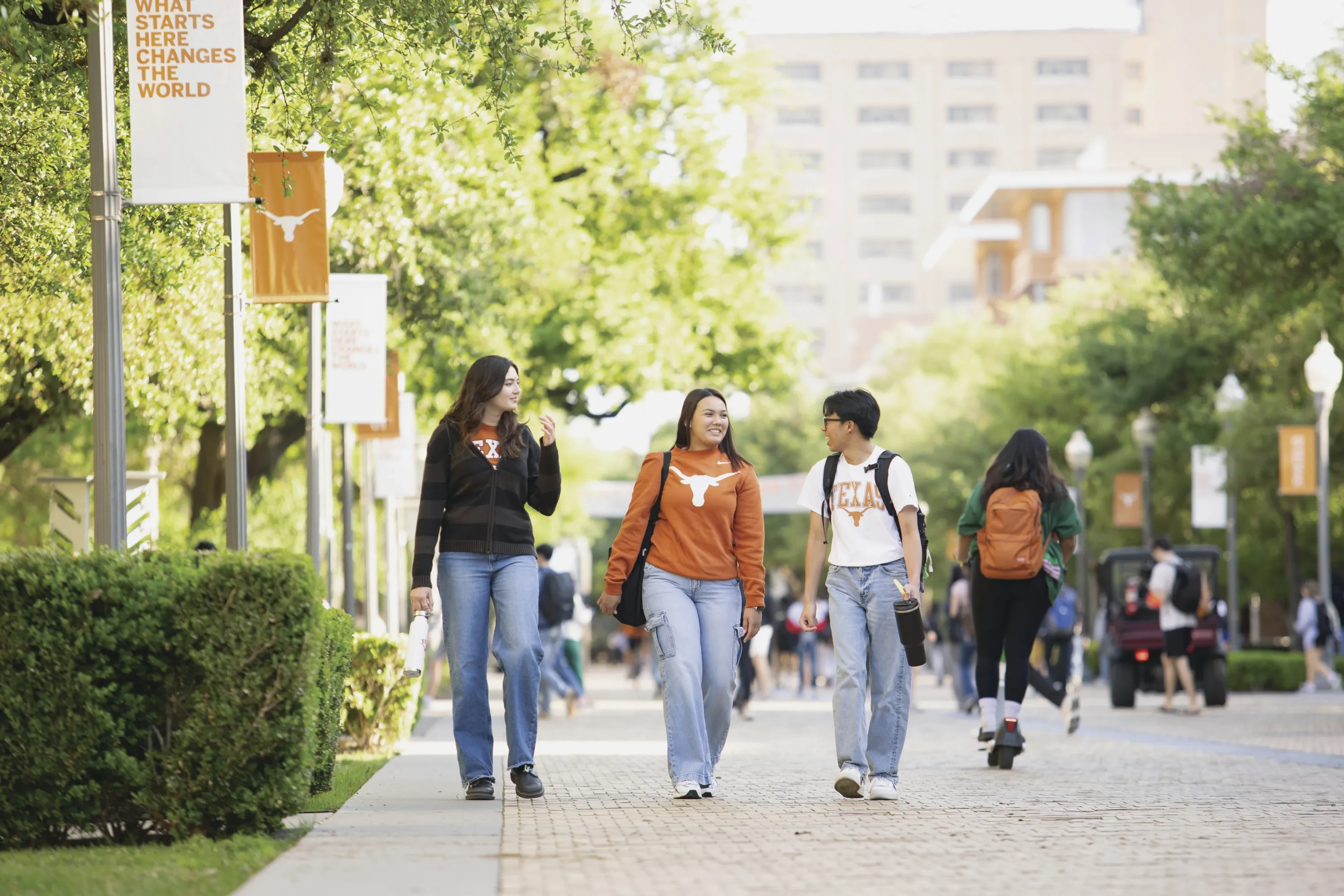
In the spring of 2026, as a recent Canfield Business Honors graduate, Aria Rideaux, BBA ’26, Life Member, was saying goodbye to the place that had become her home. From the shade of the Battle Oaks to the crowds shouldering across Speedway and the call of the carillon bells, she knew campus well. She was a tour guide and had spent seven semesters showing students and families around.
“It’s a bittersweet feeling to know that you’re leaving the Forty Acres behind,” Rideaux says. “I have grown, loved, cried … gone through so many major transitions here. I’m grateful to know that I’m leaving a legacy of my own for others to follow.”
She is not alone in that sentiment. From 2016 to 2026, an astonishing number—more than 358,000 alumni, students, benefactors, and friends—were moved to give back through the What Starts Here campaign , which will go down as the most impactful fundraising campaign in the history of public higher education. Longhorns showed extraordinary generosity across every conceivable category with a total of $7.45 billion for: scholarships and fellowships, faculty support, research and innovation, experiential learning, entrepreneurship, campus traditions, beautification, the restoration of our most venerable buildings and the construction of new ones.
It’s a list of gifts and causes as big and diverse as Texas, but united by one shared belief: This University matters.
Like many of the University’s more than 10,000 first-generation students, Camila van der Maal, BS ’26, dreamed of coming to Texas.
“One of the biggest things that drew me to UT was that the application fee was waived for a lot of first-generation students,” van der Maal says. “After applications, came a whole wave of fear though. I didn’t know how I was going to pay.”
The What Starts Here Campaign opened life-changing opportunities for students like van der Maal on an unprecedented scale. Longhorn alumni and friends created more than 2,000 new scholarships, fellowships, and student support endowments. UT now covers tuition for students from families with an adjusted gross income of $100,000 or less.
The legacies created by these donors have entered the lexicon and will be carried by students across campus and into their careers—Texas Challenge scholarships, Linda Bernhardt Scholars, Autry C. Stephens Scholars, Linford Scholars, Dell Scholars, Hildebrand Scholars, and more.
In total, Longhorns gave more than $1.4 billion in student support.

The moment van der Maal found out she was a scholarship recipient, her financial worries evaporated. “I could focus on my geology classes and thinking about this great future that was finally ahead of me.”
Donors who care deeply about finding solutions to our most urgent and challenging problems have also chosen to invest in the University. Over $1 billion in research support is helping to fuel more than 4,400 projects. From the Arthur M. Blank Center for Stuttering Education and Research to the Harkey Institute for Entrepreneurial Studies, donors named and helped to launch 30 centers where faculty and students are working to advance the frontiers of knowledge.
Tom Yankeelov is at the forefront of developing “digital twins”—using mathematical modeling and high-performance computing to predict how a patient’s tumor will respond to therapy. His revolutionary approach is part of the Center for Computational Oncology at UT’s Oden Institute for Computational Engineering and Sciences, which launched thanks to a philanthropic gift from Dheeraj Pandey, MS ’98, and Swapna Pandey, BJ ’98.
“It all begins with passionate researchers who are thinking outside the box, who have promising new ideas,” Swapna says. “Sometimes it just needs a catalyst to move forward.”
Nowhere is that momentum more evident than in healthcare. With a historic philanthropic commitment that brought their lifetime giving to UT to over $1 billion, Michael and Susan Dell, Life Members, are fueling what is perhaps the most significant innovation since the University’s founding—the UT Dell Campus for Advanced Research and the UT Dell Medical Center. The new north campus will unite advanced clinical care, leading-edge biomedical research and the training of tomorrow’s health professionals—bringing Austin its first academic health system and transforming how people get and stay healthy. Leaders such as Simone and Tench Coxe have been inspired to make extraordinary investments in this unique opportunity to shape the future of health care.
Michael and Susan Dell defined the confidence at the heart of their support: “UT Austin, where Dell Technologies was founded from a dorm room, has always been a place where bold ideas become real-world impact.”
With friends visiting from out-of-state, Marcie Zlotnik, BBA ’83, Life Member, had the perfect idea—she would take them on a tour of her beloved alma mater. Things did not go as planned when it came time to show off UT’s historic Tower.
The iron spandrels adorning the facade were not, in fact, painted burnt orange. That was rust. The experience is what eventually led Marcie and her husband, Bob Zlotnik, BBA ’75, MBA ’80, Life Member to become co-chairs of the Our Tower: The Next 100 Years campaign.
“To me, the Tower is a symbol not only of UT, but of higher education nationwide,” Bob says. “Our iconic building deserves all the attention we can give it.”
In addition to gifts to restore and revive the Tower, donors named nine new buildings, eight academic departments, 39 athletic spaces, 30 centers and institutes and 320 labs, student lounges, atriums, and other spaces across the Forty Acres.
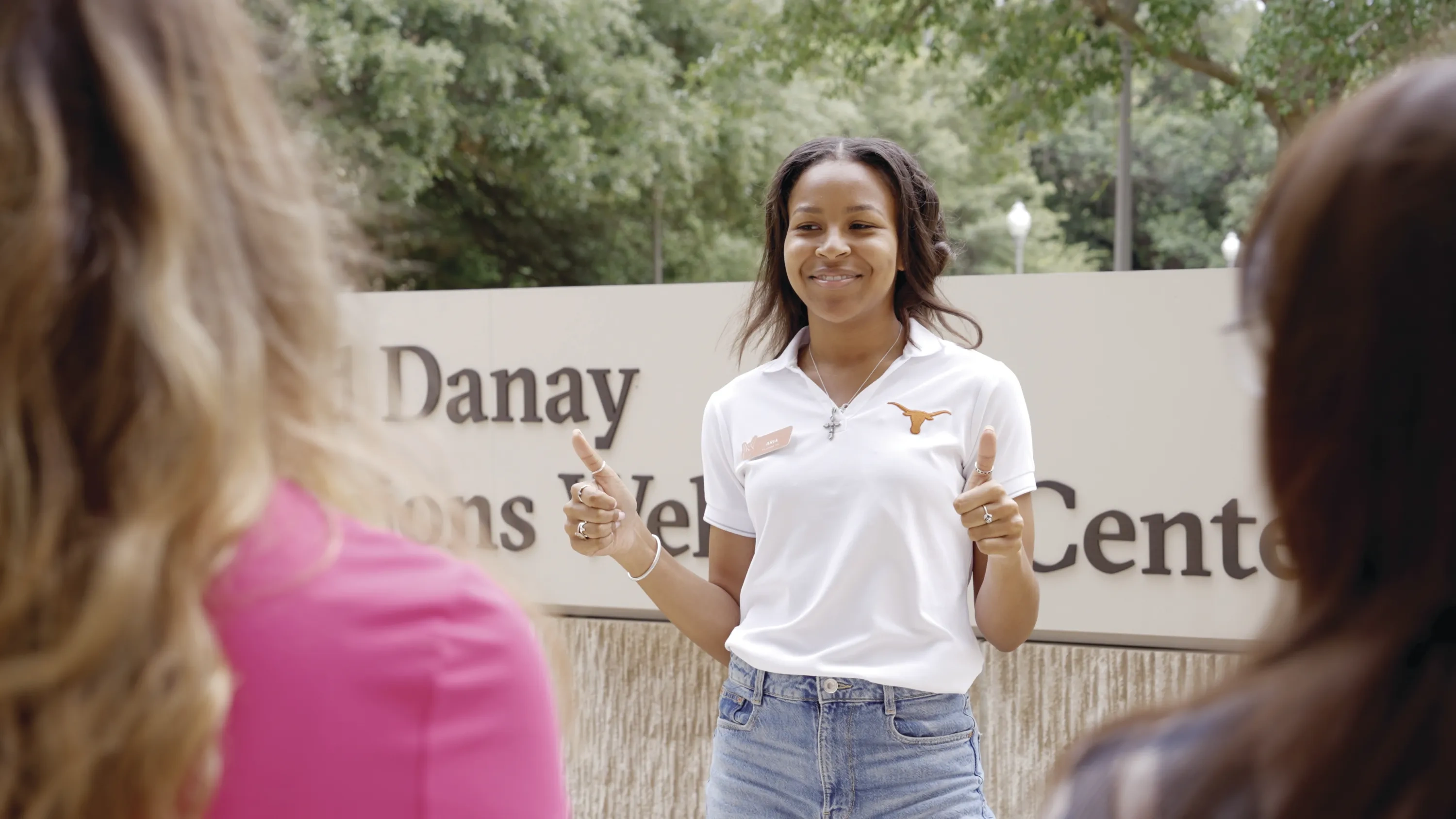
“I’m a bit jealous,” Rideaux says, maybe only half-joking. She can envision the incredible role that the new James J. and Miriam B. Mulva Hall will play in students’ lives. It will open in 2028 as a towering, 17-story landmark for undergraduate business education. “That’s extremely fitting for one of the top business schools in the country,” she says.
The founding of Dell Medical School in 2016 was the foundation that gave rise to the UT Dell Medical Center. A new core curriculum will be taught by faculty whose chairs and professorships bear the names of the loyal Longhorns who endowed them. Scholarships will bring students to a new School of Computing, forming a conduit to both the tip of the cutting-edge and the values and traditions that have stood as tall as the Tower for nearly 150 years.
Rideaux recalls the moment that finally brought her to tears. She had just completed the toughest exam of her career when she was approached by a student she had given a tour to years ago. She wanted Rideaux to know that her parents had been nervous about sending their child out of state to Texas, but Rideaux had eased their mind. She was a Longhorn because of her.
“To know that you have that level of impact, and you can leave that lasting of an impression, that it can go on to change someone else’s life, is such a special thing,” Rideaux says. “And I’m so grateful to this University. One day I want to return to campus and give back.”
CREDIT: From top, courtesy of the University (3)