Meet the Professor Introducing a Unique Instrument to a Younger Generation
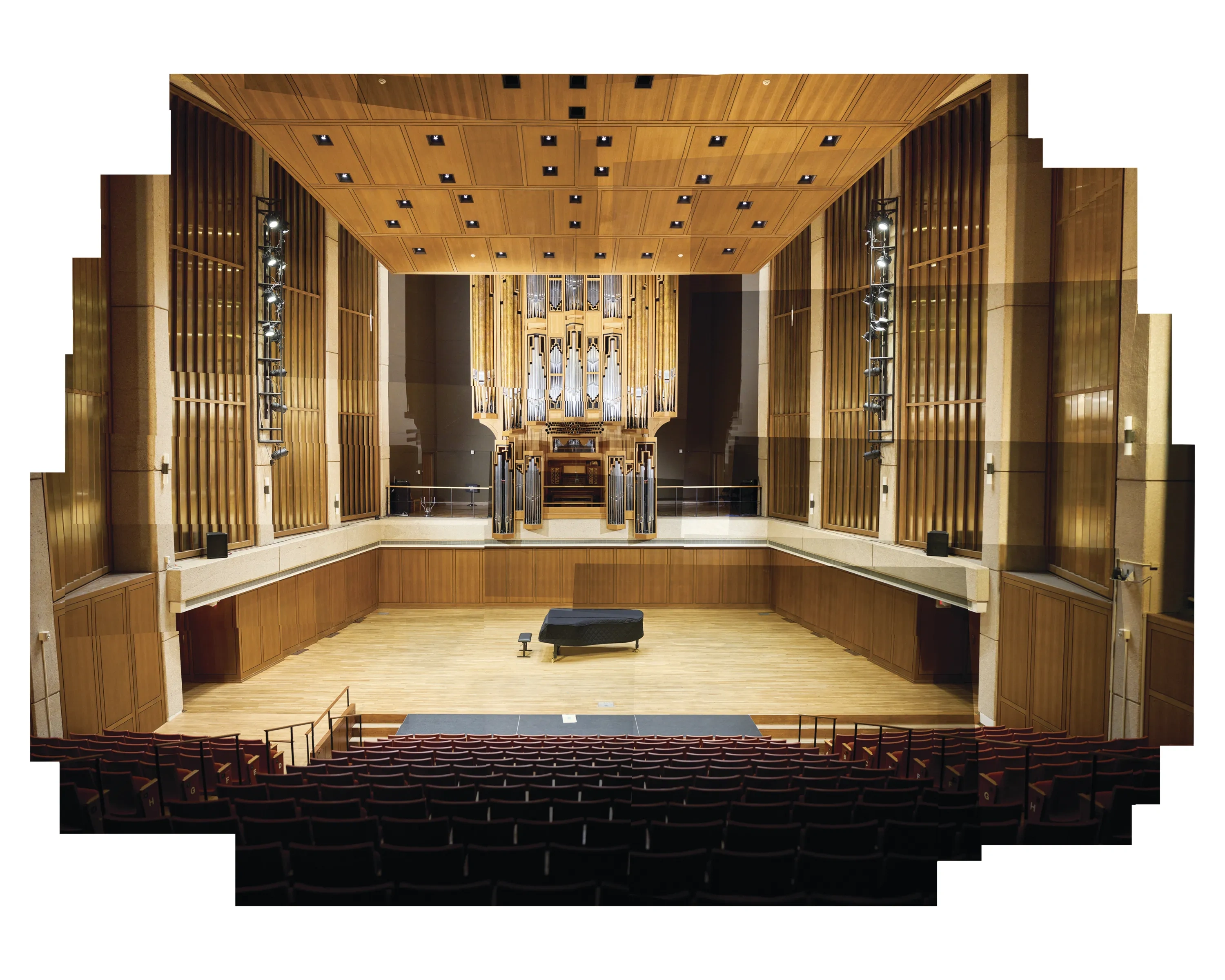
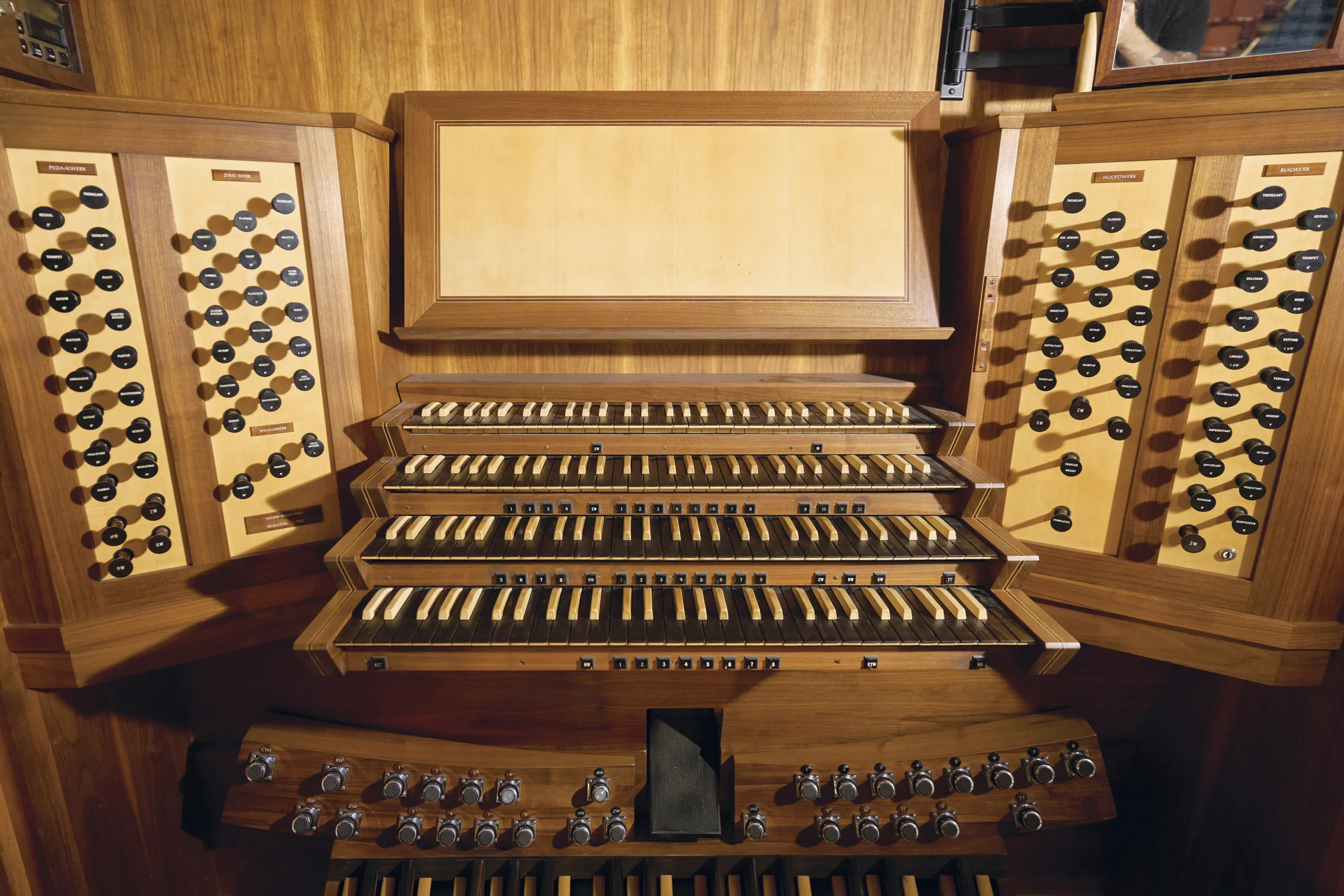
When concertgoers enter the Bates Recital Hall in the Butler School of Music, the first thing they will likely notice is a massive, elaborate pipe organ that towers above center stage. The organ has more than 5,000 pipes arranged in various geometric shapes, set into handcrafted and artful wooden designs. Each of its 67 stops—the knobs pulled by the organist while playing—resounds, evoking a unique sound and pitch. When played, the instrument’s deep, tonal music fills the room, reverberating across the walls of the auditorium.
Built in 1983 by the Houston company Visser-Rowland, the Bates organ is one of the largest the firm ever built, and the largest pipe organ in the city of Austin. Besides its size, there’s another feature that makes the instrument unique: Unlike many modern organs, this one requires no electricity to be played. Its massive sound is created mechanically, by an organist pumping wind through its pedalboard and manuals, or the many rows of keyboards.
With only a few of its kind built to this scale in the country, the organ might seem like another of the rare artifacts housed, but rarely played, in museums and archives across the UT campus. A professor in the Butler School is fighting to make sure that’s anything but the case.
Gregory Eaton is a lecturer of organ and harpsichord at the Butler School of Music. He’s played this organ in the Bates Recital Hall numerous times since he joined as a faculty member of the school in 2019. Eaton recalled attending an organ recital in Bates Hall before he started teaching at UT.
“I noticed three things. One was that two of the pipes in the facade of the organ had massive dents in them,” Eaton says. “The second was that I was one of only a handful of people, and this was a faculty recital. And the third was that I heard a woman say to her friend, ‘I had to come because this organ never gets played.’”
Eaton has spent much of his life studying music and, more specifically, playing the organ. He received his bachelor’s degree in music at the University of Redlands in Palm Springs, California, and later earned his master’s from the Manhattan School of Music. Eaton moved to Austin in 2014 to serve as the organist and choirmaster at All Saints’ Episcopal Church, which is located on the UT campus.
“It’s an amazing instrument. I mean, it can do everything from a whisper to a roar. A well-designed and built organ is very colorful,” Eaton says. “I think one reason that Americans think they don’t like the organ is because they hear it played so badly, so frequently.”
Organ has been a part of the curriculum at the Butler School for a long time, but before Eaton’s arrival, the program had been waning. The grand Visser-Rowland organ in Bates Hall required much-needed repairs, and there was little student interest in taking organ classes, which coincided with a general lack of interest in organ music across the country. Eaton had one non-music major student taking an organ class with him in 2019.
“In Europe, it’s viewed as a concert instrument. In the US, it’s viewed as a church instrument. And the degree to which church affiliation has dropped has changed that,” Eaton says. “And also, you’ve got the movement in churches towards praise bands and things like that, which means that the organ is used less. So, if it is just surviving as a church instrument, that’s not a good model to go forward.”
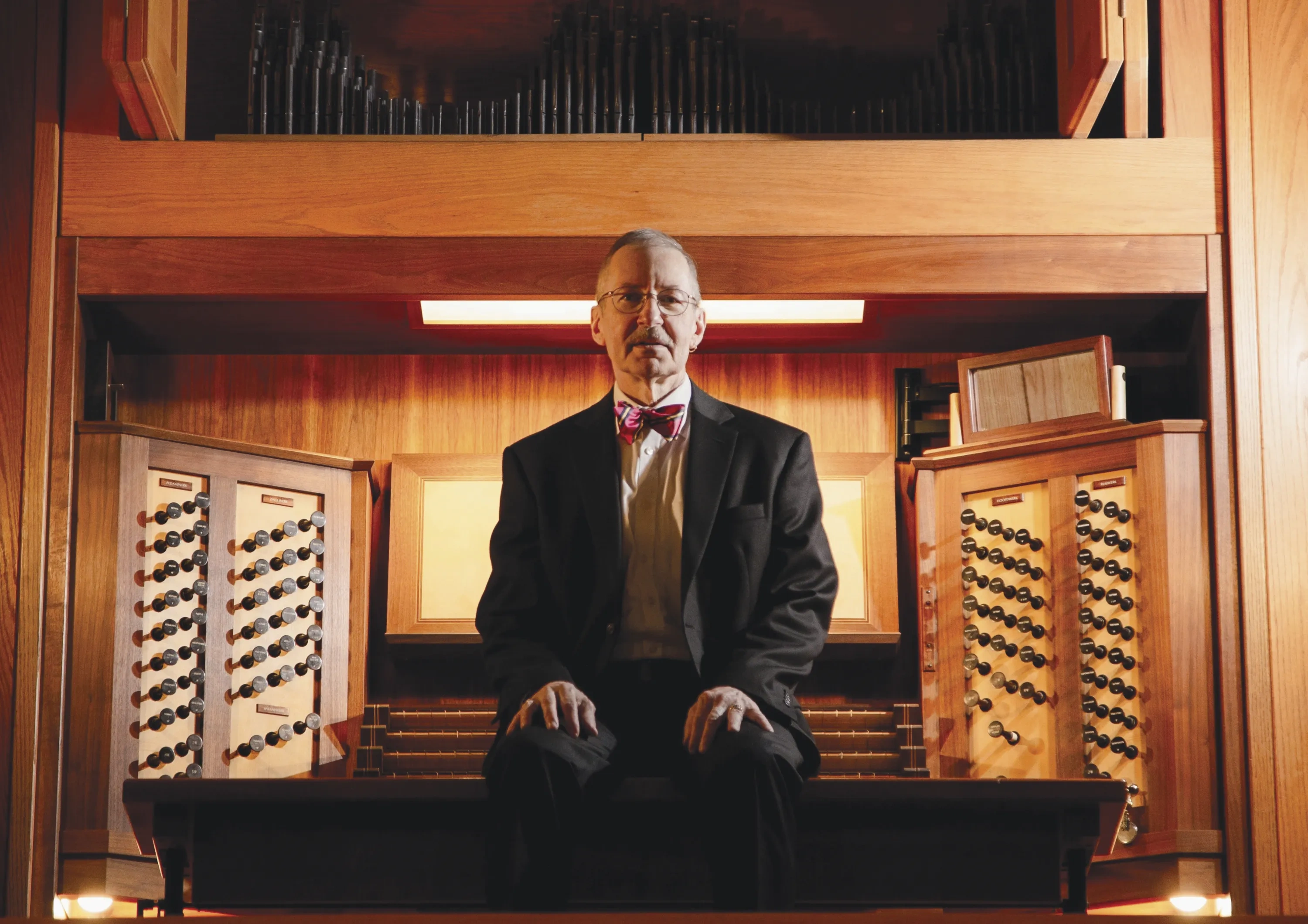
Eaton has spent much of his time in the Austin area trying to incorporate organ music not just in churches, but also in public spaces. As a member of the local chapter of the American Guild of Organists, his organization teams up with Scholz Garden every year to play for the “Beerthoven” concert series. You may also see him dressed as the Phantom of the Opera playing that infamous theme song from the Andrew Lloyd Webber musical at the UT String Project’s Halloween concert.
“[The song] was not the hardest thing I played that day, but people were just out of their minds,” Eaton says of his audience on Halloween. “And the fact that all those parents of those kids in the string program heard the organ—they know it gets used, [and] they heard it used in a fun way.”
Eaton is also trying to incorporate more organ accompaniments for classical and concert music within the Butler School. He and his students have played alongside saxophonists, guitarists, and full concert ensembles. “If any ensemble asks for organ accompaniment here, the answer is yes,” Eaton says. “Whether it’s me or one of my students, it will happen. I want the organ heard. I want people to see someone seated at the organ play.”
Eaton also performs a solo faculty recital on the Visser-Rowland organ every year. His last two performances have nearly filled the recital hall. And, thanks to a donor, the organ is finally receiving the repairs he noticed all those years ago. Meanwhile, Eaton has been busy recruiting students to take his courses. So far, it seems to be working. Compared to the one non-major student studying under him in 2019, Eaton now has eight students enrolled in his organ course and two students taking harpsichord. Most of his students are piano performance majors who take his course as an elective.
“Because we have such a superb collaborative piano program,” Eaton says of the field of piano performance study that emphasizes partnership with vocalists and other instrumentalists, “it is a really good idea for those piano students to take organ and/or harpsichord because that increases their marketable skills. There’s a big demand out there for substitute organists for churches and things like that, but you can’t just go into a church and play the organ.”
Noah Sonderling, DMA ’24, earned his doctorate at the Butler school. Following his studies at UT, he was a piano and keyboard fellow at the New World Symphony in Miami, where he also had the opportunity to play organ. He’s currently a staff pianist at the Colburn School in Los Angeles and occasionally plays organ for the Sacramento Philharmonic. Sonderling had little experience playing the organ before taking Eaton’s course.
“He was very passionate and enthusiastic about the organ, teaching the organ, and the instrument itself,” Sonderling says. “He taught me many things about technique and the repertoire, but also about how the instrument works.”
Eaton has been teaching more full-time organ students, too. He’s working to secure full-ride scholarships for students who want specifically to study organ, which would make UT’s organ program competitive with more robust programs at Baylor, Southern Methodist University, and Rice.
Chase Petersen, MM ’23, graduated with his Master of Music in Organ at UT Austin and is now working on an advanced degree in organ in Germany. Petersen says he thinks the organ has been experiencing a bit of a comeback in the last decade.
“There’s still lots of people studying and getting degrees in organ,” Petersen says. “It’s always probably going to be a bit of a niche field. It’s not like the organ is going to be the new piano someday. But it seems people are drawn to it in a lot of ways.”
Petersen credits international organists who have gone viral on social media, such as Anna Lapwood, for introducing the instrument to new and younger audiences, and potentially inspiring future organists. But on the Forty Acres, Eaton is that bridge for a younger generation that wants to learn how to play the organ. Through UT’s program and his own advocacy, he says he is determined to keep the instrument relevant, a part of the fabric of American music. And while the various keyboards, pedals, and stops may be intimidating, the last thing he wants is for his students to give up.
“I have to keep from smiling too big at the beginning of every term because I get these piano students who have never sat at the organ,” Eaton says. He is often one of the first people to teach them how to play the instrument. “I’ve developed a standard speech for them. I say, ‘You are here because you are a superb musician. I’m going to make you feel like an absolute beginner, so please don’t get frustrated. This is not what you’re expecting.’”
Photos: Matt Wright-Steel