UT’s New School of Computing Brings Together Computer, Data, and Information Sciences
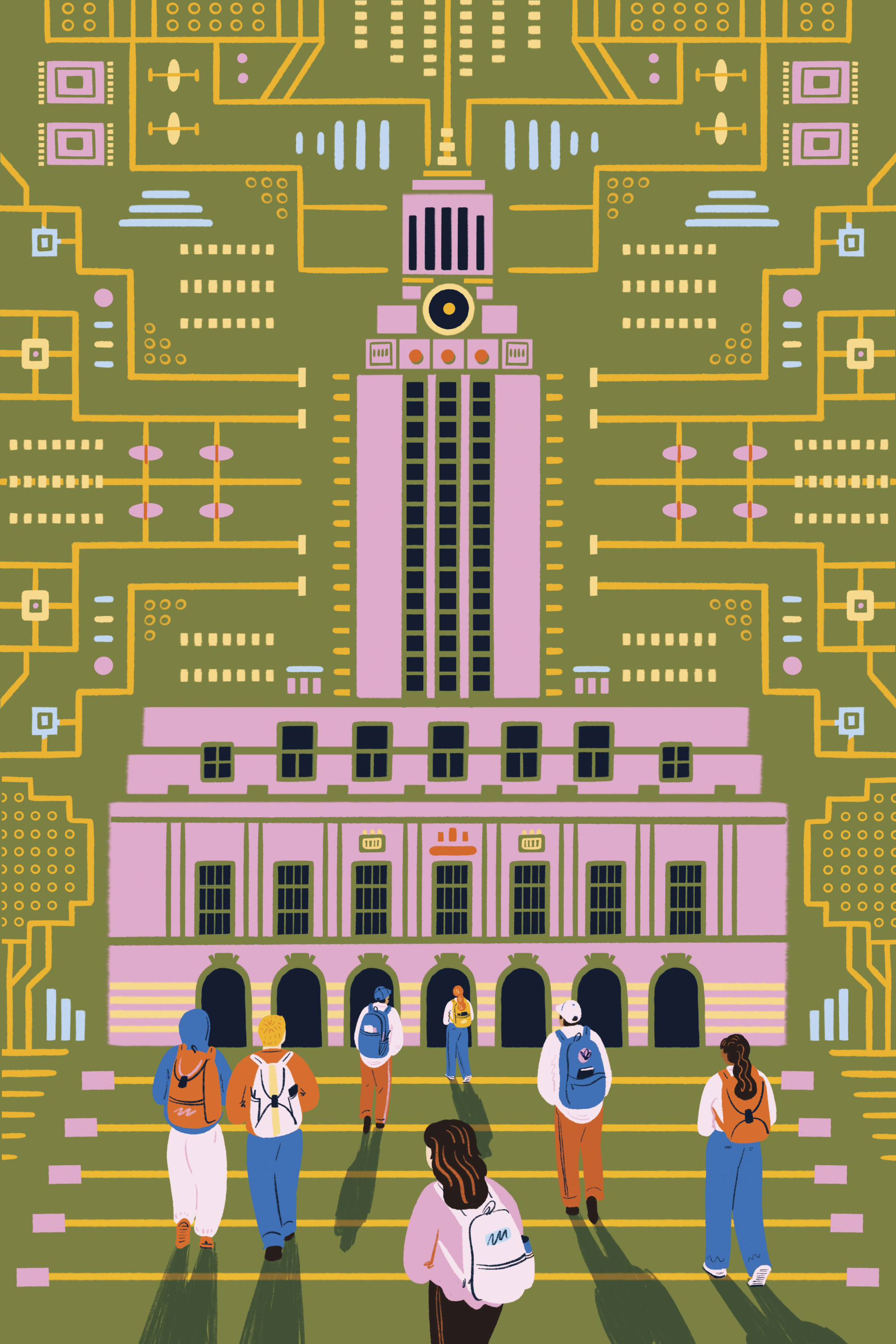
Computing now affects nearly every part of our lives. It shapes medicine, business, art, and politics, changing how we work, create, and connect. UT Austin is meeting the moment and beyond with the new School of Computing. In February, the UT System Board of Regents approved the creation of the school, set to launch in fall 2026. The school will unite three existing fields—computer science, data science and statistics, and information studies—into a single academic unit within the College of Natural Sciences.
“By expanding opportunities for our students and advancing interdisciplinary research, the School of Computing helps cement UT’s place in defining the technologies, ideas, and approaches necessary for navigating our era of rapid technological change,” said David Vanden Bout, PhD ’95, dean of the College of Natural Sciences at the time of the announcement.
By bringing these programs together, the University will accelerate research, expand access to computing education, attract top talent, and better serve the growing number of students drawn to these fields.
This effort comes at a time when demand for computing skills shows no sign of slowing. Artificial intelligence, machine learning, and data science are transforming industries from health care and transportation, to finance and the arts. Already one of the nation’s largest producers of computing talent, UT Austin’s computer science program ranks among the top 10 in the country and aims to build on this momentum.
To support this vision, the University plans to hire 50 new faculty members, which will grow both teaching and research. UT’s computer science department already has more than 7,600 undergraduate and graduate students, making it one of the largest in the country.
UT’s computing roots began the mid-20th century: The School of Information traces back to a 1948 library science program, the computer science department began in 1966, and data science emerged more recently, with the Department of Statistics and Data Sciences established in 2014.
The investment in the new School of Computer Science builds upon the University’s massive investment in technology-forward programs and facilities. In November, UT doubled the capacity of its Center for Generative AI to more than 1,000 GPUs, giving researchers the computing power to tackle large-scale problems across medicine, language, and data science. In 2020, UT established its Machine Learning Laboratory as a campuswide hub for AI research.
Peter Stone, current chair of the Department of Computer Science and founding director of Texas Robotics, will serve as a special adviser for the school’s formation, in collaboration with interim iSchool dean Ken Fleischmann and James Scott, chair of the Department of Statistics and Data Sciences.
Looking ahead, students will need to understand not just how to build new systems, but how those systems shape the world around them. Stone said this approach will enable students to work across fields to advance research and impact in areas such as robotics, health care, and machine learning: “World-class strength in computing, data, and information has ripple effects far beyond any single discipline.”
CREDIT: Tara Jacoby