Building the Medical Center of the Future
Something big is happening in the life of The University of Texas. In the boardroom of the UT System Building, in meeting rooms inside the President’s Office, in conference rooms at Dell Medical School, and across the Forty Acres, a massive undertaking is underway: the building—conceptually and now physically—of a new academic medical center. Earlier this year, UT identified a parcel of mostly vacant University-owned land in north Austin as the ideal location for this historic project.
“The academic medical center is a transformational project that will redefine the University going forward like few projects have done in UT’s history,” President Jim Davis, BA ’96, Life Member, says. In the 1930s, the University decided to build a Tower as a bold statement of what the University intended to be—a place of unrivaled excellence in education and learning. The academic medical center is this generation’s statement about excellence in sustaining health, treating disease, and discovering new cures and treatments to improve and save lives. “There are moments in history when we are called to do something truly bold,” Davis says. “This is one of those moments.”
From a fifth-story conference room in the Health Learning Building, Claudia Lucchinetti, UT’s senior vice president for medical affairs and dean of Dell Medical School, motions over her shoulder at a lot where the Erwin Center once stood. “As plans evolved, we learned that the site couldn’t contain our ambitions,” she says. The area was envisioned as the future medical center’s location when it was first announced by the UT System Board of Regents in 2023. “The original site offered benefits, but our UT System and University leadership concluded that we needed a setting and location that would allow us to fully realize our vision.”
The new site is just a quick drive up MoPac, southwest of the bustling Domain district. At present, a lone building, now home to several University research units and UT’s research licensing and startup support teams, sits at the edge of a thicket of cedar trees.
This new campus will be part of a larger UT academic health system. The University will start construction this year on 27 of 100-plus acres, but is planning for the campus’s long-term future, and leaders are envisioning a larger advanced research campus that will combine the excellence of the medical center with UT’s already world-class research enterprise.
“I don’t think I’m speaking out of turn to say this was mandatory for The University of Texas,” says Charles Fraser Jr., BA ’80, Life Member, Distinguished Alumnus, one of the world’s foremost cardiovascular surgeons, and head of cardiovascular and thoracic surgery at Dell Medical School. “It’s a tremendous opportunity for the greater University in just about every way—serving society, serving our future leaders, catalyzing transformational discoveries and innovations. It is just paramount. But it’s also even a layer above that: What we have to offer mankind is really something unprecedented in health care. It’s just been … it’s beyond my vocabulary, really.”
UT Austin would not have launched an academic medical center when it did—or how it did—had it not recruited Lucchinetti. By 2022, the renowned neurologist had spent 27 years at the Mayo Clinic in Rochester, Minnesota, and was serving as dean and director of its Center for Clinical and Translational Science. “I never contemplated another job, never thought about looking elsewhere,” she says. “Then, I was contacted about this monumental project in Austin, Texas—at one of the world’s great universities. I got a spark.” She read about the opportunity of serving as the University’s senior medical leader and dean of its still very new medical school, and the wheels started turning.
After months of discussions, Lucchinetti decided to write a vision statement to help her decide whether to leave behind an institution at which many a doctor and researcher would kill to be. As she wrote, she began seeing the convergence of many streams: of need (“Austin is a city that has highly fragmented care”), of UT and its existing assets (“I thought, imagine UT’s School of Engineering alongside something like the Mayo Clinic”), and the city’s rapid growth, innovative spirit, and tech entrepreneurial environment. She calls the writing of this document her “aha moment.”
One day shortly after Lucchinetti arrived at UT, Luci Baines Johnson, a longtime UT supporter, came to meet her. She brought a tiny marble block with “Can Do” etched in gold. Johnson explained that her mother’s name was also Claudia. While the nation knew her as Lady Bird, Johnson’s father called her something else: “Can-Do Claudia.” “And so, I brought you this,” Lucchinetti recalls her saying. Perhaps prophetically, it now sits on Lucchinetti’s desk.
By August 2023, less than a year after Lucchinetti’s arrival, the Board of Regents announced plans to launch a monumental health care initiative that would transform the University. Chairman of the Board Kevin Eltife, BBA ’81, Life Member, who has helped shape the medical center vision, has been a staunch supporter of the project. “The establishment of The University of Texas at Austin medical center will undoubtedly result in transformative cancer care, provide students at the flagship campus with unmatched experiences, and benefit patients throughout the state and nation for all time,” Eltife says.
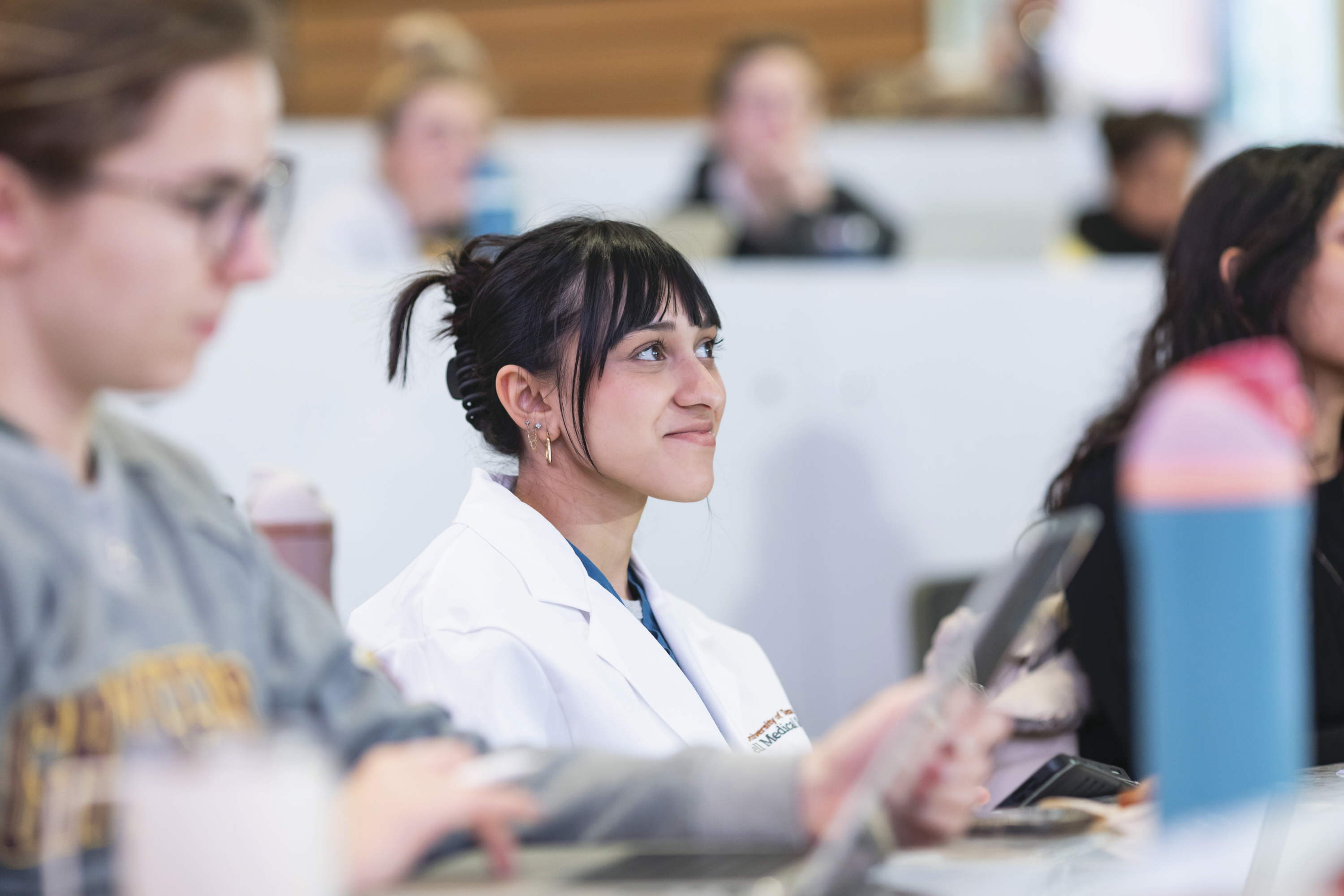
Of the three pillars that define an academic medical center—education, care, and research—education was the necessary first step. The Dell Medical School will anchor the medical center. In 2013, Michael and Susan Dell, Life Members, made a monumental gift through their family foundation to establish Dell Medical School, an investment that reflects the Dells’ commitment to changing lives through education, health innovation, and economic impact. Michael, ‘83, is a Distinguished Alumnus. “Michael and Susan Dell played a foundational role in the creation of Dell Medical School,” Lucchinetti says. “They have helped launch a new era for health and medicine at UT.”
In its first decade, Dell Medical School has achieved remarkable success: Its MD program now educates 50 doctors a year, admitted from 6,000 applicants. Another 490 residents and fellows train across a range of disciplines, practicing under close supervision across Central Texas—including next door at Dell Seton Medical Center, a relationship that will continue. It also has recruited 560 faculty physicians from around the world.
Building an academic medical center means UT will have the runway to design care on its own terms. “If you really want to maximize the opportunity to build something truly greenfield and AI-driven from the start, and to leverage the full strength of the University,” Lucchinetti says, “you have to build, own, and operate the system of care. High-quality, integrated care can’t happen in systems that are distributed.”
What does “integrated” mean in medicine? Lucchinetti explains it like this: Imagine a patient with shortness of breath and a history of heart disease. Instead of being referred from one specialist to another over weeks, she’s seen by an internist, cardiologist, and, if needed, a pulmonologist. In one setting, she gets imaging, answers, and a coordinated plan delivered by a system built to orchestrate all that. In other words, the system orbits the patient; the patient does not have to orbit and navigate the system.
Michael Ryan, UT’s chief health care technology strategist who co-led Mayo Clinic’s hospital venture in Abu Dhabi, describes integration this way: “Our patients, whether they’re coming for cancer care or heart problems or a sudden neurological issue, will register once with us. They will get one bill. They’ll have one interaction with their insurance company. They’ll have one app on their phone, one digital experience. It changes everything for the patients in terms of not only their care but how they interact with the health system.”
This is the answer to the broken status quo, where bewildered patients and their families are expected to coordinate confusing and sometimes even contradictory information. “Even in great legacy institutions,” Fraser says, they’re left to wonder: Is this consultant talking to that one? I’m hearing a different message from the various consultants, and who do I believe? Who’s actually in charge of my care? If you’re in the throes of a serious illness, you quickly learn that if you don’t advocate for yourself, there’s not necessarily a common thread holding the health care team together in a coordinated way.”
Behind the scenes, the integrated model is already being implemented in Fraser’s department. Every morning at 7 a.m., a huge team assembles to discuss each of their 40-50 heart patients—every surgeon, cardiologist, anesthesiologist, critical-care doctor, advanced-practice nurse, pharmacist, psychologist, social worker, and administrator. “We discuss all the patients because if we don’t, and someone in the care continuum is a little bit out of the loop, then we can get off course.”
Fraser says that he never experienced a completely integrated gathering like that until he got here and developed this paradigm with the team he has recruited from around the world. “We couldn’t have done that except for the newness of the spirit of things here and the unifying aspiration to do things better than ever before,” he says.
Austin, Texas, is the largest city in the U.S. without an academic medical center—a fact that makes little sense to Fraser. “We’ve had Nobel laureates here,” he says. “We’ve got leading everything. You can’t name a subject that Austin is not at the cutting edge of—engineering, computation, law, architecture, business, tech, just on and on.”
Then, the harsh reality: “Not a single citizen in Austin today can get a liver transplant here. Zero. Baby, child, adolescent, adult—they cannot get a lung transplant. Until very recently, they couldn’t get a kidney transplant. That’s just a tiny sliver of the health-care pie,” he says, “but think about that. It’s completely incongruous with a preeminent city, a forward-thinking city, and that’s just to cover the basics.”
Fraser and others agree that this must be fixed. But to rise to our greatest calling, he says, we need not only to get those specialties here, but to become the best—to leapfrog the “Austinites don’t have to leave” stage and go directly to the “People are coming here from around the world” stage, providing destination-level care.
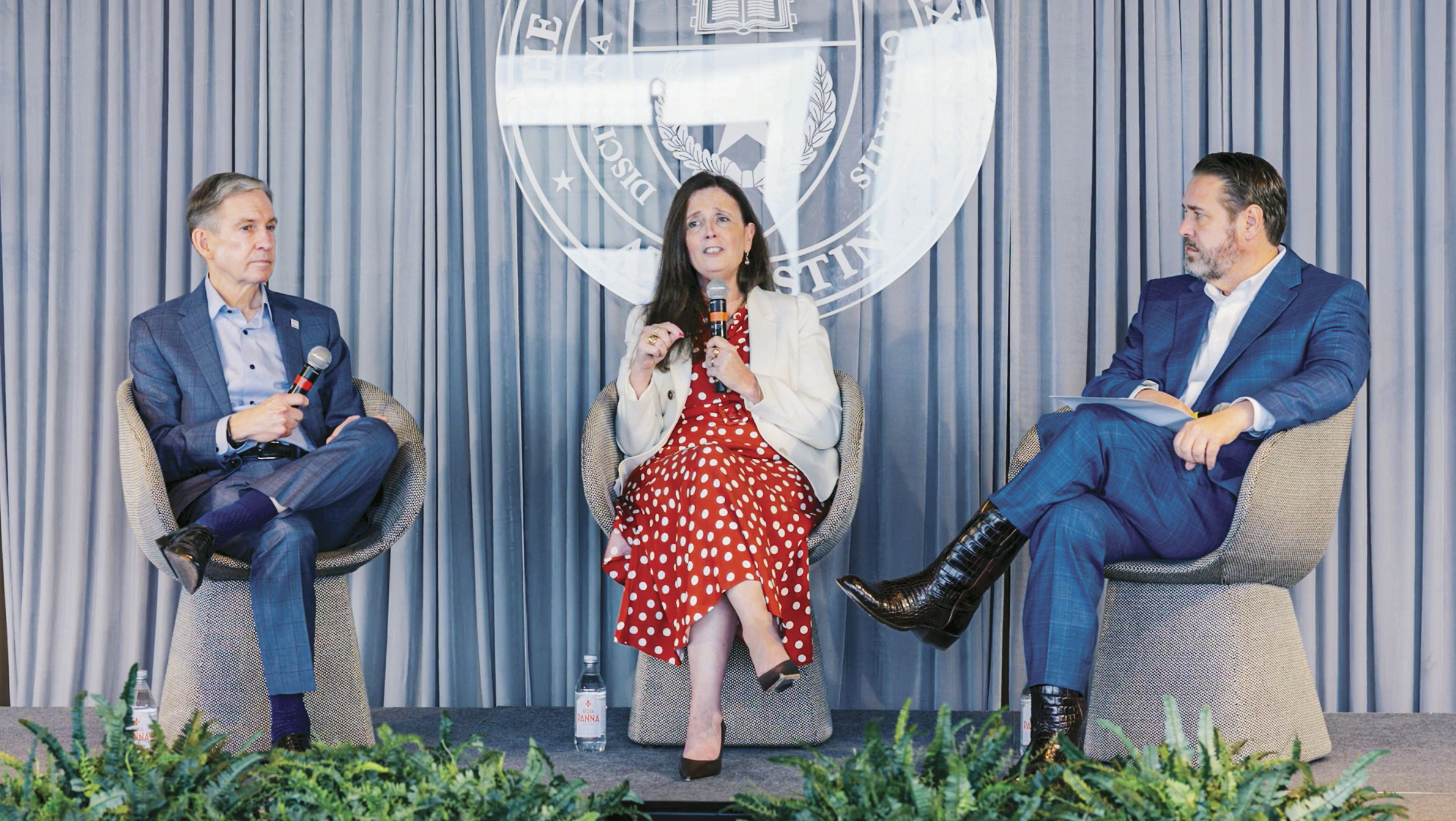
This brings us to The University of Texas MD Anderson Cancer Center, the world’s foremost cancer hospital and research center, in Houston, to which at least 6,500 Austinites traveled last year for care. Since the Regents’ 2023 announcement, we have known UT MD Anderson would be joining UT right here in Austin, with a vision to elevate cancer care, research, and the patient experience. At a March panel in Austin, Peter Pisters, president of UT MD Anderson, spoke about the collaboration. “As we think about the complementary strengths of two amazing organizations, in simple math it’s one plus one equals 10,” he said. “We’ll provide the oncology solution at a world-class level that will create a gigantic halo effect and really help the University to focus on the other centers of excellence, such as cardiovascular care, neuroscience, orthopedics, sports medicine, and so on.”
The vision of providing truly integrated care is what drove the plan to bring UT Austin and UT MD Anderson cancer care together into one hospital. This approach will create a seamless experience for patients, families, and care providers.
Bringing advanced care to Central Texas was the initial motivation for Tench and Simone Coxe to get involved. After they moved to Austin from California, they watched a close friend drive to Houston to get what Tench, whose venture-capital career included early support for companies such as Nvidia, described as “care she should have been able to get here at home.”
With no previous ties to the University, the Coxes made a significant investment in the medical center on the strength of Lucchinetti’s vision. “Having spent my career backing strong leaders, meeting Claudia made it clear: Supporting the vision for the medical center is exactly the opportunity Austin needed,” Tench says.
Davis believes the convergence of three things will differentiate UT’s medical center from all others: the integrated model of care, innovative use of technology, and its location in the booming city of Austin.
“Integrated means that we are bringing the entire care team around a patient,” Davis says. “Innovative means incorporating the newest and highest-quality technology and artificial intelligence to elevate the quality of care that’s even possible.”
As for Austin, he says there’s no other place in the world this could happen. “We have the greenfield location for it. This city has a rapidly growing population. UT is the best research university in the world. Chairman Eltife and the Board of Regents are leading the UT System with excellence and action,” Davis says. “We get to build the medical center from the ground up without the burden of old things we need to retool. And we’re in complete alignment with the state of Texas, our Board of Regents, our faculty, our students, and the patients we’re going to care for. That can only happen in Austin—right now. We remain incredibly grateful to Chairman Eltife and the Board of Regents, Governor Abbott, and all our friends and financial supporters who have come together to accelerate this vision.”
Lucchinetti says UT now has the space to be highly intentional about creating a healing environment—including lots of natural light and the ability to weave green spaces into the grounds. Creating healing environments is old hat for the University’s partner. “UT MD Anderson already knows that when you go into an environment to get your cancer care, the brightness of the lights, the colors, the art—it all matters,” Lucchinetti says.
As for the construction of the medical center and the design of the future campus it will anchor, there is much thought going into its physical connection to the Forty Acres. Davis says the architectural details will be important. He’s asked campus architect Brent Stringfellow “to imagine a conversation with Paul Cret,” the architect who most influenced the look and feel of the Forty Acres. “What does it feel like when you make that turn off Stonelake Boulevard and are driving into this new facility?” Davis says. “Where is our Speedway? Where is our South Mall? How do we know from the materials, color, shape, or scale that this is The University of Texas at Austin? How do we reflect some of our campus’s iconic features to create a connected experience?”
But don’t expect an imitation of the Main Campus. Rather, Davis thinks of it as a sort of an architectural call and response.
Building from scratch also means being able to embed technology into the experience. Robots might deliver drugs from the pharmacy to the nurses’ station or carry fresh laundry, but Lucchinetti does not want technology in patients’ faces. It will be hidden, embedded in the environment, so they don’t feel bombarded by it.
Burnout is a severe issue in medicine, and many doctors and nurses are leaving the workforce. “There are just hours spent dictating and reviewing your notes,” Lucchinetti explains. “In the AI-native system we’re building, charting becomes autonomous.” Technology chief Ryan adds: “It actually creates the physician documentation that goes to patients, it creates their orders, it does all of that for them instead of them doing it manually after the patient leaves.”
Many may be wary of the rapid rise of artificial intelligence in everyday life, but like it or not, it’s here, and the ethical use of AI in health care is among its most promising applications. “Most health systems are trying to retrofit AI into a 30-plus-year-old infrastructure,” Lucchinetti says. “So we asked, If AI, automation, robotics, and ambient intelligence were native to health care, what would we build, and what would it deliver?”
One of the answers: digital twins. This is when each patient has a computational, continuously updated model of themselves, which will allow them to be able to predict their risk for disease and even simulate treatments.
As a prime example of what will be possible by combining UT’s research engine with its medical center, UT’s Oden Institute for Computational Engineering and Sciences, a leading interdisciplinary research unit combining advanced computational science, engineering, mathematics, and modeling, is currently working closely with Dell Medical School and UT MD Anderson to tailor therapies in cancer care. Based on insights from that collaboration, the medical center will be able to deliver care tailored to the patient—predictive and eventually preventive—using multiple streams of data: their treatments, their wearables (such as a smart watch), their diet, what their scans are showing, and their genetics. Helping process that tsunami of data will be UT’s Texas Advanced Computing Center, less than a mile away from the future site of the medical center and home to several of the world’s most powerful supercomputers.
Regarding AI, Fraser, who has held the hearts of 18,000 humans in his hands, says, “I feel like a crude carpenter as a surgeon compared to where my successors are going to be in the realm of what’s available to them, what they can achieve.” The surgeon, who trained at Johns Hopkins and has worked at the Cleveland Clinic, adds, “I’m not overdramatizing the profoundness of this point in history.”
Davis sees clearly how building the new medical center, infused with an AI-first operational model, could offer tremendous insights for evolving the experience on the Main Campus. “If we can leverage AI effectively to monitor patients and help them navigate a complex health system, why not leverage the same technologies to help students navigating our Main Campus?” Davis says. “Think about it: You’re new to campus, it’s your first day on the Forty Acres, and you’re trying to navigate all the opportunities, emotions, and challenges that may come with this type of experience. What insights can we take from the medical center to make it easier for students? This is not just one-way learning. What we learn by building the academic health system will also change how we experience the Forty Acres.”
In addition to AI, the possibilities for research collaborations and future discoveries are practically endless, and these, which have been explored for the past decade with the medical school, now will be turbocharged. The medical center will leverage UT’s historic strengths in engineering, nursing, pharmacy, social work, computing, business, law, and the arts to an even greater degree than the medical school has so far.
What else should Texas Exes know about the medical center? “The new academic health system we are building will truly change the world,” Davis says. “What we are building has never been built before, and that ambition reflects who we are as Longhorns. Every Longhorn has contributed to this idea. Everyone who’s come through the University, who has learned here or has come back to teach or build something, has contributed to the very spirit of being willing to do something as bold as building this academic medical center.”
CREDITS: Sam Chivers; Dell Medical School; The University of Texas