Ancient Documents Once Buried With Mummies are Now at the Harry Ransom Center
In the aftermath of the Antonine Plague nearly 2,000 years ago, an enslaved woman in Egypt faced an uncertain future. Her master had died, and another man claimed to have inherited her. Rather than quietly accept her fate, she filed a legal petition asking the Roman authorities to intervene. That petition survives today—and is currently featured in “Lives and Literacy in Ancient Egypt,” a new exhibition of rare papyrus manuscripts at the Harry Ransom Center that explores how writing captured the lives of people in Greco-Roman Egypt. The documents range from religious texts and magic spells to personal letters and legal documents.
“We can see that these papyri preserve a lot of interesting lives that we don’t necessarily expect to have access to in this kind of detail in an ancient civilization,” says Katherine Taronas, a co-organizer of the exhibition and postdoctoral research fellow at the Institute for the Study of Antiquity and Christian Origins (ISAC) at UT.
The exhibit is the result of an international partnership between the Ransom Center and the University of Manchester’s John Rylands Research Institute and Library, bringing together rarely seen papyri from both collections that illuminate a period of technological and cultural change on the banks of the Nile. For many of the objects, this marks their first-ever exhibition in North America.
“On the whole, when we look back at antiquity, we’ve lost a lot,” says Geoff Smith, ISAC director and associate professor. “We’re hoping people, as they walk through, have a series of micro-encounters with antiquity, made possible through these little fragments.”
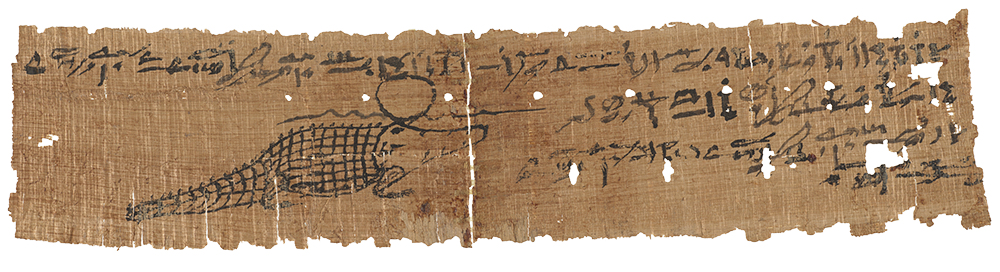
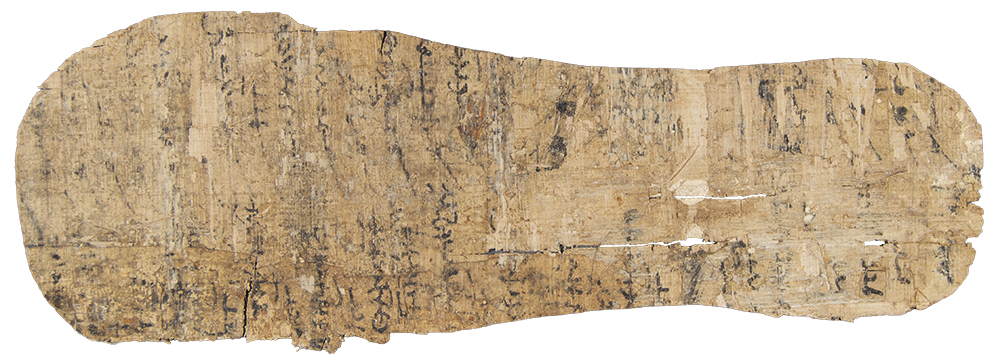
Many of the papyri come from the Ransom Center’s Piet Sijpesteijn Collection and are among the earliest examples of the written word to be housed at UT Austin. When the original documents were no longer needed, they were repurposed by ancient artisans to create mummy casings from cartonnage, a papier-mâché-esque material created by layering glue, plaster, and fragments of old papyrus. Mummies were encased in these three-dimensional forms when entombed. Today, these rare fragments, and the writing on them, provide vivid clues about ancient daily life.
“As you might imagine, they’re kind of dirty,” says Aaron Pratt, a co-curator of the exhibition and curator of early books and manuscripts at the Ransom Center. “They also have adhesive bits on them,” he adds. The conservation teams completed extensive work to straighten out the fibers from their adhesion to the curved forms and clean the papyri before placing the fragments in new glass housings, ensuring the documents were in stable enough condition to display. Now, Pratt says, selections of the Sijpesteijn Collection can be used in classrooms and other educational settings in ways they have not been for a very long time.
The Ransom Center’s papyri holdings alone weren’t substantial enough to support a full exhibition, however. Enter the John Rylands Library, which boasts an internationally significant collection of Egyptian manuscripts. During a research trip, Smith connected with Jeremy Penner, curator of African and Near Eastern manuscripts at the Rylands Library, and the two began discussing the possibility of a joint exhibition to highlight their complementary collections.
One thread the organizers drew out is how many different cultural traditions overlapped in Egypt as the region passed through the hands of different empires. “We can see these really creative syntheses be born out of the interaction of different traditions, whether that’s religious, visual, or literary,” Taronas says. “It’s really a vibrant time of interaction and cultural change.”
Evolutions in written language offer one of the clearest threads of this exchange. “Even within the Egyptian language trajectory, you have four different kinds of writing,” Smith explains. Pictographic hieroglyphs underwent phases of stylization, evolving into the more recognizable Hieratic and Demotic scripts. When Demotic was transliterated into Greek characters, it became the language of Coptic, which “looks like Greek, but it’s Egyptian,” says Smith. Most of the surviving materials from Ancient Egypt are written in Greek and speak to political history and the history of immigration to Egypt. “The Greeks and Romans were very bureaucratic and loved paperwork,” Smith says.
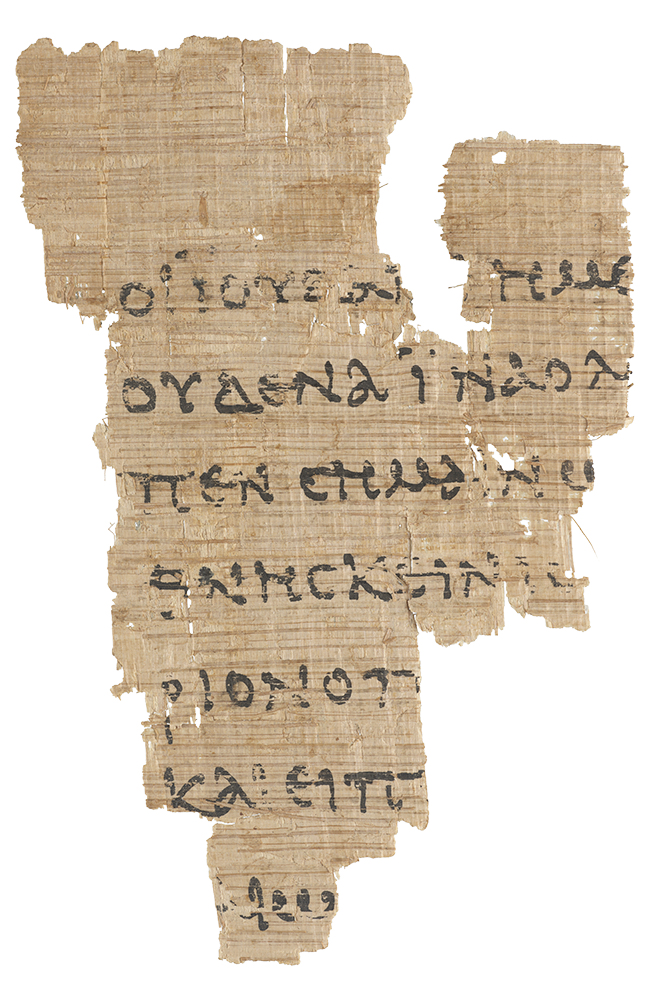
Documents from the Rylands Library include Christian scriptures such as Papyrus 52, the oldest known fragment of the New Testament, which contains parts of the Gospel of John. Other papyri provide a glimpse into the ways religions competed for converts, such as a letter Taronas characterizes as “an early testament to this other religion of late antiquity, Manichaeism, being present in Egypt at the time.” (Followers of Manichaeism revered the 3rd Century prophet Mani, whose teachings combined elements of Christianity, Judaism, and Persian Zoroastrianism.) The letter warns Christians not to be swayed but provides evidence, as Taronas puts it, that in this historic moment, “new religions are on the block.”
Magic also played an important part of daily life in the ancient world. Artifacts such as a papyrus amulet that was carried around like a talisman showed how people turned to the supernatural. “If you needed help with healing, or if you had a love interest and they weren’t paying attention to you, or if you had a rival and you didn’t want them to do well in business,” Smith says, “you would turn to magic, to the help of the gods and of demons and of demigods, to help you bring about the end that you desire.”
The Egyptian religion of the period incorporated Greek and Mesopotamian ideas, alongside astrological knowledge with its own complex influences. “The main document that opens the exhibition is this very strange papyrus fragment that documents a fictional dialogue between Plato and an ancient Egyptian priest,” Pratt says. “This ancient Egyptian priest is educating Plato in the astrological methods and beliefs of this Greek-inflected ancient Egyptian world. So, it’s like, ‘Plato, you might have something to learn from this distinctively Ptolemaic era of astrological and astronomical knowledge.’”
Since the conditions in this period of Ancient Egypt allowed so many papyri to survive, Taronas says, it’s possible to have a uniquely “intimate experience of the past, and of all these different characters in history that are just not preserved in other places.” Among the many voices captured in these fragments is the enslaved woman, whose petition written nearly two millennia ago ensured that her story would not forever be lost to history.
Lives and Literacy in Ancient Egypt runs through August 3, 2026.
CREDITS: Trent Lesikar; John Rylands Research Institute and Library, P. Ryl. Hieratic 50; The University of Texas at Austin, Harry Ransom Center, Piet Sijpesteijn Papyrus Collection 119