Texas Softball Takes the Field, Eyeing Another National Championship
The bases were going to be loaded in Oklahoma City.
It was the sixth inning of Game 1 of the Women’s College World Series Finals between The University of Texas and Texas Tech. NiJaree Canady, the 2024 USA Softball Collegiate Player of the Year at Stanford, was on the mound for Tech, having received a reported $1 million in name, image, and likeness money to leave Palo Alto for—go figure—Lubbock. And she was earning every penny.
Canady and the Red Raiders had already upset defending national champion Oklahoma for the right to play UT and its own ace, then-sophomore Teagan Kavan. And now, behind five innings of one-hit ball by Canady, Tech had a 1-0 lead, the lone run aided by a questionable obstruction call against the Longhorns on what would have otherwise been a thrown out at second base by junior All-American catcher Reese Atwood. Canady came out for the sixth and promptly struck out both pinch-hitter Vanessa Quiroga, BS ’25, and .415-hitter Ashton Maloney. Softball games only last seven innings. Time was running out.
But then time stopped.
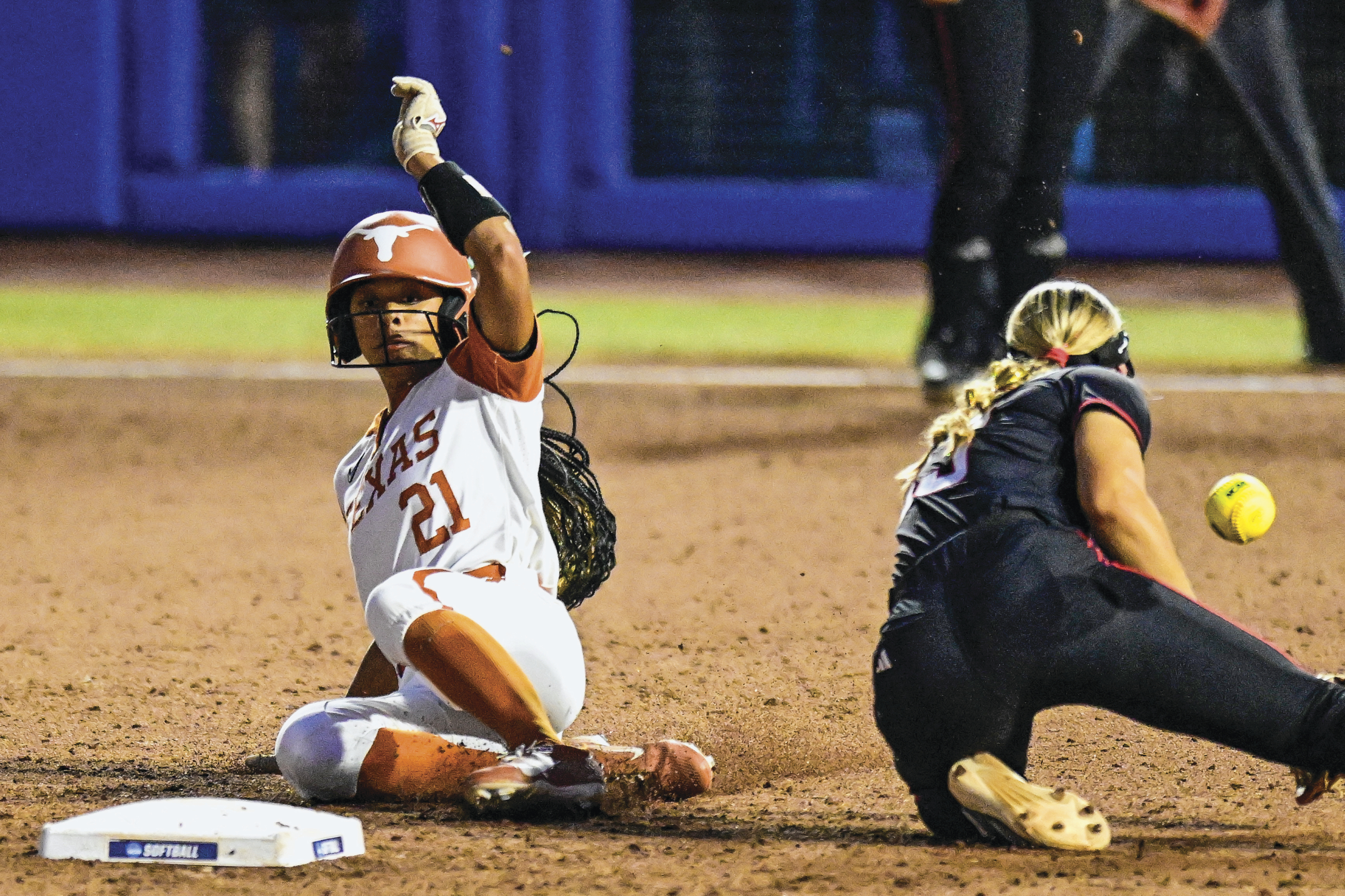
Star outfielder Kayden Henry started the rally, fouling off several pitches and falling behind in the count until ... Single! On the next pitch, she stole second. Facing two strikes, Mia Scott also singled. Suddenly, the Horns had more base runners than they’d had in any other inning.
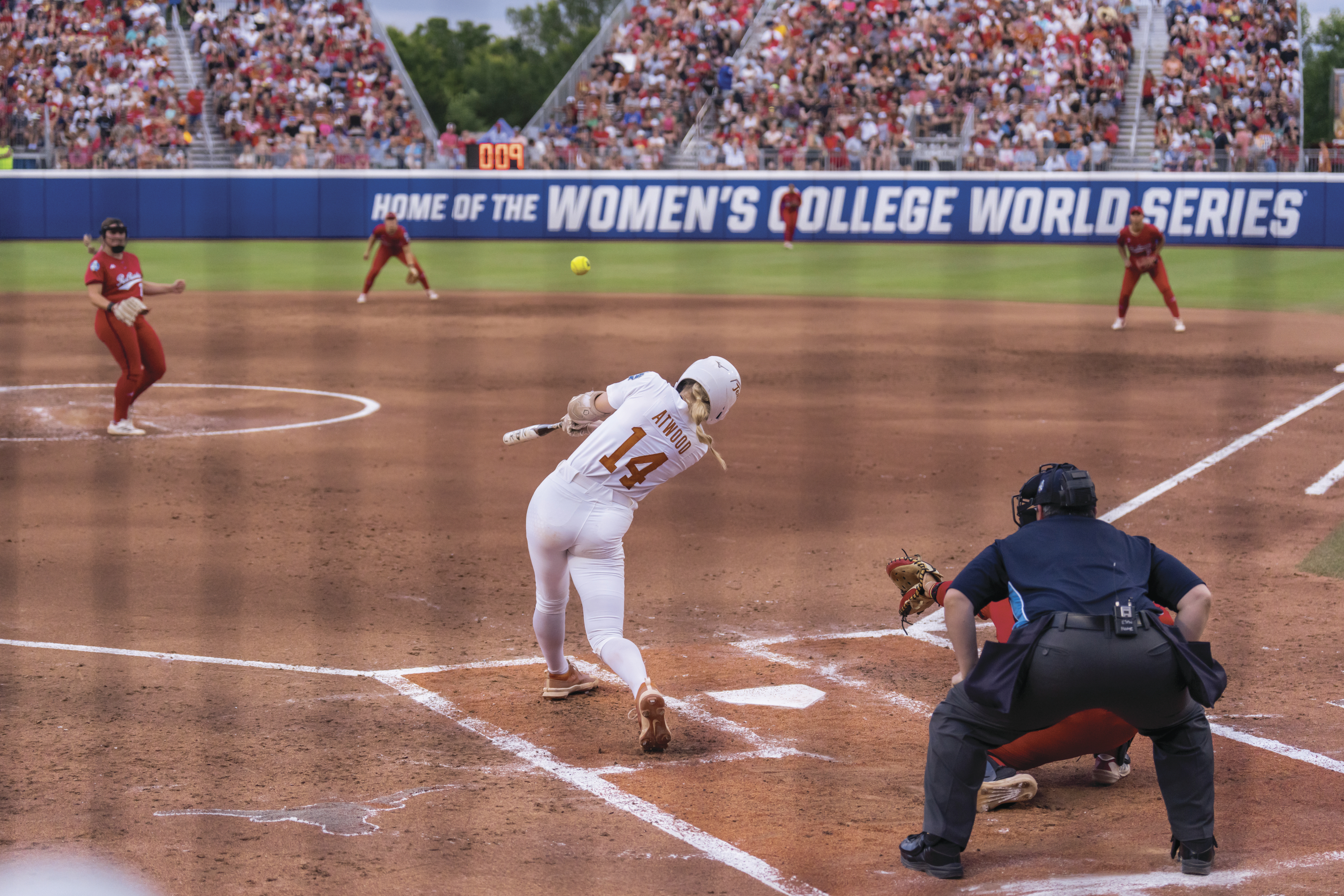
First and third, with two outs, and none other than Atwood stepping to the plate. In addition to being the game’s best catcher and, according to Kavan, the Horns’ hardest-working player, Atwood is a demon at the plate who set UT records for home runs, RBIs, and slugging percentage in 2024, and was no less dangerous in 2025.
“A difference-maker for any time in the game,” Kavan says of Atwood.
So much so that, even though Atwood had been hitless for the entire World Series—0 for 10 through three games—Texas Tech coach Gerry Glasco ordered an intentional walk.
Ball one. As Scott took second base on defensive indifference, the pitch was not too far beyond the strike zone. “I went, ‘Ooh that’s close,’” head coach Mike White remembers.
Ball two. High, but creeping toward the middle.
Ball three. Outside, and now it’s clear the pitches lacked Canady’s usual movement and velocity, since she wasn’t trying to strike anybody out.
“It made it a lot easier to swing,” Atwood says. “NiJa’s a great pitcher, so it was definitely a really insane at-bat for me to process. And that last pitch was just a little too much over the plate.”
While White has joked several times that he did not issue a green light, Atwood says she actually got a little head nod from associate head coach Steve Singleton.
“We were kind of like, ‘Oh, wow. She could do this,’” Kavan says. “It was like an out-of-body experience.”
Thwack! A two-run single to left field. 2-1 Texas. And in the seventh, Kavan slammed the door.
Taking the first game in the series determined everything that happened next. While Canady and the Raiders prevailed over the Horns, 4-3, in Game 2, the UT offense came alive against her in the sixth and seventh innings, then picked up right where they left off in Game 3, exploding for five runs in the first, three of them on a Leighann Goode home run. That chased Canady from the game. The Horns took a 10-0 lead in the fourth inning on a Scott grand slam; it was 10-4 when the game ended with a burnt-orange group hug/pile around Kavan in the circle. Canady may have been the face of softball, but it was Kavan—4-0 with a save and zero earned runs allowed—who was named the tournament’s Most Outstanding Player.
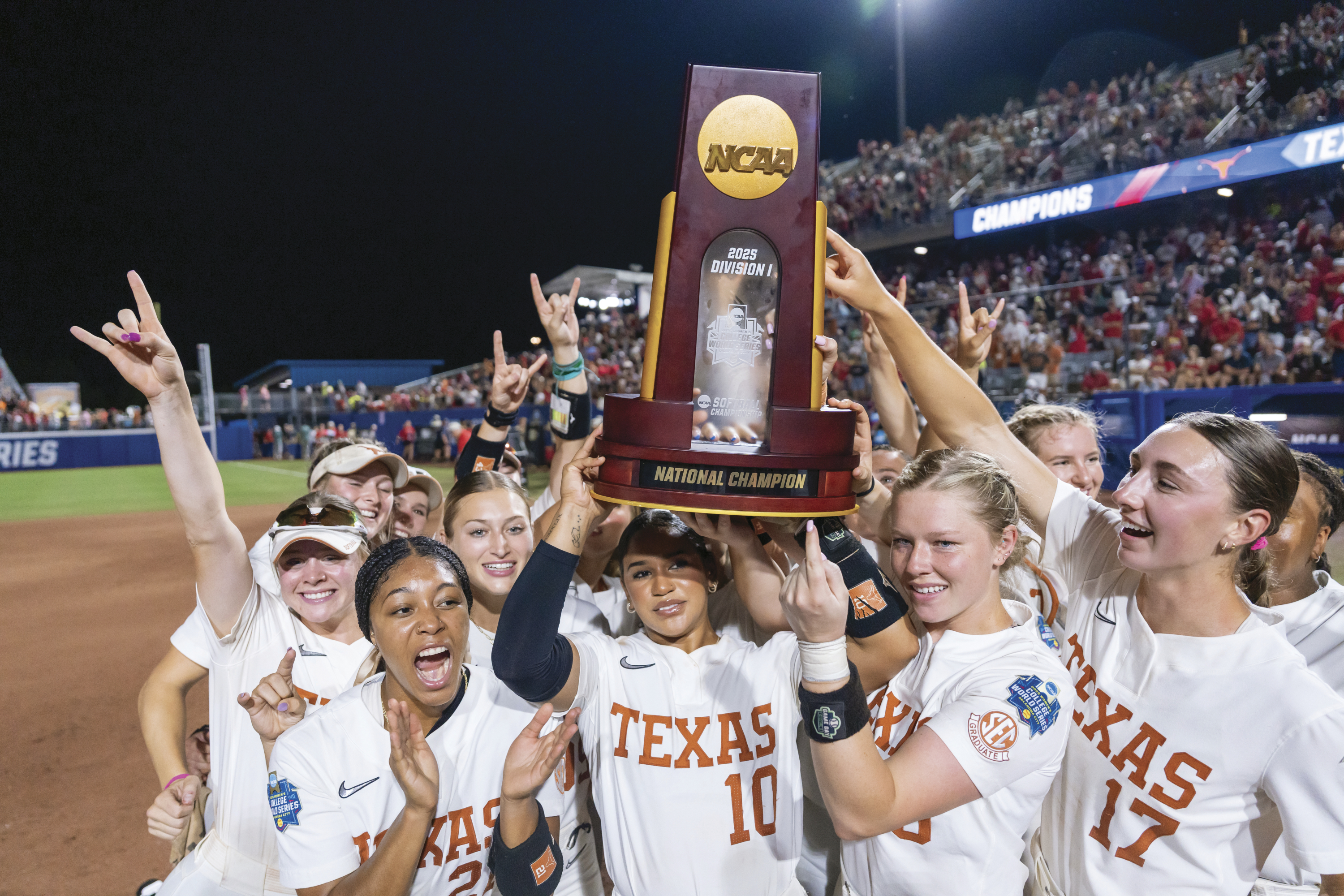
Finally, the Longhorns were NCAA Softball champions. Though, finally is relative. After all, softball has only been an NCAA sport since 1982, with The University of Texas adding it in 1997. White is just the program’s second coach after Connie Clark, whose teams made the NCAA tournament 19 times, with five trips to the Women’s College World Series. Three of those (2003, 2005, and 2006) came during the reign of all-everything pitcher and Olympic gold medalist Cat Osterman, BA ’07, Life Member, while the last one was in 2013.
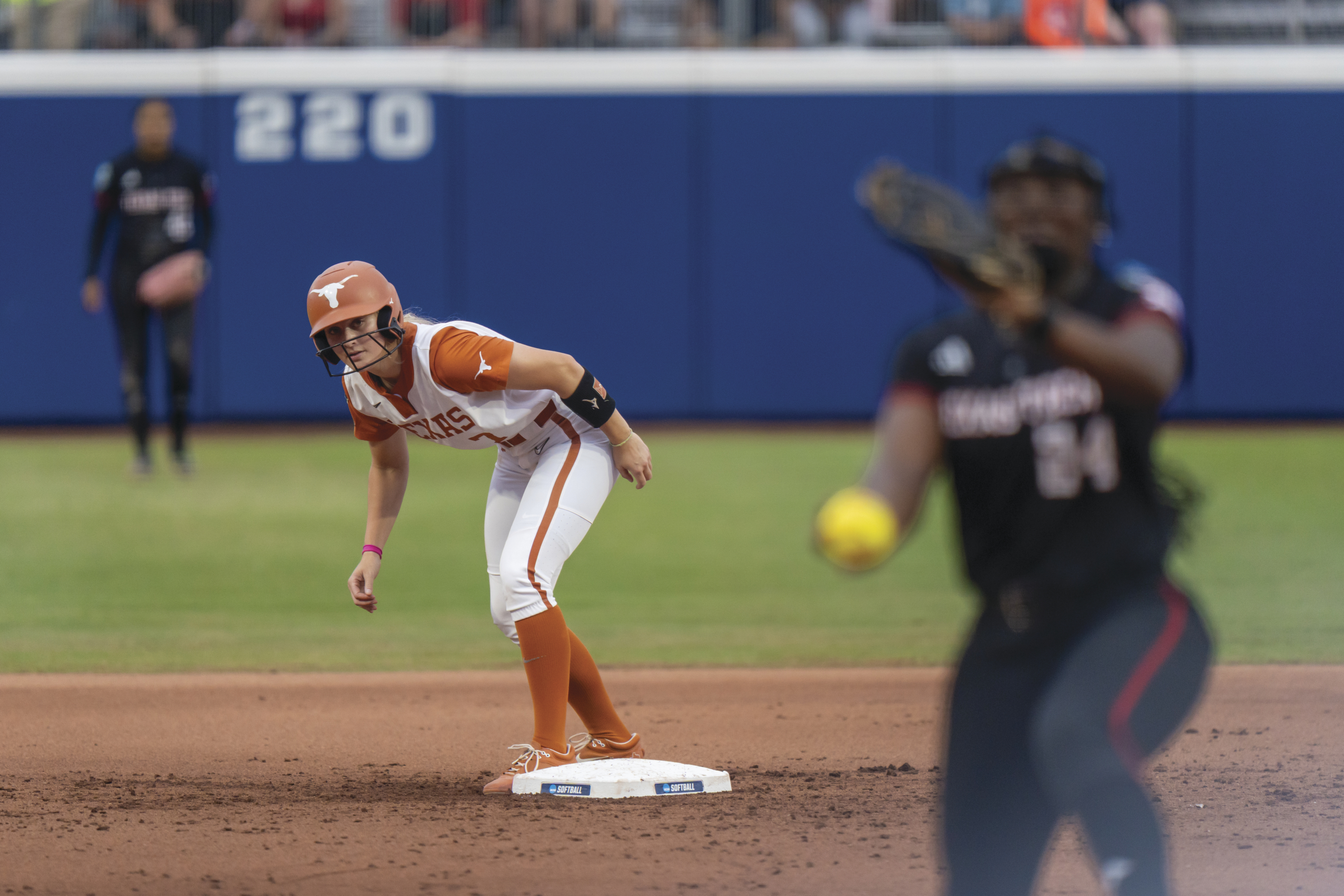
White, a mustachioed New Zealand native who became an American citizen in 1994 (but could still pass for a character from Flight of the Conchords), was a fast-pitch softball ace, both professionally and for Team USA. Chris Del Conte brought him to Austin in 2018 on the strength of his work at the University of Oregon, where the Ducks made the tournament in each of his nine seasons.
White immediately brought Texas back onto the national stage. His first season saw UT make the super regionals for the first time since 2013, while the 2020 team made it to No. 1 in the Softball America poll for the first time since 2006.
Atwood says that White, having been a pitcher himself, always seems to know what the other team is going to throw, and comes up with creative plays. White oversees the program from a GM-like role that allows his coaching staff—including assistants Kristen Zaleski (who works with the outfielders and the hitters) and Pattie Ruth Taylor (pitching)—to be hands-on with both on-the-field instruction and monitoring the clubhouse and dugout. The coaches push the players, and the players push each other, but everyone is also free to be themselves and just have fun. “Because softball, at the end of the day, is just a game,” Kavan says. “It’s fun. And that’s how we play.”
Even more than an empowering boss or savvy strategist, White is something of a softball sage: part Yoda, part Harvey Penick. Among his stalwart sayings:
“The game doesn’t know who’s supposed to win.”
“There’s no real losing. There’s just learning.”
“You’re always one pitch away from an out.”
And: “It’s all about Texas Fight.”
White’s streak of super regional appearances now sits at 15 consecutive seasons. He first got himself and the Horns back to the WCWS in 2022, when they were considered an underdog—an unseeded team that didn’t host a regional or super regional. By 2024, on the other hand, they were the No. 1 team in the country and top seed in the tournament. Both years turned out the same way: The Horns made it to the finals, only to be swept by Oklahoma, which won four straight national championships from 2021–24.
“We like to say that we take the name off of jerseys when we compete against other teams,” Atwood says. In other words, it doesn’t matter if you’re playing Texas Tech or Division II Lubbock Christian. But that was maybe just a little harder to do when your biggest rival is also the best team in the sport. The game sure seemed to know that Oklahoma was supposed to win. “Oklahoma kind of had our number for a while,” Atwood says.
“They’re the gold standard,” White says. “We call it the black hole. Once a recruit goes in there, they don’t come out. We’re all chasing that car.”
Prior to the 2025 season, White and UT had a 3-19 record against Oklahoma, and the program had not beaten Oklahoma in Oklahoma since 2014. Nothing changed in April, when the Sooners swept a three-game series in Norman, with Kavan getting rocked for six earned runs in the first game. She’d also lost Game 1 of the 2024 WCWS finals to the Sooners. Of course, the tournament is played just 30 minutes from the OU campus. So, when the Longhorns got a rematch in the second round of the 2025 WCWS, it was another tall order. Especially after real life intervened.
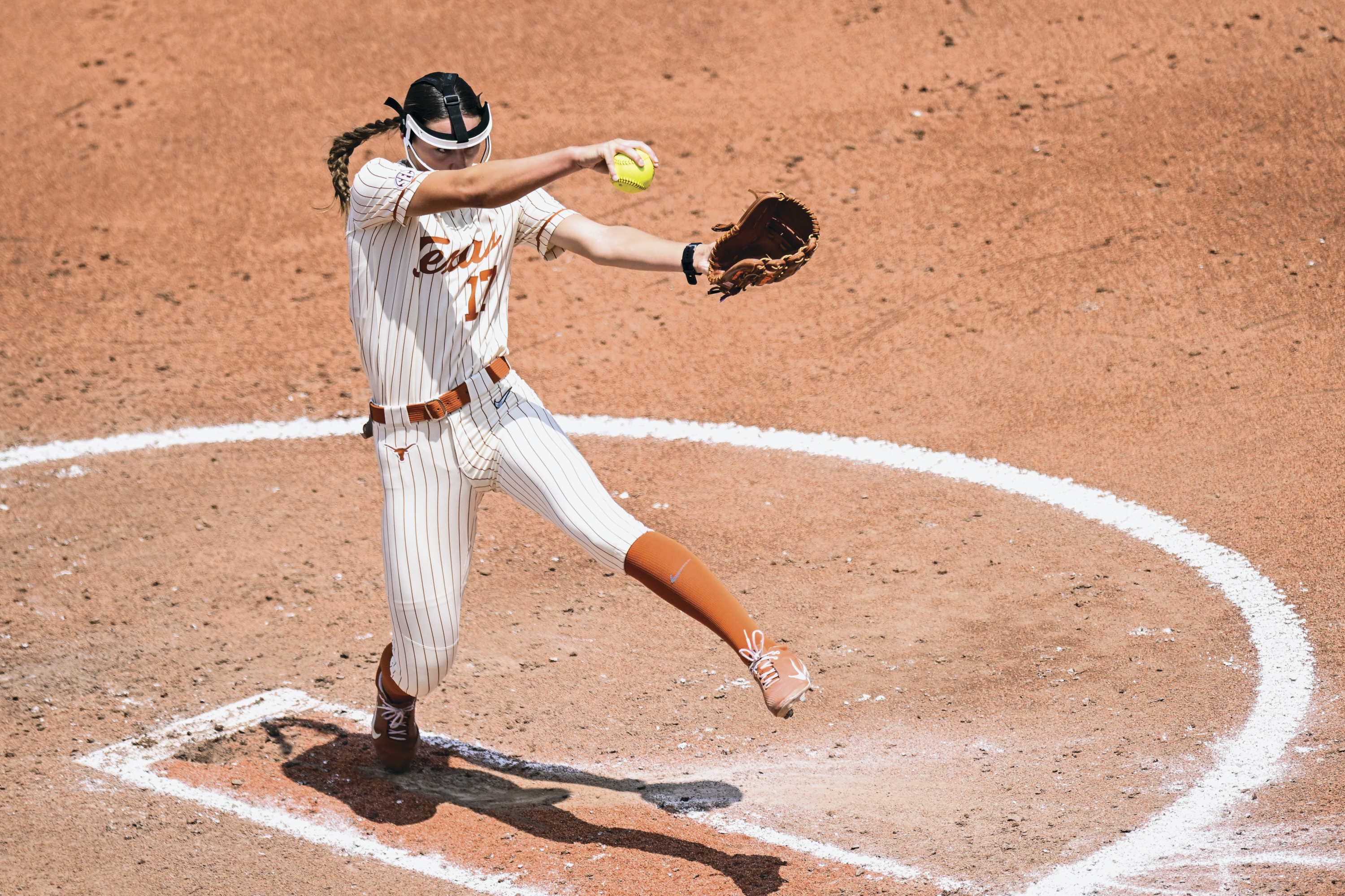
Hours before the game, Kavan received sad news from back home in Iowa. Her maternal grandmother, Anna “Jo” Lukeheart, for whom she wears No. 17 (in honor of her birthday), had died at 97. Lukeheart watched all of her granddaughter’s travel softball games on YouTube. When Kavan got to Austin, the family made sure Lukeheart had all the apps, logins, and platforms on her Smart TV to watch the Horns. Sometimes she’d binge multiple games after-the-fact and then ask her granddaughter, “Is your arm tired? You’ve been throwing all day!” Watching Kavan play for Texas was her greatest joy.
So there really was no doubt what her grandmother would have wanted: for Teagan to still be in the circle. She would go out there and pitch in honor of her grandmother, and for her teammates.
“Teagan’s one of my best friends, so I definitely wanted to be there for her,” Atwood says. “I wanted her to know that we loved her as a person before we loved her as a teammate. We were going to support her either way.”
Tall and long-armed, Kavan is both a physical and mechanical specimen, with a three-pitch mix (rise ball, drop ball, and change-up) that looks the same. And just as you can’t tell what she’s throwing, you can’t tell what she’s feeling, or that her heart rate jumps at all from pressure. “Calm, cool, collected,” White says. “A commander of things out there.” That steadiness allowed her to embrace the emotion of the day, but also to put it aside and focus on, as she said after the game, “just chucking a yellow ball.”
With so much on the line both emotionally and competitively, the Horns were aggressive from the start against the Sooners. They broke open a 2-2 tie with home runs by Henry and Joley Mitchell, as Kavan pitched 5 1/3 scoreless innings, striking out three in the bottom of the 7th to end the game. “Honestly, one of the greatest moments I got to witness on any team I’ve ever been on,” Atwood says.
“That day was probably the day that I felt the most love from everyone,” Kavan says. “In a really rough moment for me and my family, it was amazing. It showed me how strong our team was, and how well we fought for each other. It really gave me a lot of confidence going forward the rest of the tournament.”
Some of the Texas players and coaches would have relished another shot at Oklahoma in the finals. Texas Tech prevented that. But when the team returned home to Red and Charline McCombs Field to celebrate the national championship, they still heard chants of, “Texas fight! OU sucks!”
On the night the Longhorns won it all, Houston Chronicle columnist Kirk Bohls, BJ ’73, asked White if this had been his best team ever, or just the team that played the best. It’s a question that the head coach couldn’t really answer (and didn’t).
But there were still some clear superlatives. Most never-say-die team. Team that overcame the most adversity. Whether that was through injuries (most notably to infielder Vivi Martinez, who returns in 2026) or perhaps a few too many tests of White’s “there’s no losing, only learning” maxim. In addition to the season sweep by Oklahoma, they endured a 14-2 run-rule loss to Texas A&M in the SEC tournament. Against Clemson in the super regional, they were one run away from missing the World Series entirely. Already up 1-0 in the series, the Tigers tied Game 2 at 5-5 in the 5th inning, then had runners on second and third base with no outs in the bottom of the eighth against Kavan, who was pitching in relief. The ever-unflappable ace struck out the next hitter, then got two more outs. The Longhorns won it in the 10th and went on to win Game 3.
“Our resilience was great,” White says. “I mean, [we were] 60 feet away from not even making it out of the super regionals.”
Most of all, there was the team culture and chemistry. “Just loving one another is huge,” White says. “Caring about each other. I think this was the closest bonded team that we’ve had. That was a huge difference for us.”
Atwood says the chemistry was something they worked on. There was more unity and focus compared to the previous two seasons. “We had leaders last year step up and say that we were going to be different,” she says. “We were going to learn to come together as one and compete as one. Nothing else mattered, other than winning that national championship.”
Now the trick is doing it again. Doesn’t matter that you won it last time. Doesn’t matter if you’re first in the preseason (in fact, the Horns were tied with Texas Tech atop the ESPN/USA Softball poll).
“The past is in the past. We won, and nobody can take that away from us,” White says, “but we’re not entitled to another championship. We still have to put in the work.” There are new players, both transfers and recruits, to work in, as well as a new associate head coach: Ehren Earleywine, most recently an Ole Miss assistant, but before that Missouri’s head coach for 11 years, replaced Singleton, who is now in charge at the University of California.
“Climbing the ladder is easier than staying at the top,” White said. “You got to have something to shoot for. Obviously, another national championship is great, but I think for us, it’s getting even better. Understanding that we’re not at the top of our game yet. We haven’t reached the pinnacle of what we can be or what we can do.”
White says that Texas volleyball head coach Jerritt Elliot recently greeted him as “Mr. Natty.”
“Hey, man,” White responded, “you’re a three-time natty. I’m not even close.”
But two would be a start.
CREDIT: Texas Athletics