From the Finials to the Floors, the UT Tower was Built to Inspire
If the restoration of the Tower at The University of Texas at Austin were not important for any other reason, it would be important because we simply don’t make buildings like this anymore.
If you’ve driven around Texas much, you’ve no doubt been struck by the fact that no matter how small a town is, if it is a county seat, it probably has a historic courthouse, and that building is likely to be the most impressive building in that county, especially if it was built between 1870 and 1910. On the squares of Waxahachie, Lockhart, Mason, and dozens of other towns, these buildings sit like gingerbread castles surrounded by bank branches, hardware stores and barbecue joints.
I love these buildings not merely because they are old, but, like our Tower, because they were built during an age when aesthetics really mattered, especially when it came to public buildings. It was an age when people took enormous pride in the details—whether those details were the construction materials, the architecture, or the symbolism and messages embedded in the structure.
Think of any central administrative building erected on an American campus during the past 60 years. These might have all the amenities and none of the functional quirks of our Main Building and Tower. Designed with modern HVAC from the get-go, they would be more energy efficient, and topping out at three or four stories, they would be cheaper to build and maintain.
But they aren’t like this building.
They don’t possess the monumental scale or the variety of materials. They don’t evince the thoughtfulness or have the character. The word that best describes buildings of the past half-century—even the nice, expensive ones—is “nondescript.”
Even the finest university buildings constructed today have an aesthetic driven by economics and utility and technology. They are thoroughly modern, of course, and feel corporate. But then, in the early and middle of the past century, banks, train stations and movie theaters—all creatures of commerce—were majestic, too. The difference between then and now must be something deeper still. A century ago, even a post office was a source of immense civic pride, with great thought put into virtually every detail.
UT’s Tower was not built for efficiency. To get to my office on the third floor, you must take the Tower elevator to 8. To get back to the ground floor, you press “1,” which is not the first floor. Explaining this to visitors can feel like a Vaudeville routine or a scene by Kafka. Bugs like this were mainly the result of the project being piecemeal, with major sections conceived and built several years apart.
Nor was it built cheaply. Its $2.8 million price tag translates to about $65 million today, but a Tower was never the cheapest design. It was meant to make a statement. English professor J. Frank Dobie famously complained that the Tower should have been laid on its side; after all, he said, the one thing we have lots of in Texas is land. (What an irony that the building named for him, Dobie Center, is exactly as tall as the Tower he criticized, at 307 feet.)
On the flip side, the Tower will never be called nondescript or cookie-cutter or cheap. This building oozes with character because of its style, which blends neoclassical themes such as pillars and arches (Beaux-Arts, to be specific), regional references such as Spanish tiles, and, on the Tower itself, Art Deco lines, which connect it to the era of its creation.
What’s more, every part of the Tower presumes its permanence. University leaders had learned their lesson with Old Main, which was beautiful and beloved but poorly built. After only 40 years, large parts of it were deemed unsafe for occupation. The new Main Building was going to be built for the ages.
Consider its materials: The exterior walls were constructed of Indiana limestone, harder and more durable than local limestone. Its red roof tiles were made in Ohio, and the marble for its grand stairway, steps, and floors was mined in West Texas, Tennessee, Missouri, New York, and Vermont. We brought bits and pieces of the wider world here to make it as good as it could be.
But we were also blending those with local materials. Its doorways were framed in a locally quarried limestone called Texas shell stone. And, in a nod to frugality, bricks from Old Main (made in Austin) were reused for some inner walls.
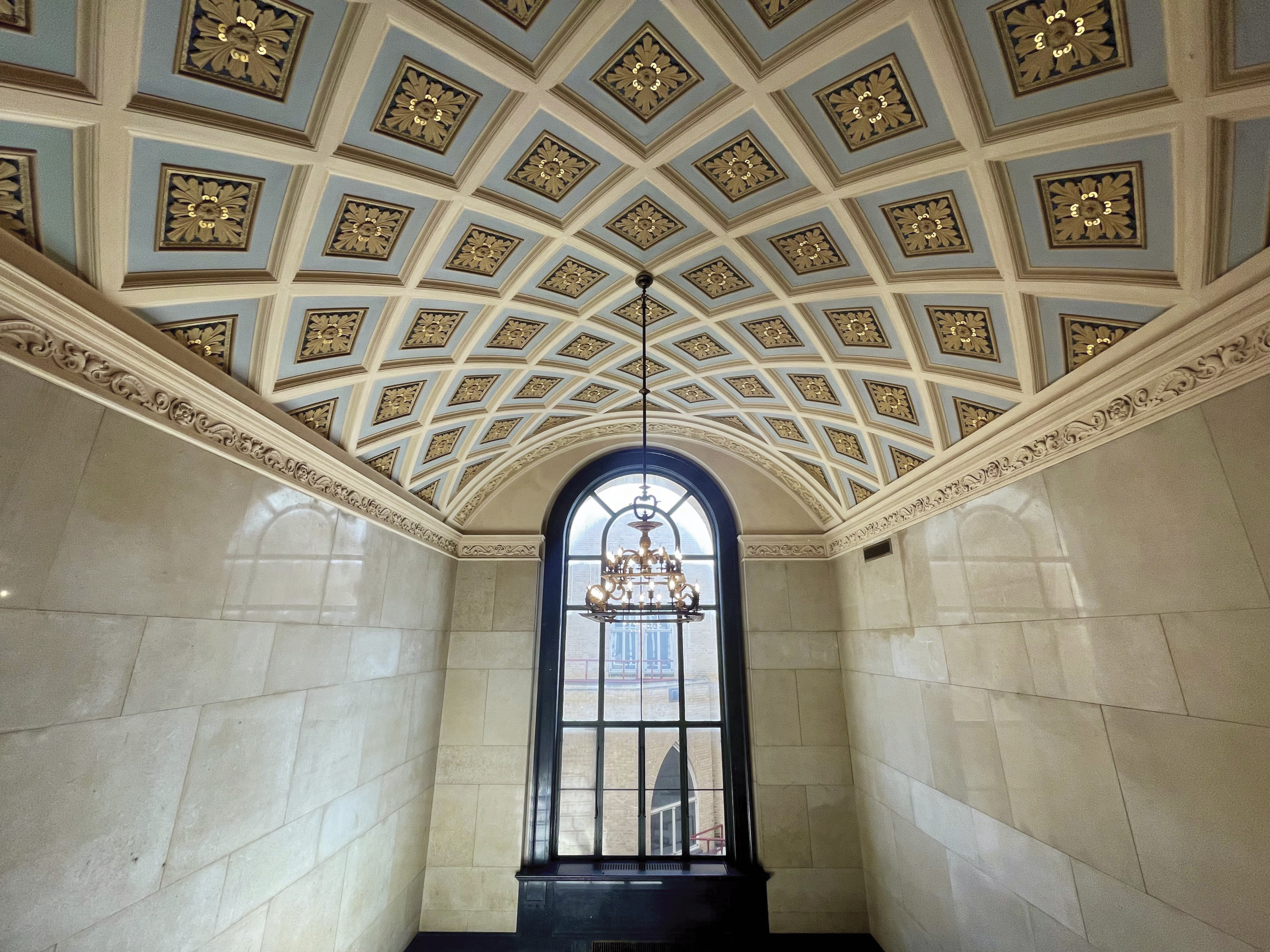
The Main Building’s interior was not sheetrock and paneling, but was finished with terrazzo, tile, wood, stone, terra cotta, cement, marble, plaster, steel, and wrought iron. Again, for the ages.
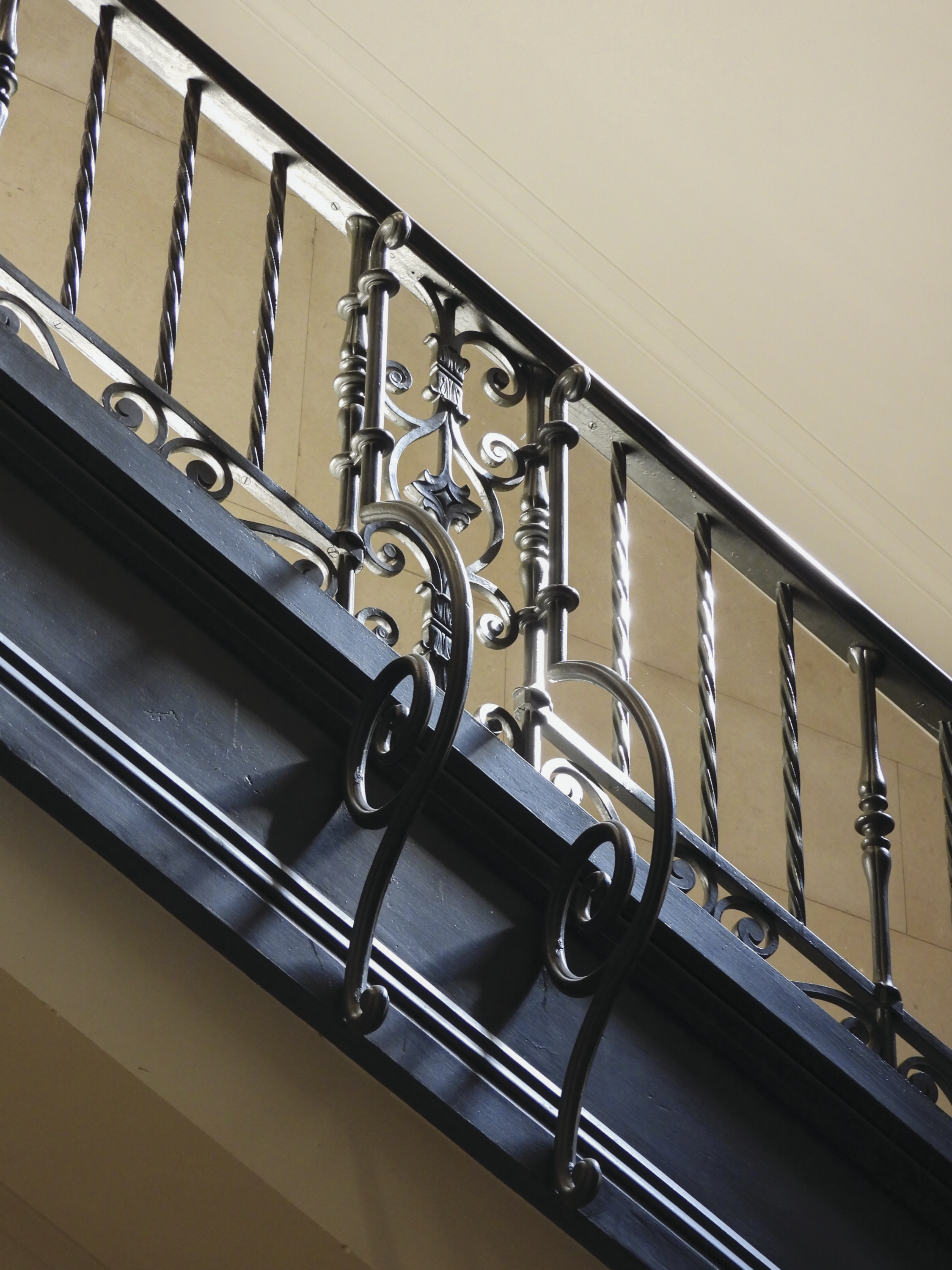
Architects custom-designed furniture for the Main Building’s libraries, including tables, chairs, desks, card catalogs, bookcases, benches, lockers, and book trucks. They specified the kind of glass in the windows. Copper screens. Metal-frame louvers. Caulking and grout. Cadmium-plated grilles. They designed wall sconces and handrails and the finials on the bannisters. The blueprints for these many custom objects, all of which were subcontracted, contain notes such as: “All objects on this sheet to be of genuine wt. iron, hand hammered and worked in an artistic manner. Subject to the direction of the architect, ornaments and etc. to be forged and finished by hand.” Other notes stipulate tersely: “Must be approved by architect.”
Lastly, consider the thought that went into the inscriptions and seals that adorn so much of the Main Building and testify to the intellectual oeuvre of campus at that time. William Battle, beloved professor of Greek and chair of the Faculty Building Committee for 28 years, had the final say in virtually all these details. (He is the namesake of Battle Hall, the Battle Oaks, and the Battle Casts, a large collection of classical sculpture replicas he left to the University. In a faculty coup for the ages, he also claimed the elegant high-ceilinged, wood-paneled 27th floor of the Tower for his department.)
Wrapping around the north side of the building and into its two courtyards are gilded Egyptian hieroglyphics and letters from the Phoenician, Hebrew, Greek, and Latin alphabets. The 113 cast-iron letters were made at a foundry in Dallas. Battle commissioned and approved them, and they were brought to Austin on a flatbed truck weeks before then-President H.Y. Benedict, BS 1892, MA 1893, was informed. In a 2010 article about the letters, now-professor emeritus John Huehnergard said, “The letters represent the history of the alphabet and, by symbolic extension, the history of learning. A fitting decoration for an edifice that was built as a library and as a symbol of learning and knowledge at the University.”
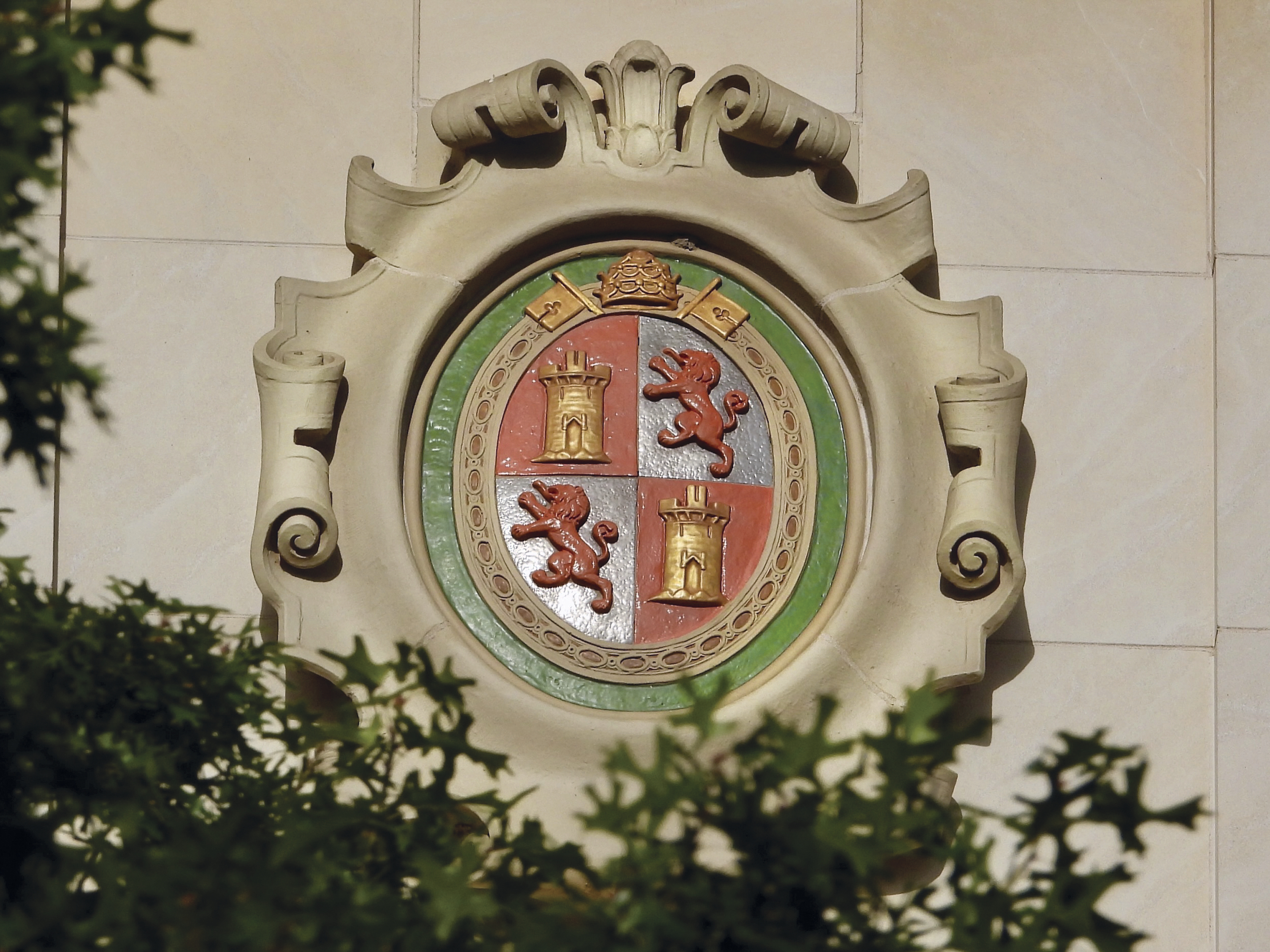
Below the eaves of the east and west sides of the building are mounted seals of 12 other universities deemed relevant precursors of UT. Professor Frederick Eby, BBA ’32, then the campus authority on the history of higher education, provided Battle a list of 15 candidates, and the two trimmed the list to a dozen: Bologna, Paris, Oxford, Salamanca, Cambridge, Heidelberg, Mexico (the first university in North America, 1553), Edinburgh, Harvard (the first university in what would become the United States, 1636), Virginia (the first public university in the United States, 1819), Michigan (which Eby claimed had the greatest influence on state universities), and Vassar (representative of women’s education).
Fittingly for a library, the names of 14 authors adorn the outside of the building, from Aristotle to William Shakespeare to Mark Twain.
The quotations used in the Hall of Noble Words, inside what is now the Life Science Library, have an interesting origin. In 1933, Battle sent a letter to select members of the faculty and staff reading: “As a part of the decoration of the ceiling of the east reading room of the new library, the Building Committee contemplates the use of noble and inspiring utterances appropriate to the function of the room as an educational agency. The concrete beams offer long, broad surfaces well adapted for such a purpose … We might, with propriety, call the reading room The Hall of Noble Words … The Committee would be greatly pleased if you would suggest utterances that seem to you appropriate. Perhaps the thoughts expressed may occasionally find lodgment in the minds of users of the reading room.”
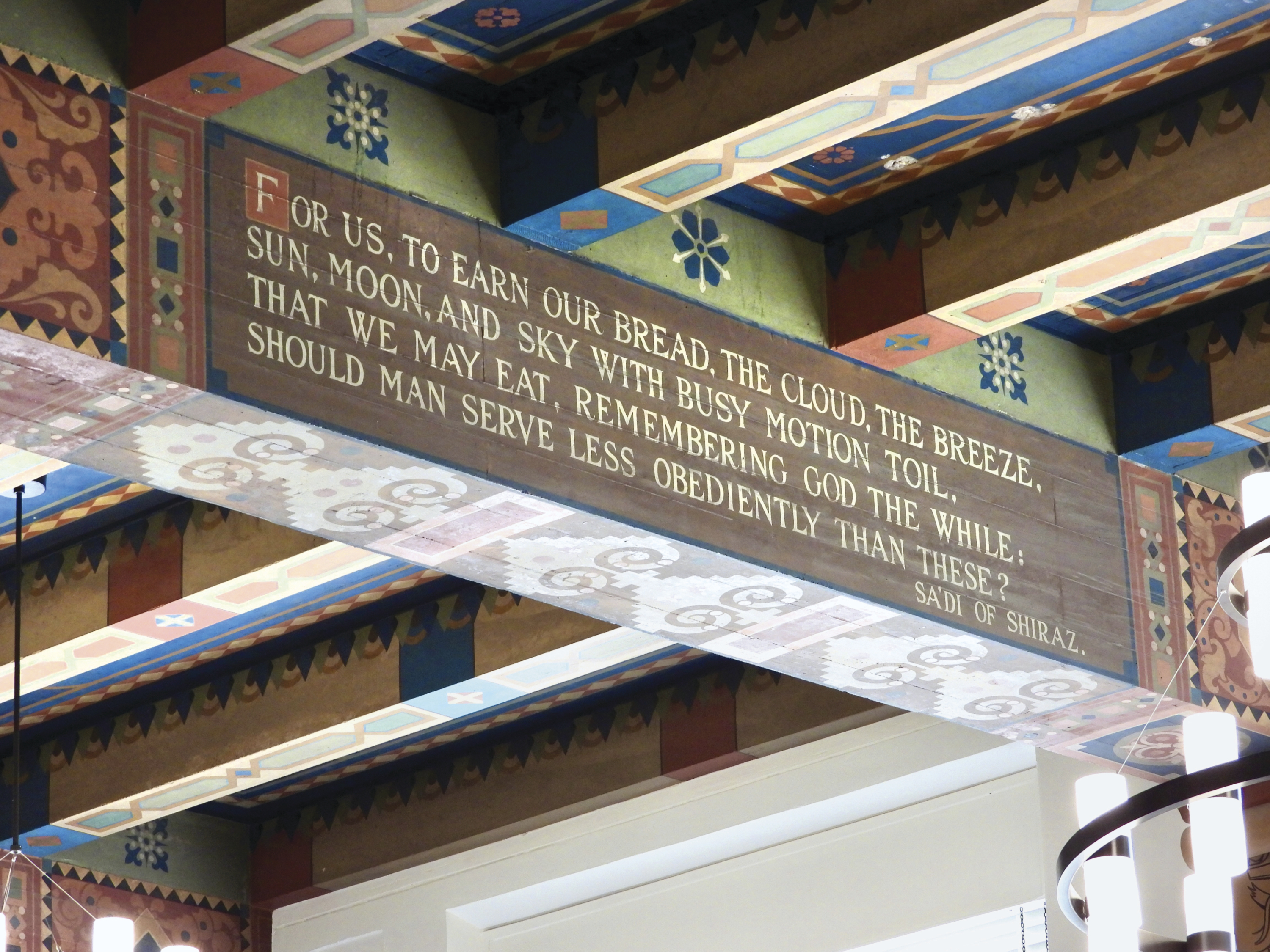
Among the thinkers quoted are Aristotle, Shakespeare, Roger Bacon, Blaise Pascal, Stephen F. Austin, and Mirabeau Lamar. Lines from Sa’di of Shiraz, Alfred Tennyson, Rudyard Kipling, and biblical scripture are found on the beams as well, even a passage from Alice in Wonderland (prefiguring UT’s acquisition of numerous Lewis Carroll papers in 1969). Architect Paul Cret was enthusiastic about the painted quotations and mused: “Do not be afraid of having the color scheme too high in key at first. It will become subdued with age—like all of us.”
Finally, there is that most famous inscription, which was chosen to adorn the front of the building. Not content to play second fiddle to the great thinkers of history, Battle originally simply wrote his own inscription: “The records of the past shall give light and courage to them that come after.” Committee members were not convinced by his attempt, so they asked math professor John Calhoun, BA ’05, to offer an alternative while preserving the spirit of Battle’s idea. Calhoun suggested “Ye shall know the truth, and the truth shall make you free,” a quote from Jesus recorded as John 8:32, which gained the necessary buy-in. Coincidentally, Calhoun became interim president in 1937, the year the building was completed.
In 1976, irreverent Student Government officers proposed the inscription be changed to “Money talks.” But the snarky, anti-establishment suggestion was unintentionally prophetic.
Money does talk. That is why the Board of Regents committed millions of dollars so that the Tower could once again say: Here we are. This is our Tower. This is the capitol building of Longhorn Nation. And capitol buildings are for the ages.
CREDIT: Avrel Seale