Looking Back on the History of the Tower
As UT embarks on the multi-year restoration project of the iconic tower, we look back at the history of the enduring symbol of the University.
1883 // The University of Texas officially opens in a ceremony on the grassy hill where the Tower now stands. UT’s eight professors and 221 students begin classes in the temporary Capitol, while its first building is constructed at the center of the University’s 40-acre site.
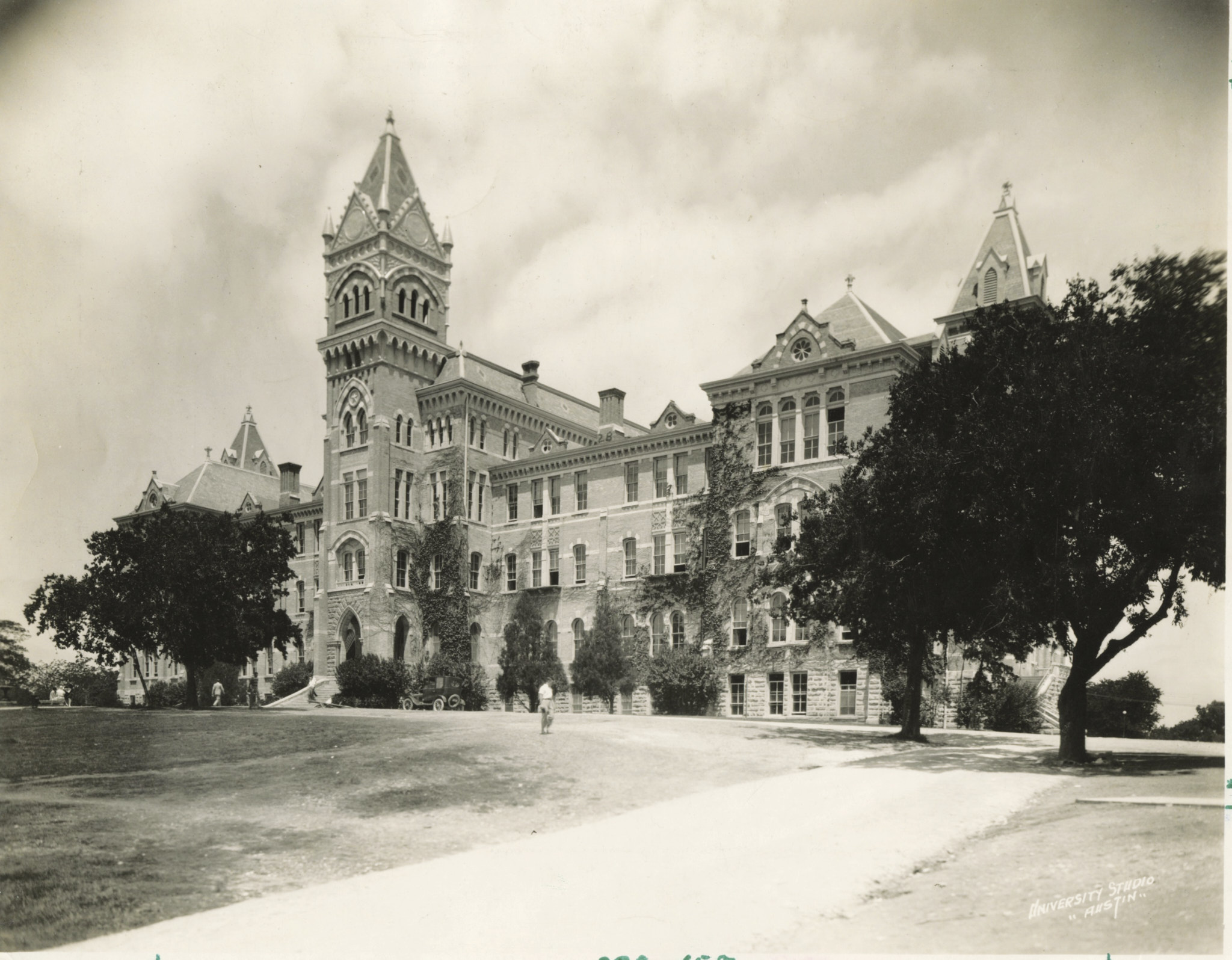
1899 // The Old Main Building is completed at the highest point of the Forty Acres. It houses the University’s classrooms, offices, library, auditorium, and gymnasium.
1911 // University Architect Cass Gilbert develops UT’s third master development plan, which introduces what will become the campus’s most defining features. His designs replace Old Main with a new building, University Hall—a tower at the center of four malls.
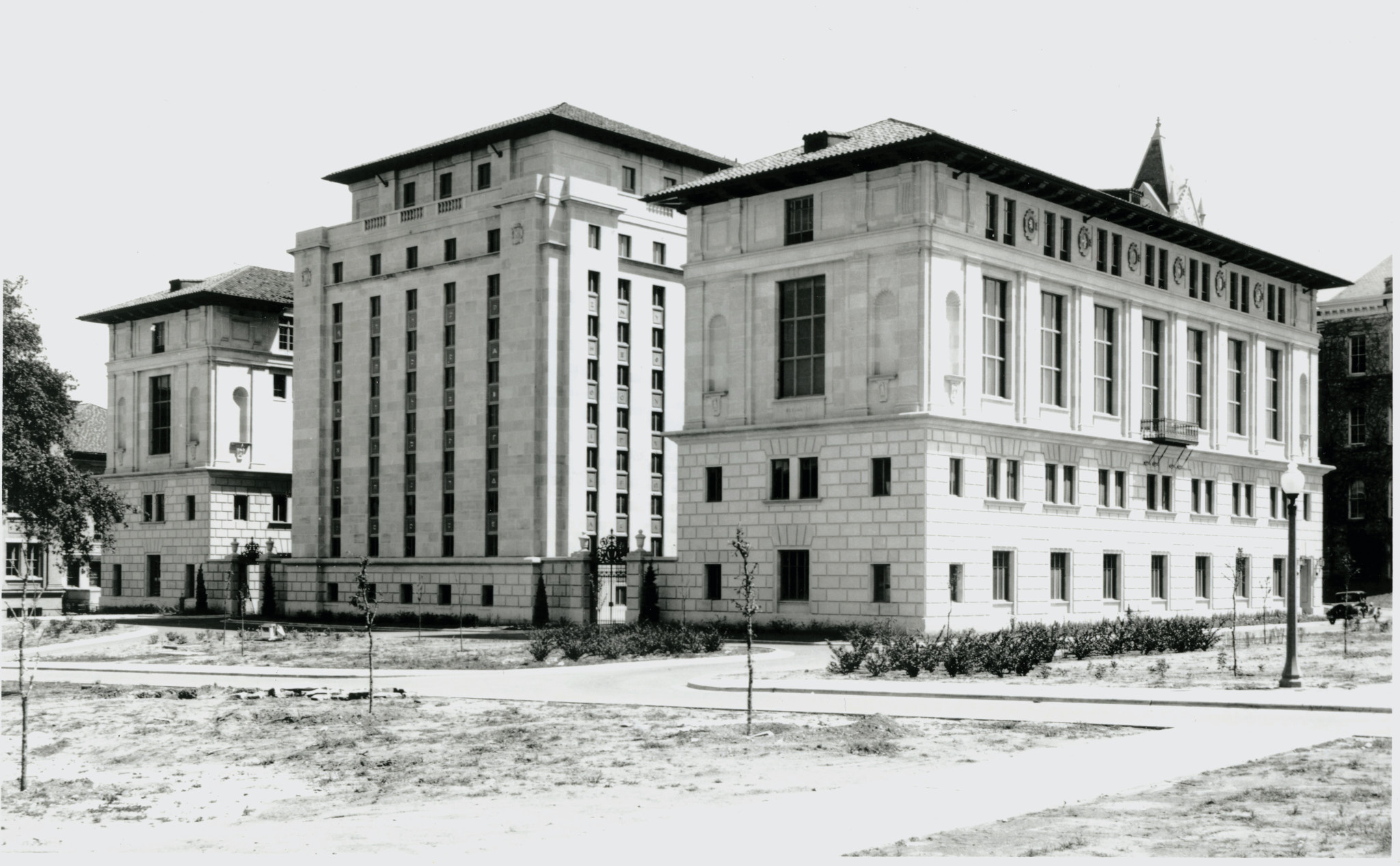
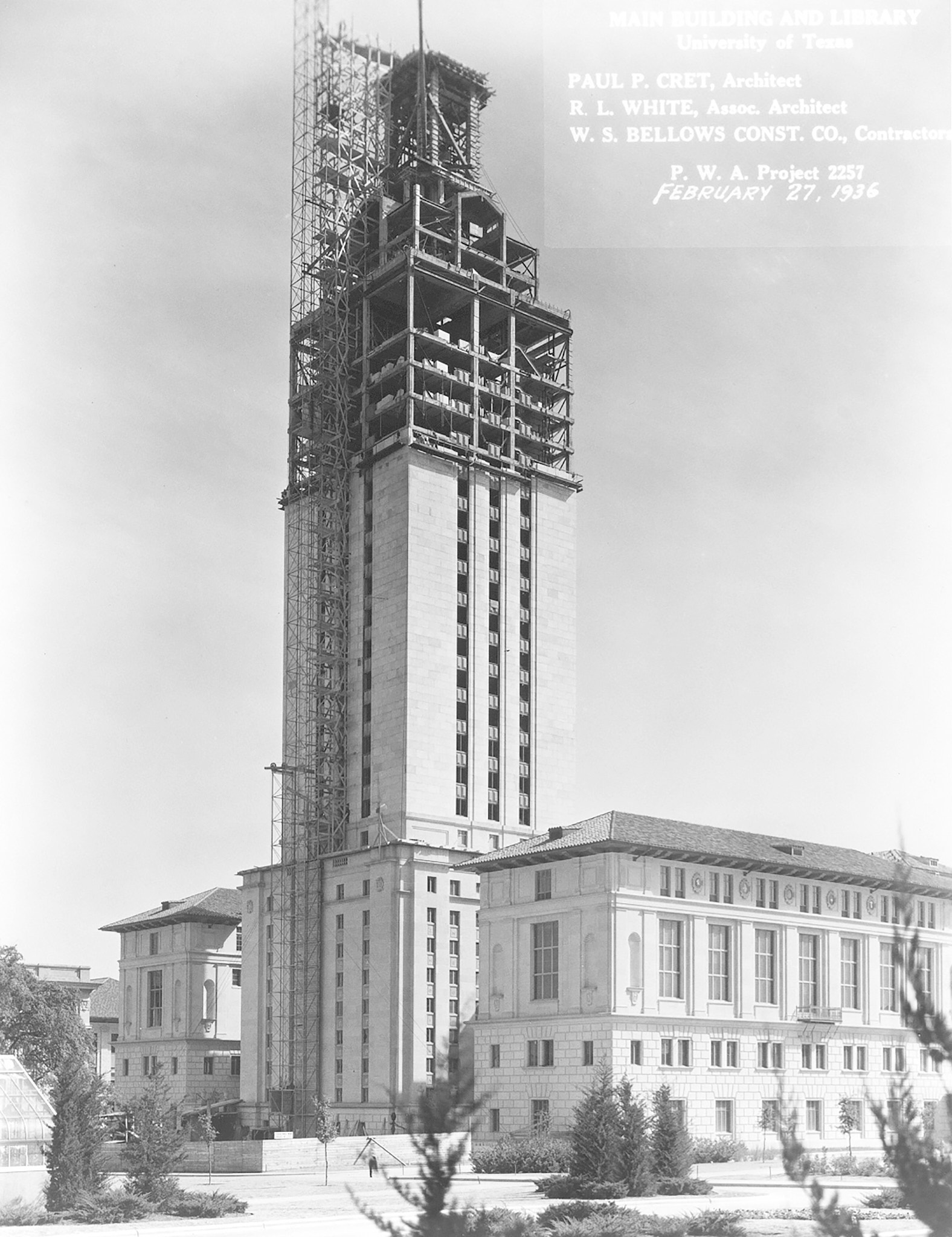
1933 // Consulting Architect Paul Phillippe Cret submits his own master development plan to the Board of Regents. Cret’s plan includes the Main Building, which replaces the demolished Old Main as a new campus centerpiece surrounded by Gilbert’s malls. Built in what Cret calls a “New Classicism” architectural style, the Main Building’s Tower becomes a counterpoint to the Texas Capitol and a defining symbol of the University.
1935 // The Tower’s monumental scale is matched by its bold design, iconic materials, and ornamental program celebrating knowledge and learning. Its walls are constructed of Indiana limestone, its red roof tiles are produced in Spain, and the marble for its grand stairway, steps, and floors is mined in West Texas, Tennessee, Missouri, New York, and Vermont. Doorways are framed in Austin shell stone, a locally quarried limestone, and Austin-made bricks from Old Main are reused for some inner walls. The rim and hands of the Tower clock are gilded with gold leaf, as are decorative letters from the Egyptian, Phoenician, Hebrew, Greek, and Latin alphabets.
1937 // The Main Building and Tower open. Constructed in two phases, the building houses University administration and the library, with grand reading rooms surrounding the library stacks in the Tower. On October 19, the Tower is officially illuminated for the first time, and the Austin American-Statesman reports that it can be seen from nearby Round Rock, Manor, and San Marcos.
1942 // The city of Austin is placed on a nighttime blackout shortly after the U.S. enters World War II in December 1941. From January 1942 until November 1943, the Tower is kept dark other than to celebrate spring Commencements and a football victory over Texas A&M on Thanksgiving Day 1942.
1947 // Carl J. Eckhardt, BS ’25, MS ’30, and a seven-member committee create UT’s first Tower lighting guidelines, which are in use to this day. An engineering professor and head of the University’s physical plant for 40 years, Eckhardt oversaw the first installation of the Tower’s exterior lighting in 1937 and created the University tradition of lighting the Tower to mark victories, celebrations, and other special occasions.
1962 // For the first time, the Tower’s windows are part of a lighting display. Eckhardt directs his crew to light the Tower orange and spell out “UT” with lit windows to celebrate Longhorn football’s first no-loss record in more than 40 years. UT wins its first national championship the following fall, and the Tower displays a “1” for the first time on New Year’s Day 1964.
1963 // Sharp increases in student enrollment and demand overwhelm the Main Building’s library, which eventually has a half-hour wait for books to be retrieved from closed stacks in the Tower. The University opens the Undergraduate Library, later known as the Peter T. Flawn Academic Center, and library facilities move out of the Main Building.
1966 // Tragedy strikes The University of Texas as a student begins shooting from the Tower’s observation deck, killing 15 and injuring 31 before being stopped by three police officers and the manager of the University Co-op. It is the deadliest mass shooting in U.S. history at the time.
1987 // The Kniker Carillon becomes the largest in Texas when 39 bells are added to the original 17 installed in the Tower belfry in 1936. Named for alumna Hedwig T. Kniker, BA ’16, MA ’17, the carillon provides UT’s daily soundtrack with chimes every 15 minutes and weekly concerts by the University’s Guild of Carillonneurs.
1995 // Fireworks at the Tower mark the end of the spring Commencement ceremony for the first time, and the tradition of lighting the graduation year in the windows begins.
1999 // At the recommendation of President Larry Faulkner, the Tower’s observation deck is reopened to visitors for the first time since 1974. The Tower Garden and UT’s first on-campus memorial to the victims of the Tower shooting are dedicated August 1, the 33rd anniversary of the tragedy.
2012 // The Tower celebrates its 75th anniversary and, for the first time, is lit to celebrate itself, with a “75” window display.
2013 // UT’s Biodiversity Center installs a nest box and live webcam for Tower Girl, a peregrine falcon who has made her nest at the top of the Tower since at least 2010. Thousands of Longhorns watch the livestream and follow Tower Girl’s Instagram for updates on her hunting and occasional egg-laying.
2022 // The UT System Board of Regents, led by Chairman Kevin Eltife, provides the $26 million lead investment to preserve and protect UT’s most celebrated landmark. The Our Tower campaign invites every Longhorn to join in the restoration, renovation and reimagining of the Tower for future generations.
2024 // The UT System Board of Regents approves a $70 million plan for a multiyear exterior restoration of the Tower, including stonework repairs, window refurbishing, historic gilding and clock face restoration, LED lighting updates, replacement of select roofs, and original metal and wood color matching. The project is expected to be completed in 2027.
CREDIT: Courtesy of The University of Texas