How Two Longhorns Built a Texas Burger Empire
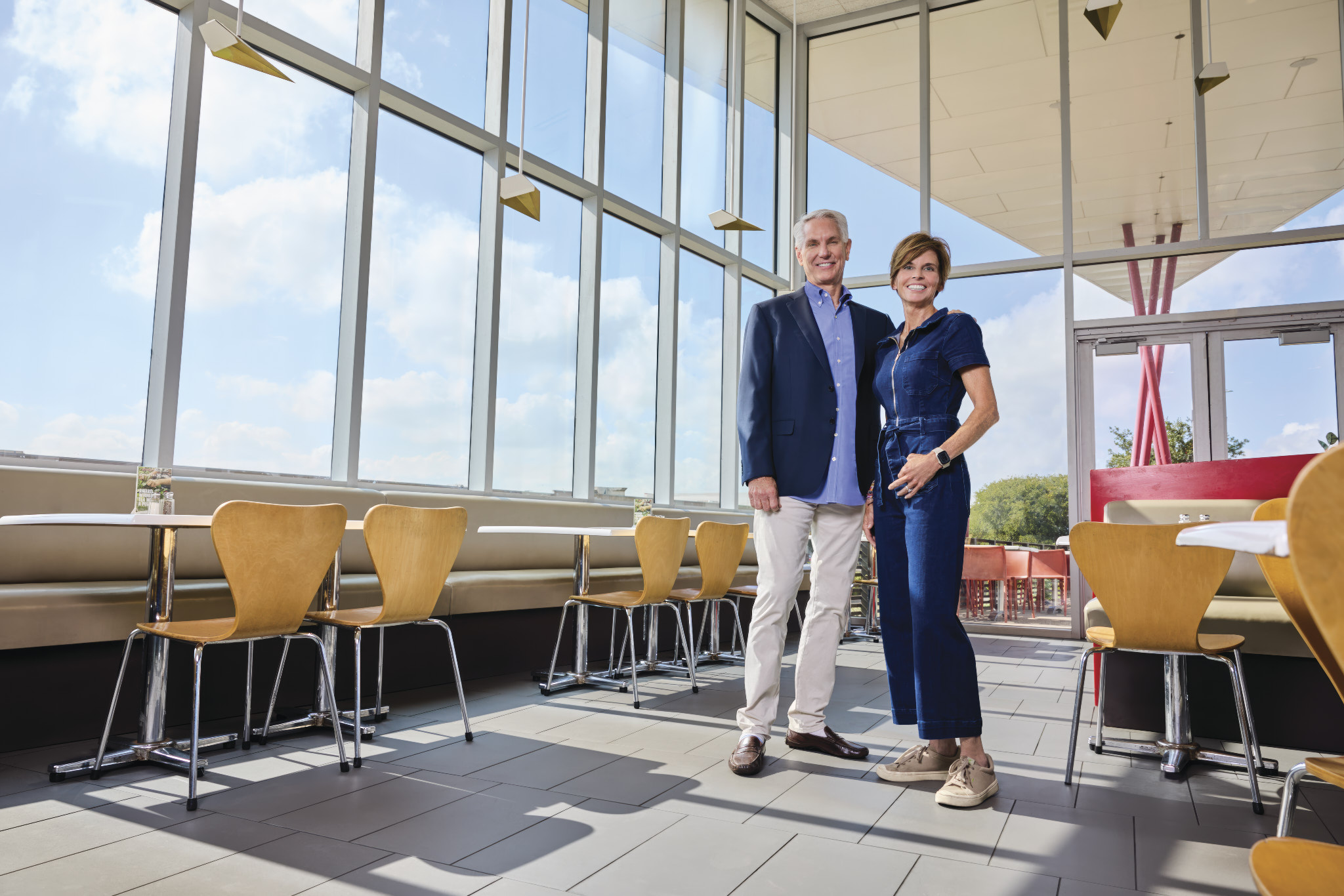
Maggie Garcia stood over the grill at P. Terry’s Burger Stand cooking eggs, bacon, and sausage to fulfill incoming orders of breakfast burgers. The Monday morning had barely begun, and nothing seemed out of the ordinary for the 46-year-old devoted employee, who joined P. Terry’s on the second day the fast-food joint opened its doors in 2005. That is, until Patrick and Kathy Terry, married co-founders of the beloved Austin burger chain, entered the restaurant with their teenage daughter and a handful of P. Terry’s executives, none of whom could hide their excitement for what was about to happen.
Patrick, BS ’80, ducked into the kitchen and brought Maggie out in front of the cash register before presenting her with a workplace service award for her two decades of dedication. “The truth is, there isn’t anything that we could give you that would express the gratitude we feel for you,” Patrick said in a short speech. “You have always represented what we want P. Terry’s to be, and you’ve done it by just being here and being yourself.” Visibly shocked and overcome by the moment, Maggie teared up and leaned into Kathy, BBA ’92, Life Member, who was dabbing her own eyes. In the Terrys’ final gesture of appreciation, they handed Maggie an envelope with a cash gift.
While the homespun ceremony lasted only a few minutes, it was a window into the company’s ethos. In an industry often associated with disposability, when it comes to making business decisions, the Terrys prioritize long-term relationships over short-term gains. With 37 locations across Texas and more than a thousand employees, P. Terry’s is not just a restaurant; rather, it is an ongoing experiment that proves prosperity and generosity aren’t mutually exclusive. The approach has quietly redefined what it means to succeed in the American fast-food industry. “They treat us like family,” Maggie told the Alcalde.
The foundation for the Terrys’ business practices can be traced back to their upbringings in West Texas, where scarcity, grit, and a reliance on your neighbors shaped people’s way of life. Growing up in Abilene, Patrick watched his father build the local CBS affiliate television station KTAB-TV from scratch. However, it was the visits with his parents to Mack Eplen’s Drivateria, a beloved hometown burger chain, that would make the most indelible impression on the future fast-food impresario.
Eplen, the restaurant’s namesake, was a local legend who ran nearly a dozen quaint eateries using fresh ingredients at affordable prices. He was a steady presence at his stores, and Patrick’s nostalgic attachment to the restaurant is owed in no small part to watching Eplen shake hands and pat the backs of his patrons. “Everybody knew Mack,” Patrick said. “To make yourself available to the customers gives you a connection that you don’t have without that.”
Kathy’s childhood in Midland was defined in many ways by the time she spent with her father at his industrial laundry business. On weekends, Kathy helped fold towels, wash uniforms, and keep his books. A divorced dad supporting four children, he briefly lived in the laundry building to make ends meet. After saving up to rent a small house, Kathy’s father would hire people in town who were struggling and let them use the shower. “My dad’s business was more than just a source of income. It became his community and gave his life purpose,” Kathy said during a TEDxUTAustin talk last year.
Years later, both Patrick and Kathy made their way to The University of Texas at Austin, though at different times. While working in the Texas Union food court, Patrick earned his advertising degree, which helped him understand branding and storytelling in a way that later fueled P. Terry’s distinct identity. One of his most influential experiences was taking Professor Tom Philpott’s American Experience class, a nine-hour credit course combining English, history, and government. Philpott’s impactful teaching style left a deep impression on Patrick and cemented his sense of what was “right and true and good,” he says.
Kathy’s path to the Forty Acres was less direct, since she transferred from Angelo State almost by accident. (A girlfriend urged her not to follow a boy to Texas A&M and make something of herself at UT.) When Kathy wasn’t in class, she was working at a law firm downtown, so she did not enjoy a traditional college experience attending parties and football games. But the tenacity she acquired putting herself through school, plus the accounting degree she earned at McCombs, gave her the skills to run P. Terry’s. “[Graduating from UT] validated me because I never had that validation growing up,” Kathy says.
After graduating, Patrick and Kathy finally crossed paths in a downtown gym and began dating. Patrick had recently sold a pizza restaurant and was dabbling in real estate, though he remained a restless dreamer with his heart set on fulfilling his childhood fantasy of owning a burger stand. Even after they married, Kathy didn’t take the idea seriously, until one day Patrick came home and said, “I got that location I’ve been wanting for my burger stand.” It didn’t take long for Patrick’s dream to become a shared purpose.
Patrick credits his West Texas roots with securing the property at the corner of Barton Springs and Lamar that would become P. Terry’s first location. Anne Williams, who owns the property, is also from West Texas. She recalls being impressed with the design of what Patrick wanted his restaurant to look like, which included sketches of futuristic, Jetsons-esque architecture.
“There are rules [about business] if you’re from West Texas that you know, and if you are not from West Texas, you don’t know,” Patrick says. He never discussed money with Williams, the number one West Texas rule. Instead, he focused on presenting Williams with a clear vision and passion for what he wanted to create. Despite competitive bids from established businesses such as Valero and Goodwill, Williams took a gamble and went with Patrick. “Sometimes it’s not all about the money. It is about who loves their project,” Williams says. “It’s like having a horse out at the ranch. You can look in their eyes and see how much heart they have. They may be your smallest filly, but she’s going to work harder than anybody else is.”
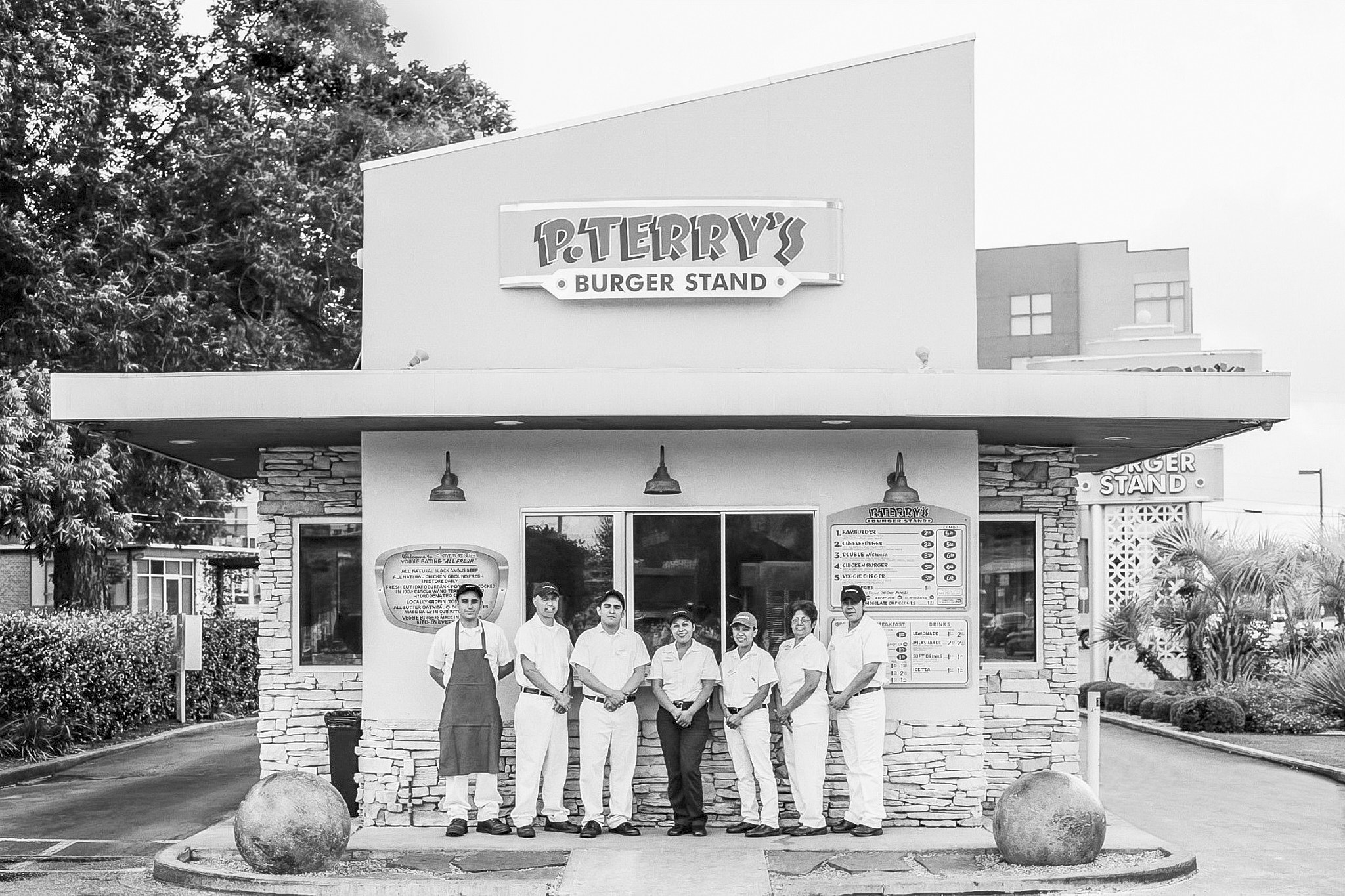
Coming up with a name became a challenge. Patrick and Kathy both agreed it needed to be short and catchy, but they could not agree on one. As they were leaving a party one night at the house of a friend who was also named Patrick, someone said, “Bye, P. Terry,” to distinguish him from the homeowner. Kathy lit up. “That’s the name,” she said. Patrick was reluctant, but he eventually came around. “I knew that it would tie me to [the business] in an emotional way that I didn’t know if I was prepared for,” Patrick says. “It’s been the best thing that’s ever happened. I mean being P. Terry is a pretty great thing.”
When it sunk in that this dream would become reality, Kathy realized they had an incredible opportunity. She had recently read Fast Food Nation, an investigative book by Eric Schlosser that exposed the low quality of food and poor treatment of workers in the fast-food industry. She gave the book to Patrick and told him, “If you’re going to do this, you should do it right.”
From the outset, Patrick, summoning his inner Mack Eplen, obsessed over serving the best ingredients at the lowest possible prices. He sourced hormone-free, vegetarian-fed, Black Angus beef—always fresh and never frozen. He insisted on using Idaho Burbank potatoes for their fries, despite the difficulty this particular variety of potato presents in harvesting and storage. To maintain the delicate starch to sugar ratio for optimal taste, P. Terry’s now employs a “french fry queen,” who meticulously tests the sugar levels of the potatoes every four days and then provides detailed instructions on how each store should prepare them.
Every detail the Terrys employ reinforces a positive customer experience. Real plants adorn the interiors, and the hand-painted signs add to the cozy, mom-and-pop ambience. “I like to think that we’re in the human connection business. We just happen to sell really good burgers,” Kathy says.
The first location opened on July 5, 2005, in a cramped, 527-square-foot building. Fewer than four years later, the Terrys opened up their second shop which offered indoor seating. As they expanded, Patrick and Kathy’s yin-yang dynamic helped shape their brand. Patrick used his experience in advertising to maintain the vision of the company, curating what the chain would look and feel like. He hired renowned Austin-based architect Michael Hsu, BArch ’93, to turn his original sketches of Googie architecture into a reality. Hsu’s iconic designs have come to define P. Terry’s restaurants ever since. Meanwhile, Kathy focused her talents on ensuring the operation ran smoothly. Perhaps most importantly, though, Kathy became the “conscience of the company,” as Patrick likes to say.
In the company’s early days, Kathy was working a shift when everyone kept wishing Rosario, one of the employees, a happy birthday. Embarrassed she didn’t know Rosario’s birthday, Kathy entered every staff member’s birthday into her calendar and personally baked and delivered them a cake to make sure they knew how appreciated they were. For nine years she did this, baking and delivering hundreds of cakes. Eventually, the company hired a full-time birthday cake baker, who to this day, is the only employee with a company car so that she can deliver the cakes.
The Terrys also instituted an interest-free loan program for their employees in case any worker needs financial aid to cover unexpected expenses. Kasey Hockenberry is one longtime employee who has taken advantage of this perk. In 2011, he was barely three months into his job as a crew member at P. Terry’s when a truck rear-ended him, and suddenly he didn’t have a vehicle to get to work. Patrick cut him a check to help put a down payment on a new car. “When things happen in my life, or if I need somebody to talk to, or whatever it is, Patrick always answers the phone,” said Hockenberry, who is now P. Terry’s vice president of operations.
Patrick and Kathy don’t just support their employees; they have made a deliberate effort to nurture the community that has embraced them. P. Terry’s quarterly tradition, “Giving Back Day,” has raised more than $2 million for Texas nonprofits since 2006—donating every penny of Saturday profits across all locations to local charities. The company’s philanthropic instinct extends further still with “Spirit Nights,” which direct a portion of sales to school organizations. And after tragedy struck close to home this year when floods devastated Central Texas, P. Terry’s donated all of its profits on July 10—$150,000 in total—to the Austin Disaster Relief Network.
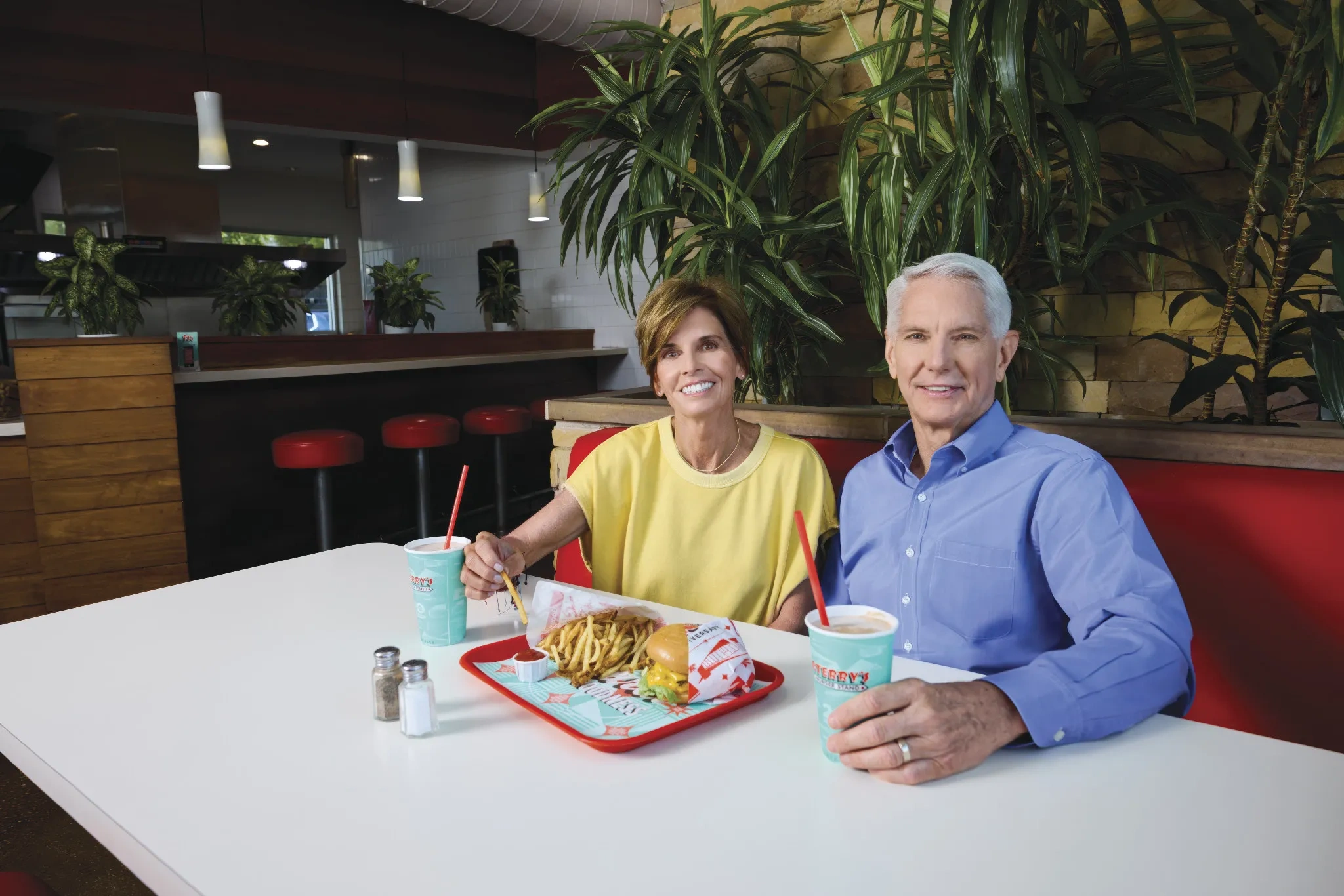
By 2016, P. Terry’s had grown into a beloved Austin institution. The Terrys contemplated a massive buyout offer, which Kathy jokes was enough to finance their own private island. Their excitement, however, was short-lived. On a plane ride, Kathy watched The Intern, the Robert De Niro film about a 70-year-old widower interning at a fashion website. Toward the end of the movie, his character tells Anne Hathaway’s character, “No one will ever care about your company the way you do.” The line stopped her cold. As soon as she deplaned, she called Patrick and told him she didn’t want to sell. If they did, quality would go down, prices would go up, and Patrick’s dream would vanish. “It would be profit over people, the people that we love,” Kathy said. A silence hung in the air before Patrick expressed his own relief. He’d been having second thoughts, too. Nearly a decade later, even as Texas fast-food giant Whataburger sold to a Chicago-based private equity firm in 2019, the Terrys have resisted selling or franchising and have been strategically expanding into other markets such as San Antonio and Houston.
For its 20th anniversary this summer, the Terrys visited their original location for a special event. Guests received free T-shirts, but the real draw was the opportunity to meet Patrick in person. Despite heavy rain, fans lined the block well before the event began. For more than three hours, Patrick spoke with every guest in line, signing shirts, posing for photos, and listening to countless stories of what the restaurant has meant to people over the years. True to his humility, Patrick reminded guests that their appreciation should be directed toward the entire team, emphasizing that without the daily dedication of the crew, there would be no reason for anyone to stand in the rain to meet P. Terry.
CREDITS: Knoxy Knox, P. Terry's
*Want to learn more, listen to Patrick and Kathy Terry on the Hello Longhorn podcast.
CREDIT: Knoxy Knox