The Making of a President
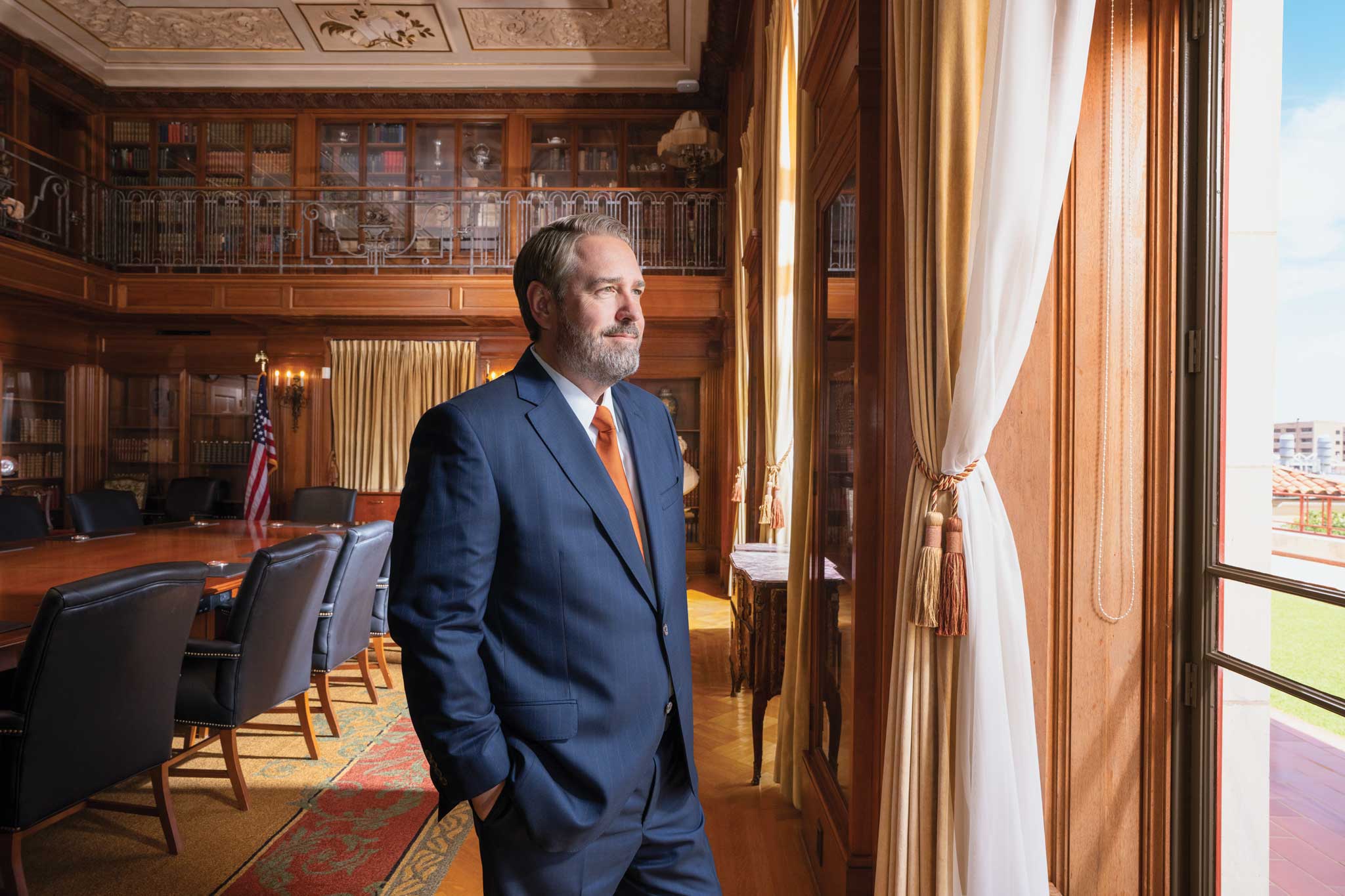
On July 21, 2025, the UT System Board of Regents voted unanimously to name Jim Davis as sole finalist to become the 31st president of The University of Texas. In the announcement, Chairman Kevin Eltife, BBA ’81, Life Member, said: “His understanding of almost every facet of UT Austin’s opportunities and challenges is remarkable, and his versatility in being able to navigate them, all the way from conception to successful execution, has served UT very well.”
Davis, BA ’96, Life Member, is no outsider. In fact, he has a burnt-orange background that few people can claim. At the age of four, his father became chair of the University’s Radio, Television, and Film department and he went on to earn his undergraduate degree at UT in history. In 2018, he returned to his alma mater and served as Senior Vice President and Chief Operating Officer and Vice President for Legal Affairs and Business Strategies. For years he has been known as the dependable strategist behind the scenes—leading some of UT’s most ambitious projects to fruition. Now, he is poised to lead the institution that has in many ways defined the course of his life. In late July, the Alcalde sat down with the Interim President to get a sense of where he’s coming from and where he and The University of Texas are headed next.
What’s your earliest memory of the University?
My first memory is of the Mustang Statue at what is now the Texas Science & Natural History Museum. I was four, my family had just come to Austin, and we went to see the dinosaurs. We went up that grassy hill, and I just remember the scale and the size of it. I don’t think I had seen a statue before, and it has that combination of movement, nobility, and scale that I’ve never forgotten.
You grew up here in the 1970s and ’80s, which was a very different city than it is today. What stands out in your memory about your childhood in Austin?
Austin in the ’70s was very artistic, very easy. You knew everyone in town, you knew everyone in your neighborhood. There is a member of the faculty here on campus who I met on my street when I was a child, and we’re still friends. I have friends from middle school and high school that teach here, too. And then, my family was on campus a lot, so I would go to film events with my father. There’d be a screening of something interesting at the Union, and I was just that tag-along kid.
Austin for me was Barton Springs, coming to campus, going to football games, and watching people like Earl Campbell. I was just a child, but he was already legendary at Barton Hills Elementary.
Why did you join the Navy?
The truth is I was not ready for college when I was 17. I was going to Austin High, and I was going to the Kappa Sig house because my brother was there in his victory lap year at UT. It was a ton of fun, but I wasn’t mature enough to manage school.
How did that experience change you?
I got sent to Scotland and was stationed with Royal Navy guys in their 30s—seriously salty sailors. I was the 18-year-old among these much older, working-class British guys, and it was a different kind of fun.
It sounds like they gave you an education.
That’s for sure, but most importantly during that time I also married my high school girlfriend, Teresa. She came overseas with me for the last two years, and the real credit for me turning it around should go to Teresa and her discipline. She was near the top of her high school class, and I was in the bottom of mine at Austin High. She chose to marry me when she graduated from high school instead of going to college. I absorbed her discipline and her drive more than anything else.
In the Navy, you became a cryptographer. That sounds kind of stealthy.
Well, in cryptology there are two parts. There is the code breaker, but that was not me. I was the code maker, the code keeper. My job was to maintain the secrecy of the Navy’s communications, but I was also enlisted, so it was very simple: Do what I was told. The thing I really learned in the Navy was attention to detail. Even the smallest tasks are critical in a big system. Do your job well every time; you never know when it’s going to matter.
After the Navy, you returned to Austin and enrolled at UT. Why were you drawn to study history?
History is still the subject I care about the most. It helps me understand the world better—why we are engaging in behavior or conflict or collaboration or solutions. It’s reflected in how humans have done that before. In every organization I’ve been in, history has informed how I make a decision. It also puts what feels like a difficult new crisis into a context that is easier to understand. It’s easier to believe we will get through it because we’ve gone through something like it before.
What was your life like back then?
I came to college on the GI Bill, and Teresa (BS ’96) came, too. We did all the normal things like going out to parties with your friends and joining clubs and groups, but I also needed a job, so I worked all the way through college. My first job was loading the sodas in the store at Jester Dormitory.
Was there a class that really stuck with you?
There are two that come to mind. The first was The History of Science with Dr. Bruce Hunt. He still teaches here. He taught us how progress is made incrementally, and then suddenly there’s a significant change—what he would describe as a paradigm shift. For example, going from Newton to Einstein changed our expectations of physics. That really helped me see that change is not always incremental. Sometimes, there are leaps.
The other class that I look back on with fondness and the most practical application is The History of The University of Texas at Austin. Dr. Lewis Gould taught this small seminar, and it was archive-based. We had to go into the UT archives and try to find original things to say, and, at the same time, we learned the well-
understood history of the University. That helps anchor me today in knowing when we’re confronting an idea that feels new. I might locate that in the past and find some continuity that would guide how to make a reasoned, thoughtful, and long-term decision.
What else do you remember about being a student?
I remember using the library and the adventure of that. You would find a book in the card catalog that’s on your topic, and then because of the way the books were organized, you would find a whole shelf, and it felt like discovery. I still crave that. I love the feeling of learning something new and discovering it on your own. That’s harder now in the modern world where we have access to quick and easy answers.
Yeah, a lot of mysteries in life are just too easily solved with a Google search.
I agree, and it’s about how knowledge sticks with you. There was a time when I had a biology class where I learned there are spores on the back of the leaves of ferns, and that’s how they reproduce. I left that class and walked to the Union to go to Wendy’s, and I ran across a fern plant. I turned the leaf over, and there they were. I don’t remember many details about that class, but I know how ferns reproduce.
You excelled both as an undergraduate and later at Harvard Law, earning both degrees with honors. What drove you back in those days?
I started to read the books I hadn’t bothered to read in high school. That created a drive to take that next step. The other thing that the Navy, and maybe just having more years in life will teach you, is how finite time is. I only had so many days available for me to experience UT Austin. And each day, therefore, mattered to me very much.
I want to skip forward a little bit. After law school, you clerked at the Supreme Court of Texas and then worked in private practice for 15 years. Then you returned to the public sector as a Deputy Attorney General for the State of Texas, where your role included advising state agencies like the UT System and UT Austin. Did that pique your interest in working for the University?
The role changed my thinking. At a law firm, you’re solving another person’s problems for money—it’s a fulfilling job, and I enjoyed it. But when I was a leader at the Attorney General’s office, as opposed to lawyering, I had to use a whole new skill set. Like every other process I go through, I understood the history of the Attorney General’s office. Why was it created? What is the function of that office for democracy in Texas? And, therefore, what was my duty? When I had that figured out, and it took some time, that helped me make quality decisions. The lawsuits that came through could have been almost on any topic. A few of them were for UT, and I always wanted to do my best for UT Austin. It’s my place, my home. But more than that, it was learning how to fulfill a role well when that role is a stewardship of the public trust. That was important to me when I took the next step to come to UT and started as general counsel. I asked myself the same kinds of questions. What is the role of the general counsel of the flagship public university in Texas? How do I steward and deliver that role well? It comes from a duty and a service perspective.
UT Austin really is a city within a city. Over the past seven years, you’ve been exposed to so much about the University. Is there anything you’ve learned that most alumni may not know?
There are a lot of quirks about UT Austin. When I first started, one of the lawyers told me this is probably the only place where you’re going to deal with ancient human remains, low-level nuclear waste, and road closures. There’s only one other place like that, and it’s the Attorney General’s office. So I felt well-suited for it.
The other thing that isn’t known to most people is that nearly everything you see or experience on this campus was intentional. These decisions were made over 140 years, and they don’t always coordinate well, but there was a choice, a policy, or a moment in time that someone wanted to celebrate or remember. It’s everywhere. Turn the corner, you’ll see a tree planted to celebrate the constitution. Turn another and you’ll see a cornerstone that includes the names of all the people on the construction team that built that building. Everywhere you go, you can find hidden treasure.
Given your knowledge of the history of the University, how do you describe the moment we’re in right now?
I go back to Dr. Hunt’s class on the history of science. I think we’re going through a paradigm shift regarding the role of higher education in the country. There is also a secondary question about the role of the flagship public university in Texas. That restatement of our identity is what I think we’re going through, and that correlates to how we manage other people’s funds—the federal government, for example—for research. What is the obligation of the University compared to the obligation of the federal government compared to the mission of research in the first place? It’s true also of how we review and manage our curriculum and how we onboard leaders.
So, Given that shift, do you have two or three areas where you hope to make your mark?
One that comes up frequently to me—and I hear it from others, too—is the role of artificial intelligence in the workforce and education. This shift in technology is occurring at the same time as we’re having shifts in our culture. The next generation will have a very different relationship with technology than we had in the past. So how do we preserve the fundamentals of humanity so they can be great citizens, workers, and leaders? How do we deliver humanities and arts exceptionally well in a technology-enabled world? If I could leave a mark, it would be to embrace technology and preserve the enduring human condition at the same time. That is an aspiration of mine.
Another thing is opening a new academic medical center—something we haven’t done before. We’ve been talking and planning how to build a hospital of the future. We have visions about the building being part of the care team, how the structure itself is so technology-enabled that it can improve the health and wellness of the people who come through it. That’s exciting. To do that and incorporate it into an existing academic setting is incredibly challenging. Bringing that on well, expanding our enterprise to include a clinical hospital system along with a top-tier research and academic enterprise, and finding the right balance of talent and resources—that would be another aspiration and, hopefully, a legacy for the next generation.
The last would be continuing our innovative research that improves human lives within a changing business model of where the funding is coming from. I think we’re well-positioned to be good partners with funders—whether it be the federal government, the state, corporations, donors, or foundations. We need to steward the funding well and grow our market share in a constricting environment for money.
On the research front, is this a matter of just changing the mix of funding sources to sustain the enterprise, or is it more complicated than that?
I think it starts with changing our expectations and attitude. We should remember we are stewards of other people’s money to deliver an important mission outcome that benefits the country and the state and creates a revenue source that will fuel more research. As opposed to being threatened by a change in what it costs to do the research. It’s fundamentally an attitude, an optimism, a business-focused approach to a changing market. I’ve talked to a lot of our alumni and supporters who asked about the research, and I’ve asked them if they’ve ever in their company had to go through a change in their customer base or a competitive threat or a shift in the financial markets, and they all have. This is no different. Approaching that logically, strategically, and with a forward, optimistic vision is how we will succeed and how we will thrive.
Your background is nontraditional for a university president. Given the changes facing higher ed you just described, will it be an asset?
I do think I bring a different set of experiences to questions that many universities haven’t faced in a long time. I’m still that same kid that turns over the leaf and looks at the back. I’m still as curious as I’ve ever been, and I don’t come burdened with pre-set expectations that it must be a certain way. I’ve been around this place for a long time. I have a strong sense of how it operates and where its strengths and weaknesses are. This is a place that I truly love, and my commitment to it being special and great is unlimited.
Since becoming interim president in February, what’s one thing you learned or experienced that made you stop and say, “Wow”?
The one I reflect on most frequently is the complexity of the humanity of the place. I understood it before, kind of intellectually, that this place is full of sometimes conflicting values or splintered visions and missions, and I recognized before that we’re supposed to be that way. We are a multitude of ideas as opposed to a single topic. This is a place where Farrah Fawcett and Janis Joplin were students at the same time.
For the past six months, I’ve met hundreds and hundreds of students, hundreds of members of the faculty, families, alumni, supporters, and politicians who each have their own perspective on what we are and what we should be. Experiencing that multitude is awe-inspiring. I don’t know if it’s possible to understand or experience that without sitting in this chair. I ask students their thoughts or their reactions to the issues of the day. I also host a faculty breakfast every Friday and ask each person: “Why did you come to UT?” The stories they tell are just fantastic and completely different. Some are here because of the amazing students we have, or the lab space was just perfect for their work, or because there was another department down the street that really mattered to them that made their work even more special. There are a thousand reasons why people have come here, and they’re all good. Steeping yourself in the complexity of this place—that is a once-in-a-lifetime experience.
What have you learned about today’s UT students?
They are incredibly committed. They are committed to success, to learning, to excellence—and they have very high expectations of the rest of us for how we deliver that educational experience. Their level of achievement and their raw ability drives our University to be stronger. That feels different than when I was in school here.
Is there anything you’ve learned about the University in all your time here that you want to make sure alumni know?
I’d like them to know that we have thrived at this University through a variety of challenges and huge opportunities. For generations, leaders have made bold choices, visionary choices, and that has set us up today to be an incredibly strong institution. That is the journey we’re on again, and still.
What does your family think about all this?
They’re all pretty excited because everyone in my family except for my sister is a Longhorn. She is an Aggie. My wife’s family is full of Longhorns, too. My mother is just overjoyed. She moved here with my father in 1974 and now gets to see me carry on the family tradition of working at the University. She also went here and got her degree in library science. And then, of course, Teresa and I are very proud of the ability that we have as a family to make a positive difference at the place we love so deeply. I also have a daughter who is a staff accountant at the University, and a son who is in his last year studying finance. It’s wonderful to have our roles here happening at one time.
If you were speaking to a prospective student, what would you tell them is most distinctive about UT Austin?
There’s no limit to what they can accomplish, and everything that they can imagine that they want to learn or experience is possible here. Sometimes you have to go find it; sometimes it’s right in front of you. But it is truly limitless.
And what does it mean to you to be a Longhorn?
Longhorns are bold, and we have a desire to see a better outcome—a better world. That makes us very optimistic. There’s also something about the friendship, the compassion, the kindness of Longhorns that matters. You can be from anywhere and come here, and you’re a Longhorn. You can leave and go anywhere else in the world, and you remain a Longhorn. It endures throughout your life.
This interview has been edited and condensed.
CREDITS: From top, Jeff Wilson, The University of Texas, Jeff Wilson