A Texas Ex Explores the Sun-Drenched Coasts of Portugal, Spain, and Morocco
By day, Paul Begala, BA ’83, JD ’90, Life Member, Distinguished Alumnus, is a writer, CNN political commentator, and professor at the University of Virginia. But on his days off, Begala and his wife, Diane, BA ’82, MBA, MPAff ’85, Life Member, love to travel with the Flying Longhorns. Ever the journalist, he documents the sights and events of each day and sends a log to his group as a parting souvenir. We thought it was too good not to publish in the Alcalde.
In 1981, I met a girl in the liberal arts lounge at UT. Four kids and 44 years later, Diane Friday Begala is a board member of the Texas Exes. One of the great joys of our Life Membership in the Exes has been the Flying Longhorns—an exuberant group of intrepid travelers who crisscross the globe, bringing the Gospel of Bevo to the world.
Diane was recently asked to lead a Flying Longhorns trip to Portugal, Morocco, and Spain. As her plus one, I carried her bags and took careful notes. This travelogue is a summary of those notes, but it can never capture the camaraderie, the laughter, or the esprit de corps of traveling Longhorns.
Sunday, April 27 // Arrival
Lisbon, Portugal
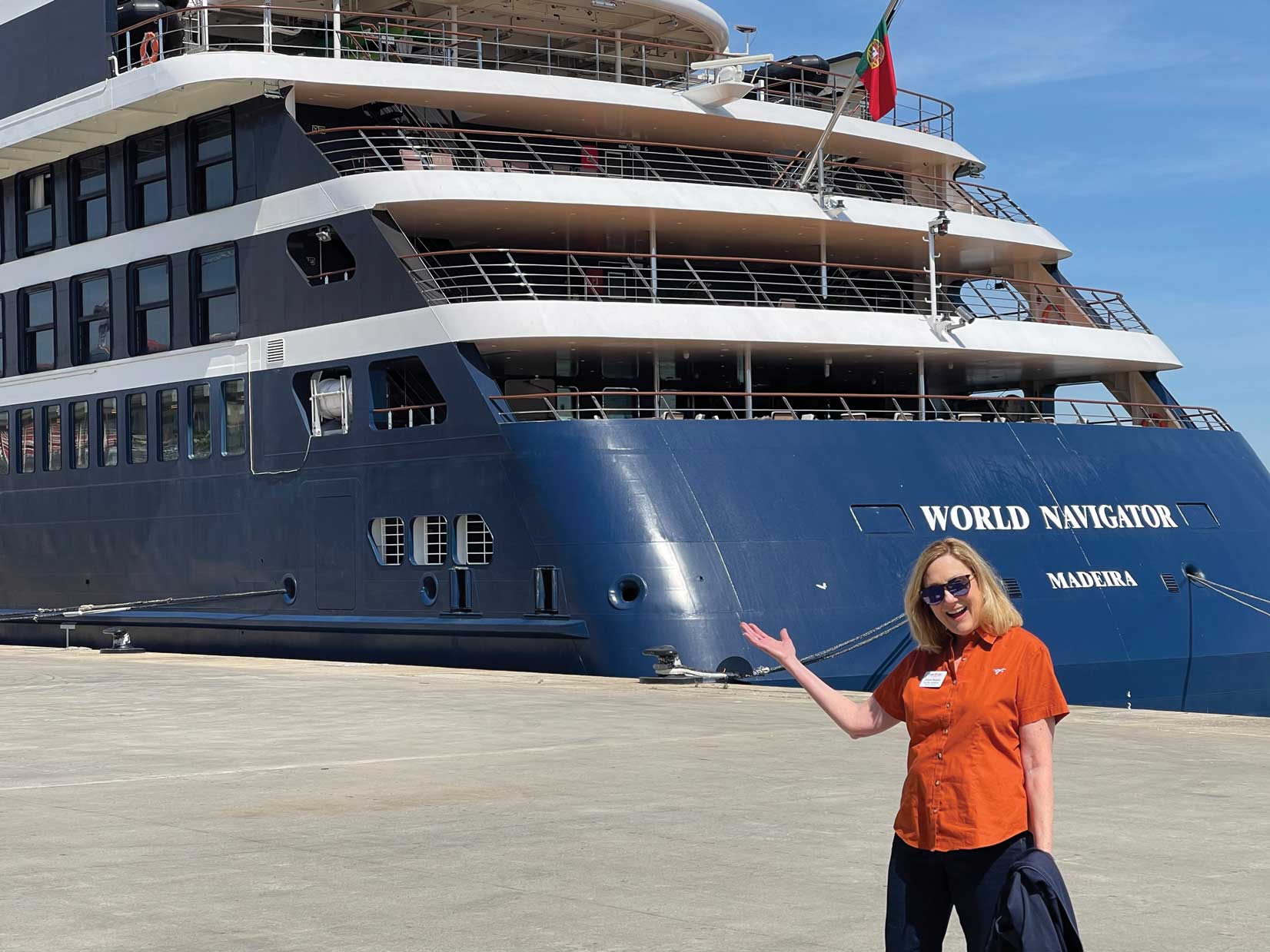
The World Navigator is more like a yacht than a cruise ship. At 413 feet long (126 meters for you fancy metric types) with eight decks, the Navigator would be dwarfed by a large cruise ship. The intimacy of a cruise in which the total number of passengers cannot exceed 200—with a staff of 117—gives one a feeling of elegance and comfort. The walls of the four-year-old ship are gleaming mahogany, and the black and white marble floors, the spa, sauna, hot tubs (two!), and swimming pool all make you feel like a mogul cruising St. Tropez.
Our group of 35 traveling Longhorns far exceeded those from Dartmouth, Tufts, and other schools whose football teams suck. We all hit it off immediately, living by the old adage that one never asks someone where they went to college. If they went to UT, they’ll tell you soon enough, and if they went anywhere else, why embarrass them?
The World Navigator set sail for Portimao early in the evening as we enjoyed our first meal together on board the ship. After watching the sun sizzle into the western sea, producing a spectacular burnt-orange sunset, we turned in early to prepare for our first day of touring.
Monday, April 28 // Tour Day One
Lagos, Portugal
Diane woke us up with a group text celebrating the Longhorn baseball team’s come-from-behind win to sweep the Aggies, so we began our first day of touring feeling justifiably jubilant. Our first stop was Portimao, a coastal resort town in the Algarve province of southern Portugal, where we boarded buses for Lagos.
We saw the cliffs that surround Lagos, or the Ponte da Piedade (the point of the Pieta), where the waves crash against the limestone cliffs, creating caves and arches and all manner of stunning formations. The coastline is blanketed with wildflowers, mostly daisies and some purple mallows. Lady Bird Johnson would have loved it.
We hung out in the town center, perusing cork shops (Portugal is the cork capital of the world), enjoying a bica (Portuguese espresso), and people-watching. A few of our travelers reported that the power was out in some of the local shops. We thought little of it since we were headed back to the ship anyway.
After reboarding, we learned that nearly all of Portugal and Spain had been plunged into darkness as power abruptly went out. As of this writing, no known cause has been established for the outage. Lucky for us, the Navigator has its own self-generated power, and we were able to enjoy electricity, hot food, and air conditioning while those on the Iberian Peninsula dealt with traffic jams, closed railway stations, cancelled flights, and darkened homes. We all felt very fortunate to set sail for Spain in comfort that night. Fitness tracker: 6,812 steps, 2.9 miles, 2 floors
Tuesday, April 29 // Tour Day Two
Seville, Spain
The Navigator cruised overnight, then turned up the Guadalquivir River to Seville. This was the same river which Columbus sailed down when he embarked for the New World in 1492. Unlike Columbus, our captain has a 10,000-ton vessel powered by two Rolls Royce 9,000 kW engines and two electrically driven 335kW Schottel SPJ 82 pump jets. Columbus had a couple of sheets and the hope he wouldn’t fall off the edge of the world.
We woke to learn that power had been restored to the mainland and that we could continue our ground adventures as planned. We began with a tour of the Cathedral of Seville. At the time of its completion in the 15th century, it was the largest cathedral in the world (but now trails St. Peter’s in Rome and St. Paul’s in London). It is still the largest Gothic cathedral in the world and our entire ship could fit within its walls.
Columbus is entombed here—well, part of him, anyway. He may have traveled more after his death than while alive. First, he was buried in Spain, then San Salvador in the Dominican Republic, then Cuba, then back to Seville. The tomb in Seville features four enormous stone guards, bearing a coffin. They represent the four kingdoms of Spain at the time: Castille, Leon, Aragon, and Navarre. The enormous coffin they carry contains about 100 grams of Columbus, or about the size of a stick of butter—the only remains that are, umm, remaining.
We next visited Alcazar Palace, or Real Alcazar. Although built by the Christians after they drove the Moors from Seville, the architecture and decor of the Alcazar Palace are in the Mudejar style, which honors the Muslim influence.
The gardens are breathtaking—with fruit trees, fragrant flowers, and a magnificent peacock, who screeched for food.Fans of the HBO series Game of Thrones will be pleased to note that several scenes were shot in the Alcazar Palace.
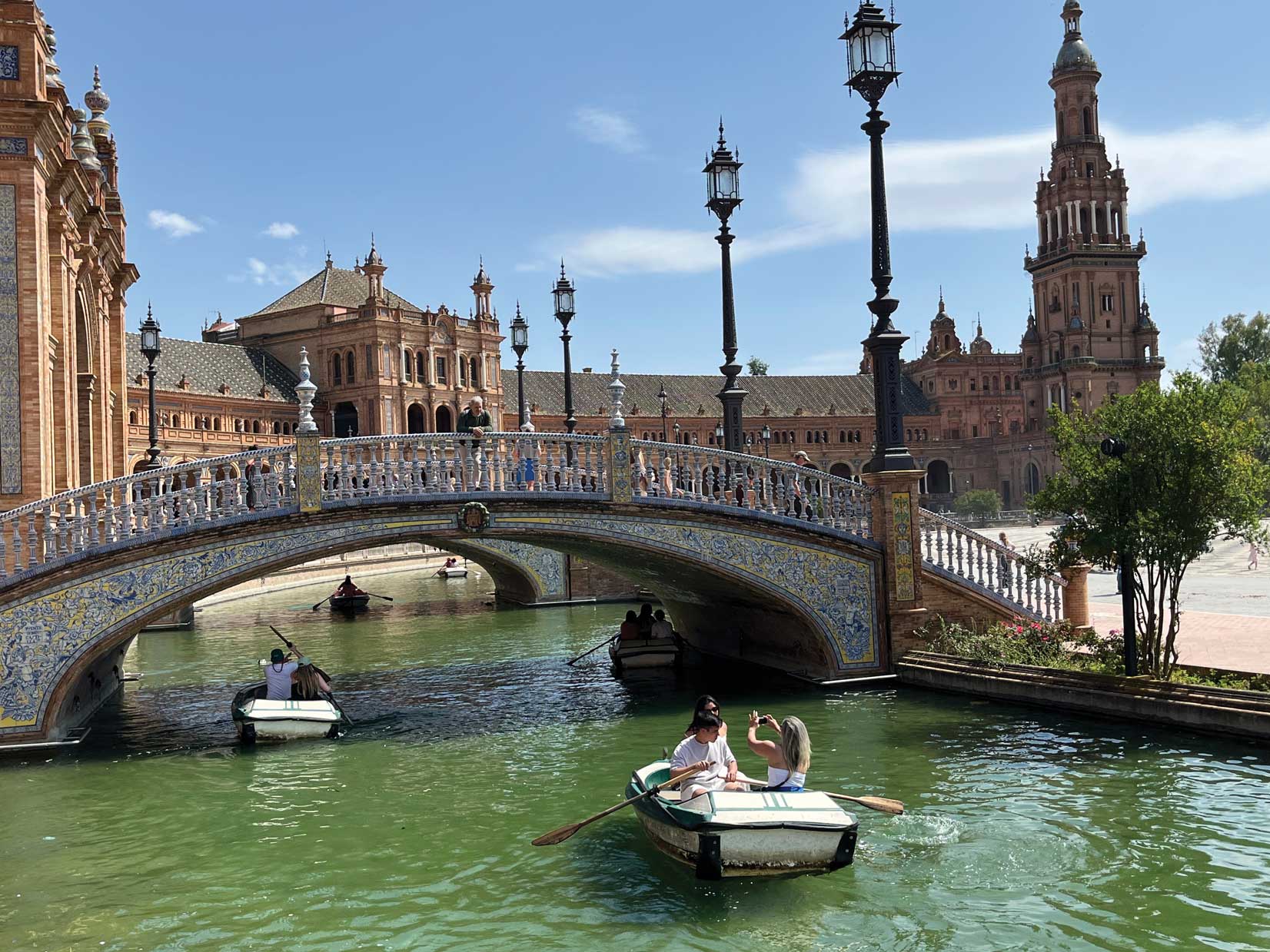
Our final stop was the Plaza de Espana. Built for the Iberio-American Exposition of 1929, it is a colossal semicircular set of structures that honors each of the 19 Spanish regions. The central plaza features an enormous fountain, whose wind-blown mist was much appreciated in the Andalusian sun. The Plaza de Espana has also been in many movies, including Lawrence of Arabia, and Star Wars: Episode II, Attack of the Clones. Fitness tracker: 9,391 steps, 4.1 miles, 6 floors
Wednesday, April 30 // Tour Day Three
Tangier, Morocco
The weather was drizzly, but our spirits were high as we set out for Tangier.
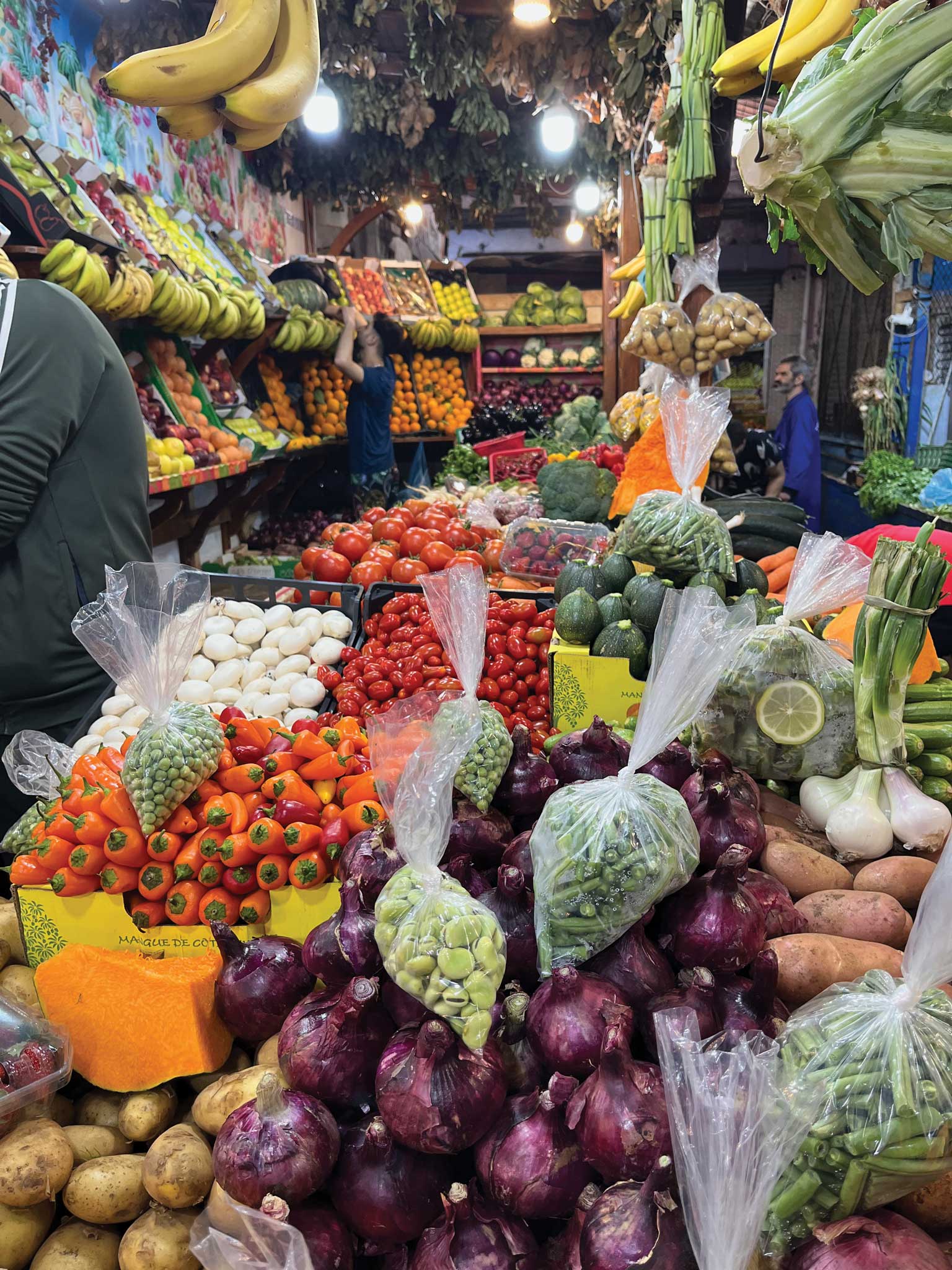
Tangier has always been an international city, with influences from all the countries that occupied her, from the Phoenicians to the Portuguese, Spanish, French, and British. As we entered the city, we saw some women in hijabs; others, in fashionable western ensembles. Head covering is optional. Track suits seem to be the preferred fashion choice for men.
Signs are in Arabic, English, and French. Islam, Catholicism, and Judaism are all practiced here, and tolerance is an important value. Indeed, Tangier’s artistic, eclectic vibe has inspired artists as varied as Paul Matisse, Paul Bowles, and the Rolling Stones.
The Medina of Tangier is in the market of the old city. We entered through the Bab de Kasbah gate. (There are five gates; Bab means “door.”). The walls of the Kasbah date from the 15th Century and are still standing strong.
We visited Mohammed, a rug maker who showed us a vast array of rugs and runners in every size. His rugs are hand-knotted and made from the wool of baby lambs’ necks. Uh huh.
It turns out that these rugs are waterproof, fireproof, pet-proof, and can survive a nuclear attack. The colors are gorgeous, the dyes are natural—not chemical—and the designs vary from geometric to a centered medallion to Navajo-style. Sadly, not even one featuring Bevo, but I guess you can’t have everything.
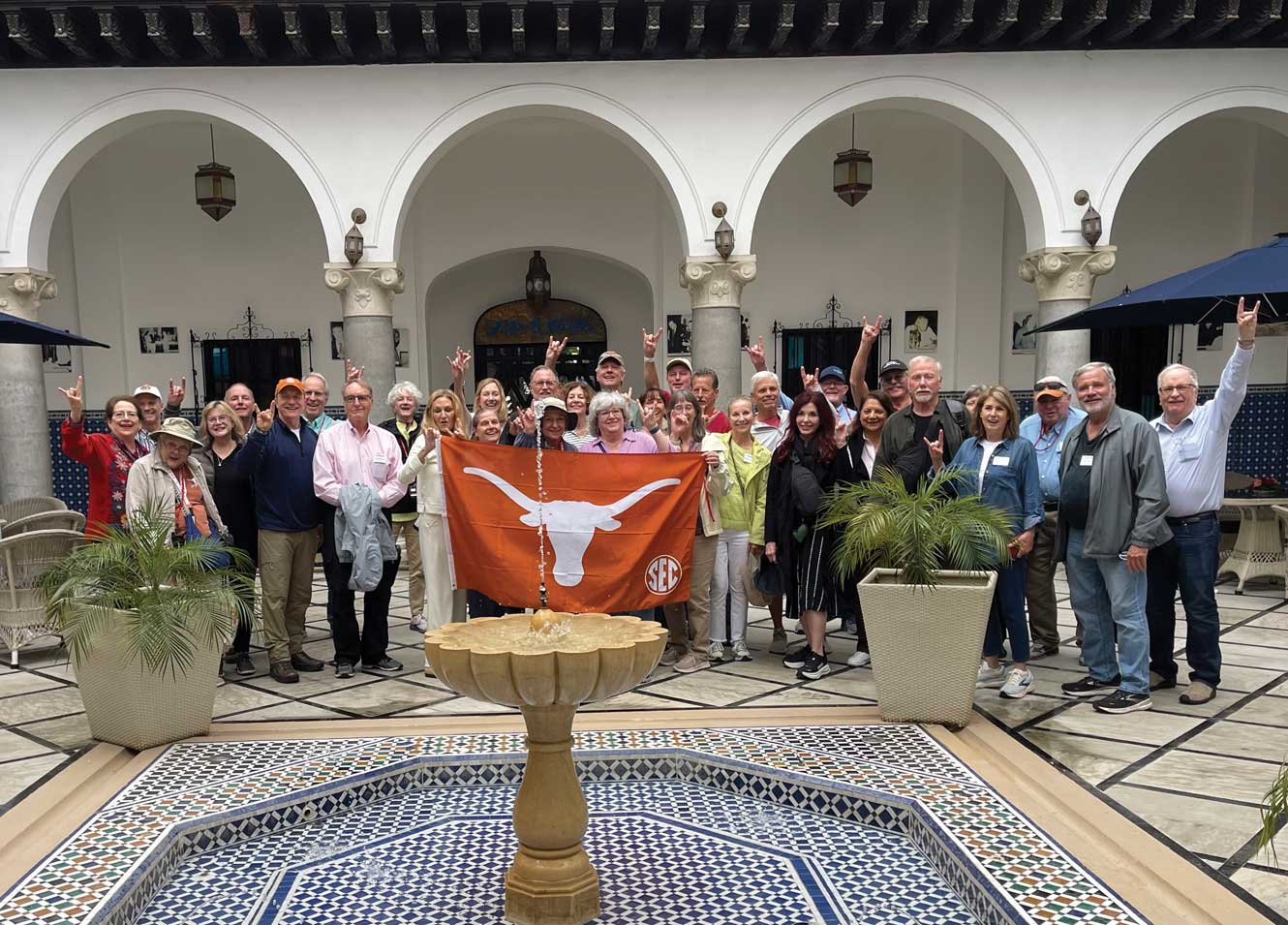
After lunch, we unfurled our Longhorn flag on a gorgeous Andalusian patio, smiled, threw our horns up, and made all the lesser mortals jealous.
Upon returning to the ship, Diane and the Texas Exes hosted a happy hour reception in which we threw more horns up, sang “The Eyes of Texas,” and watched as the prettiest college flag on earth flew over the coast of North Africa. Fitness tracker: 7,404 steps, 3.2 miles, 13 floors
Thursday, May 1 // Tour Day Four
Granada, Spain and the Alhambra
Malaga means “the queen,” and it is a beautiful port city, full of orange trees and jacarandas. Our bus took us on a two-hour drive through the Spanish countryside, over mountains and past farming communities.
After arriving in Granada, we had lunch next to the Alhambra at a hotel that was once a Franciscan convent. Then we toured the spectacular Generalife gardens, replete with aromatic trees, fruit flowers, and vegetables—all planted to feed the 2,000 people who lived here under the Moors.
We toured the Renaissance palace of Charles V, which he commissioned in 1527 for his wife (and cousin), Isabelle of Portugal. Charles’s grandparents, Ferdinand and Isabella, were also cousins.
Charles V’s palace is the only square palace in Spain, with a breathtaking circular, open-air colonnade in the middle: a circle inside a square.
Construction of the Alhambra began three centuries before Charles’s palace, in 1238 when ordered by Abdallah ibn al-Ahmar, who ruled as Mohammed I. Palace design elements feature stars, geometric patterns, and the Muslim expression, “the only conqueror is Allah,” which is painted or chiseled into the walls 5,000 times.
One of the double-arched windows in the main courtyard, our guide informed us, is one centimeter off center. This was done intentionally because the palace could not be perfect; only Allah is perfect. But the Alhambra is pretty dang close.
The sauna and massage rooms were upstairs. Musicians played for the Sultan, his wives, and his harem in the spa, baths, and saunas. It was quite an honor to be a musician at Alhambra, but there was a catch: The sultan hired only blind musicians so they would not ogle the women. Ray Charles and Stevie Wonder would have killed here.
For those of us with unimpaired vision, the Alhambra was a visual delight. What we perhaps had not expected was how the architectural genius of 13th-century Moors could keep us cool on a brilliantly sunny day. It was May 1, Labor Day in Europe, so the Alhambra was packed. Despite all those sweaty bodies, we remained cool and smelled only sweetness.
Well done, Abdallah. Fitness tracker: 9,098 steps, 3.6 miles, 8 floors
Friday, May 2 // Tour Day Five
Aboard The Navigator
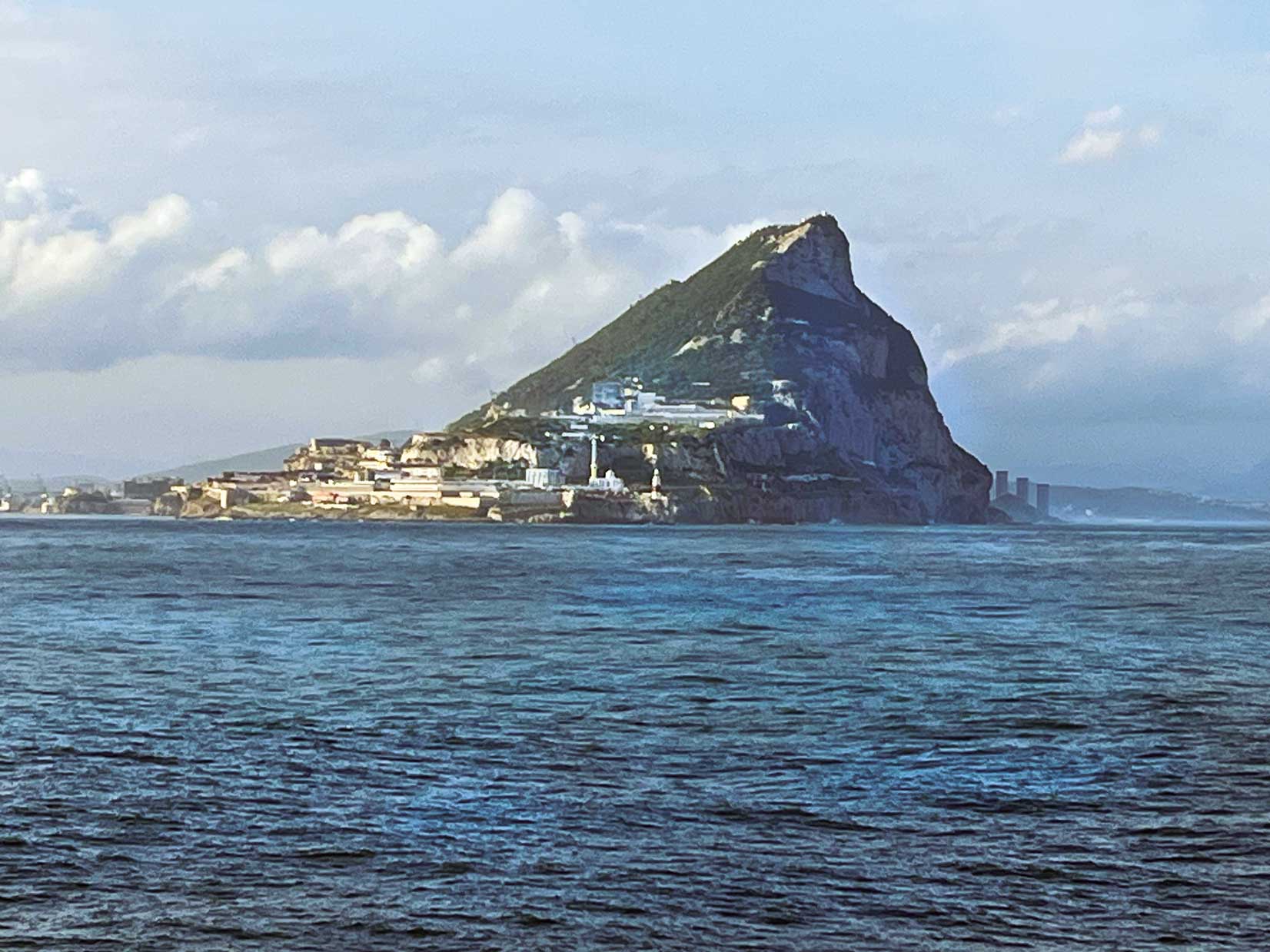
We sailed all day on the fifth day, and we were all glad to do it. This was a welcome day of rest after four days of constant activity. The evening featured a special treat: The World Navigator crew talent show. After dinner, we assembled in the Atlas Lounge over cocktails to watch crew members perform songs, dance numbers, and towel-folding tricks. Fitness tracker: 2,914 steps, 1.2 miles. Embarrassing.
Saturday, May 3 // Tour Day Six
Valencia, Spain
No long bus rides today. Thank goodness, because some people were suffering from the after-dinner cocktails they enjoyed during the previous night’s talent show. (Not naming names, but Diane is writing this part of the travelogue from memory.) Today we were divided into groups by our chosen activity: Most travelers took a historical and architectural walking tour, while a smaller group was treated to a paella cooking class.
Paella Valencia is typically made with a combination of rabbit and chicken. For this class, the paella was made with just chicken and typical vegetables. Those who took the class reported a great experience that involved enormous pans, fresh ingredients, and plentiful wine consumption while the paella simmered.
Those of us who took the architecture and history tour began at the Ciutat de les Arts i les Ciencies, the City of Sciences and Arts. The complex, built in the 1990s through the aughts, is an architectural marvel. Designed by Valencian architect Cala Trava, the buildings are stunning.
The science museum suggests the skeleton of a whale, with ribs sticking out and 40,000 square meters of display space inside. The Hemispheric IMAX theater suggests a human eye, as it is round with a retractable “eyelid.” The opera house looks like the helmet of a conquistador, and the Cultural Center building is blue-purple and suggests a whale—or a ship.
We viewed the Serranos Gate, built in the 1390s. The gate remains, even though the city wall was torn down nearly 500 years ago.
Then it was on to the Cathedral of Valencia. Its bell tower, called the Miguelete, houses an eight-ton bell and provides a vantage over the Mediterranean from which Valencians would sound the alarm if invaders were landing.
We arrived at the Cathedral as the doors were opening at 10:30 a.m., and as it was Saturday, there was already a long line, which we, as Flying Longhorns, were able to bypass. Lines are for Aggies.
Dedicated to the Assumption of Mary, the Cathedral is built on the site of a Visigoth church, which the Moors converted into a mosque. Then, in the 1270s the Christians built the Cathedral, which houses the chapel of the Holy Grail.
The agate cup dates from 2,000 years ago, and the faithful believe it to be the cup from which Jesus drank at the Last Supper. Light from an ancient stained-glass window above the altar of the chapel streamed through the incense-heavy air, giving the chapel an ethereal feel. After a moment, we were ushered out as children arrived to receive their First Communion.
The main altar is decorated in gold leaf Baroque, but the frescoes above the altar are Renaissance. They are striking, beautiful, and were lost for half a millennium. They had been covered by Baroque paintings for 500 years, only to be rediscovered in the 21st century. The colors are as vivid as the day they were painted.
We stopped in the shadow of St. Catherine’s for a Valencian specialty: horchata, a drink made from dried nuts and mixed with water and lots of sugar. It is very sweet and has a hint of coconut. We overheard one Longhorn tactfully comment that it is “an acquired taste.” You’ll get no argument here.
We toured Placa Redona, a circular plaza lined with stores, cafes, etc. Then into the Central Market; of course, the Spaniards call it Mercat Central. The market is lined with stalls selling Jamon Iberico, paella, fruits, and vegetables.
Near the market is La Lonja, the building where Valencia’s once-thriving silk market was housed. Inside the silk trading hall, 24 towering pillars of white (now grey) marble twist skyward from the granite floor to the vaulted ceiling. The pillars are meant to represent palm trees, an homage to the Moorish architects.
After our guided tour ended, of which this account is necessarily much abbreviated, folks explored this delightful city on their own, marveling at the religious coexisting with the scientific; the ancient next to the modern.
Then back to the ship for the captain’s farewell reception and dinner. Fitness tracker: 11,819 steps, 5.3 miles, 5 floors
Sunday, May 4 // Tour Day Seven
Tarragona and Barcelona, Spain
We bussed from the port city of Tarragona to Barcelona, only to encounter the time trials for the women’s Tour de Espana being held downtown. Streets were closed to car traffic but teeming with people. It was thrilling to stand behind the barricade and watch the women zoom by while the crowd cheered. (Oh, and the American team won.)
We saw one building by Antoni Gaudi: Casa Mila, with a facade of undulating sandstone, punctuated by wrought iron that seems to be windblown. Our guide, Carlos, attempted to show us another Gaudi building but was stymied by the barricaded streets. It’s probably very cool, and you should maybe Google it.
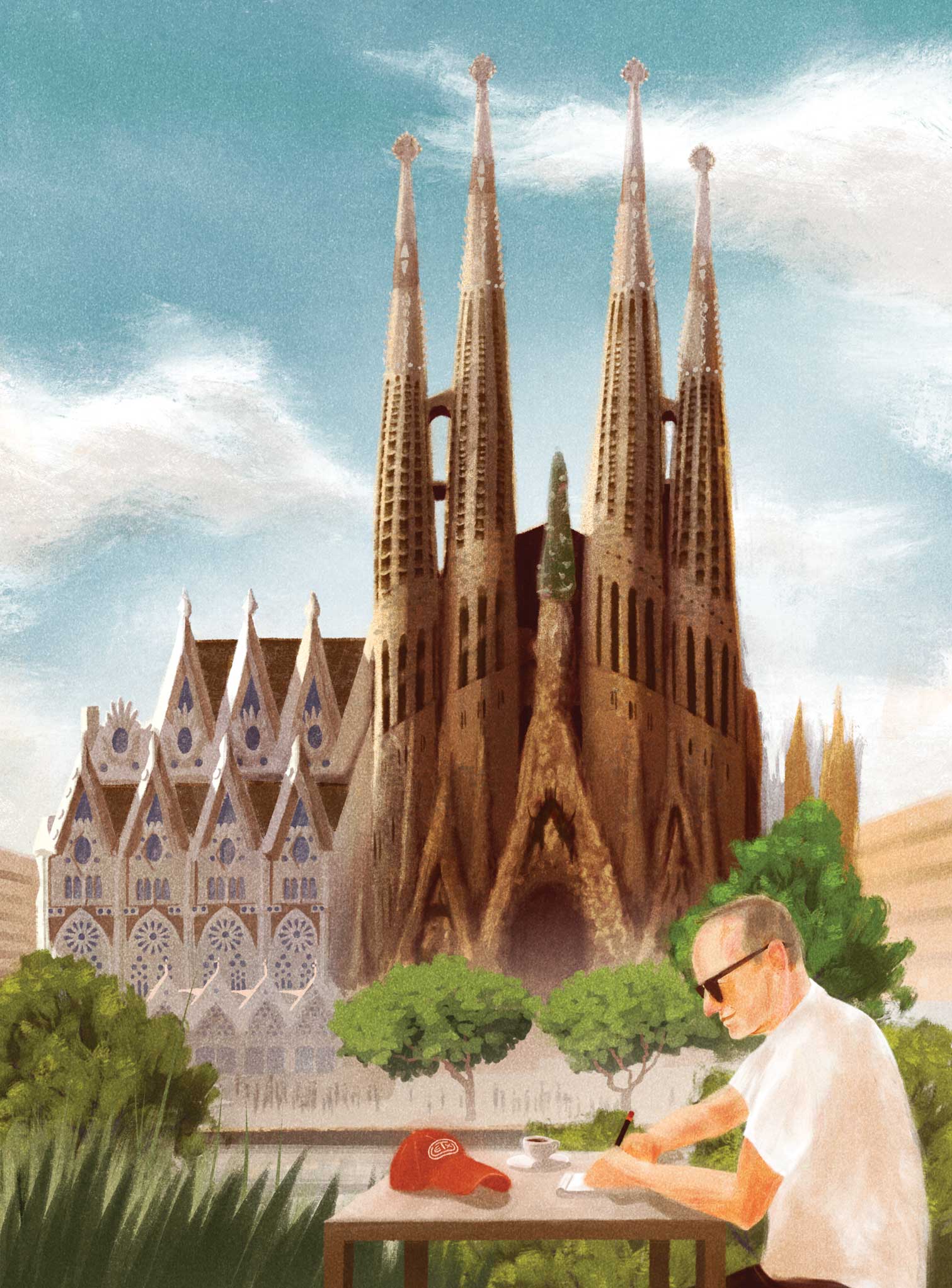
Then we made our way by bus and foot to the big attraction of the day: La Sagrada Familia, the church of the Holy Family. Antoni Gaudi, the principal architect, recently had his cause for sainthood advanced by Pope Francis just before his death. Gaudi’s creative genius is evident in every aspect of the church.
He worked on this project for 43 years, from 1883 until his death in 1926. Gaudi is entombed in the crypt, which was the first part of the cathedral to be completed. Today, after more than 130 years, the church is still under construction. We were able to view a model of the final design, which builders hope to achieve within the next ten years.
We entered through the facade that seems to drip with molten rock, as if the stones themselves were alive and afire. Gaudi chose the facade that depicts Christ’s early life to be constructed first, as it is more hopeful and optimistic than the western-facing facade, which depicts the Passion, death, and resurrection.
In 1982 Pope St. John Paul II said Mass here, as did Pope Benedict XVI in 2010. One suspects even the popes gasped the first time they entered the Sagrada Familia: There is brilliant light and white stone all around. The sensation is, literally, heavenly. The main altar, featuring a soaring Crucifix suspended from the ceiling, has an altar made of porphyry, a rare and precious stone from Iran.
The columns branch out at the ceiling like a tree. The stained-glass windows come alive when hit by the western sun. This was golden hour, and the cathedral filled with waves of luminous colors, including an orange of the burnt varietal.
We made our way back to the bus and took a long drive back to the port. Arriving late and feeling tired, we all had one last dinner aboard the Navigator and one last moonrise drink on the Mediterranean. Then we returned to our cabins and dutifully packed our bags to be ready for the 2 a.m. luggage call from the ship’s porters. Fitness tracker: 10,045 steps, 4.4 miles, 6 floors
Monday, May 5 // Departure
Barcelona
It was an early morning for everyone as we answered our staggered departure bells. Over to-go cups of coffee, we hugged, shared contact information, and exchanged parting words with one another. We are all hoping for the day when we may meet back up at a Longhorn football game, the Alumni Center, or, best of all, another future Flying Longhorns adventure. Bon voyage to all.
CREDITS: DIANE BEGALA