Three Distinguished Alumni Bring World-Class Art to Marble Falls
“I met a man who loves art as much as you do. Do you want to meet him?”
Jeanne Klein, BS ’67, Life Member, Distinguished Alumna, grew up in Amarillo with an appreciation for art, visiting museums and observing her parents’ own modest collection. But a semester of “nothing but art appreciation courses” at The University of Texas in the 1960s sparked a deeper passion.
When her friend offered to set her up with an art-loving acquaintance who lived in Houston, Jeanne was intrigued. She met her match in Michael “Mickey” Klein, BS ’58, JD ’68, Life Member, Distinguished Alumnus, who shared her interest in art from a young age. “I first went to a museum when I was 13 or 14 years old,” he says. “The Nelson-Atkins Museum of Art in Kansas City, Missouri. And it opened my eyes to the world.”
The serendipitous blind date resulted in a lifetime of love—for each other and for art.
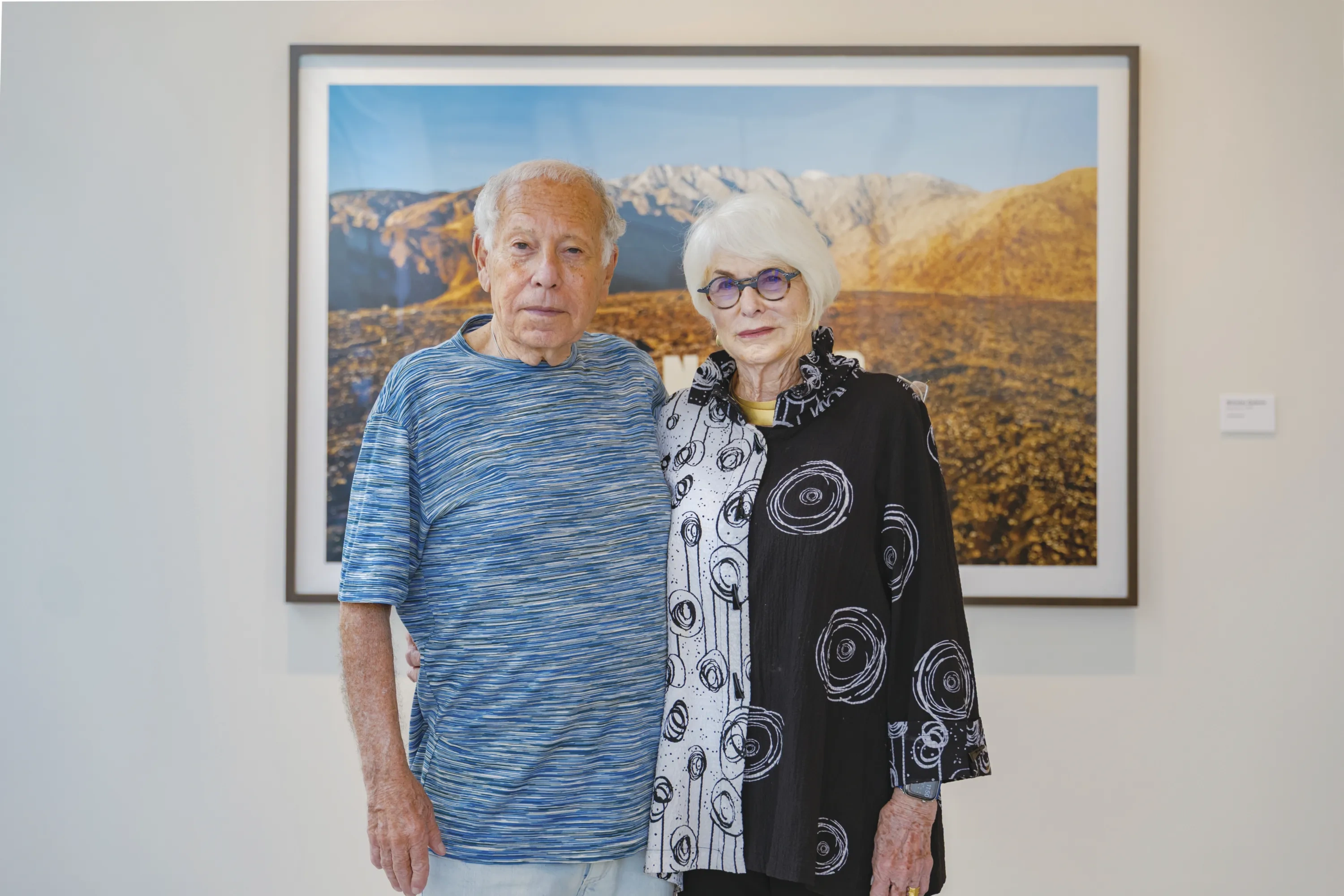
After their marriage in 1985, the couple embarked on half a century of collecting art fueled by Mickey’s lucrative career in oil and gas. Under the tutelage of famed Houston collectors Dominique and John de Menil, patrons of the stature of the Medici and Rockefellers, they traveled the world, developing a keen eye for contemporary art and amassing a multimedia collection that has garnered the Kleins a spot among ARTNews magazine’s list of top international collectors.
“We used to say early on that we only collect living art, but now that we’re so old, a lot of those artists we collected aren’t living anymore, so we can’t say that anymore,” Jeanne says with a chuckle.
“[We collect] the artists of our time,” Mickey offers, a collection which includes James Turrell, Do Ho Suh, Ed Ruscha, Jenny Holzer, Ann Hamilton, Nicholas Galanin, Agnes Martin, Ellsworth Kelly, Richard Serra, Donald Judd, Andy Goldsworthy, and Cindy Sherman, among other celebrated artists of the 20th and 21st centuries.
This year, following in the footsteps of their mentors, the Kleins are exhibiting their art to the public for the first time, transforming their celebrated collection into a cultural destination and bestowing upon the Hill Country the rare opportunity to see museum-caliber works of art in an intimate space for free.
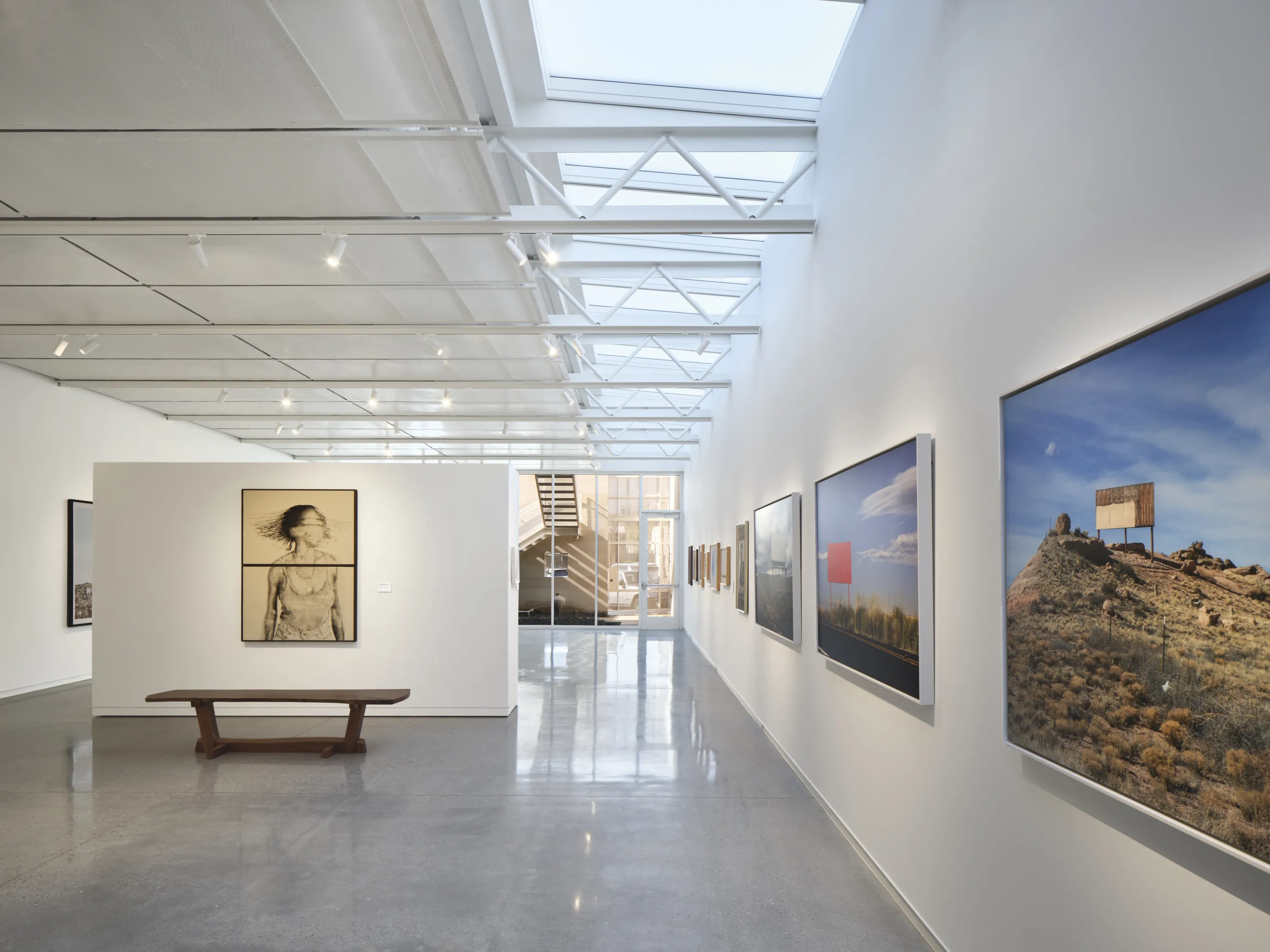
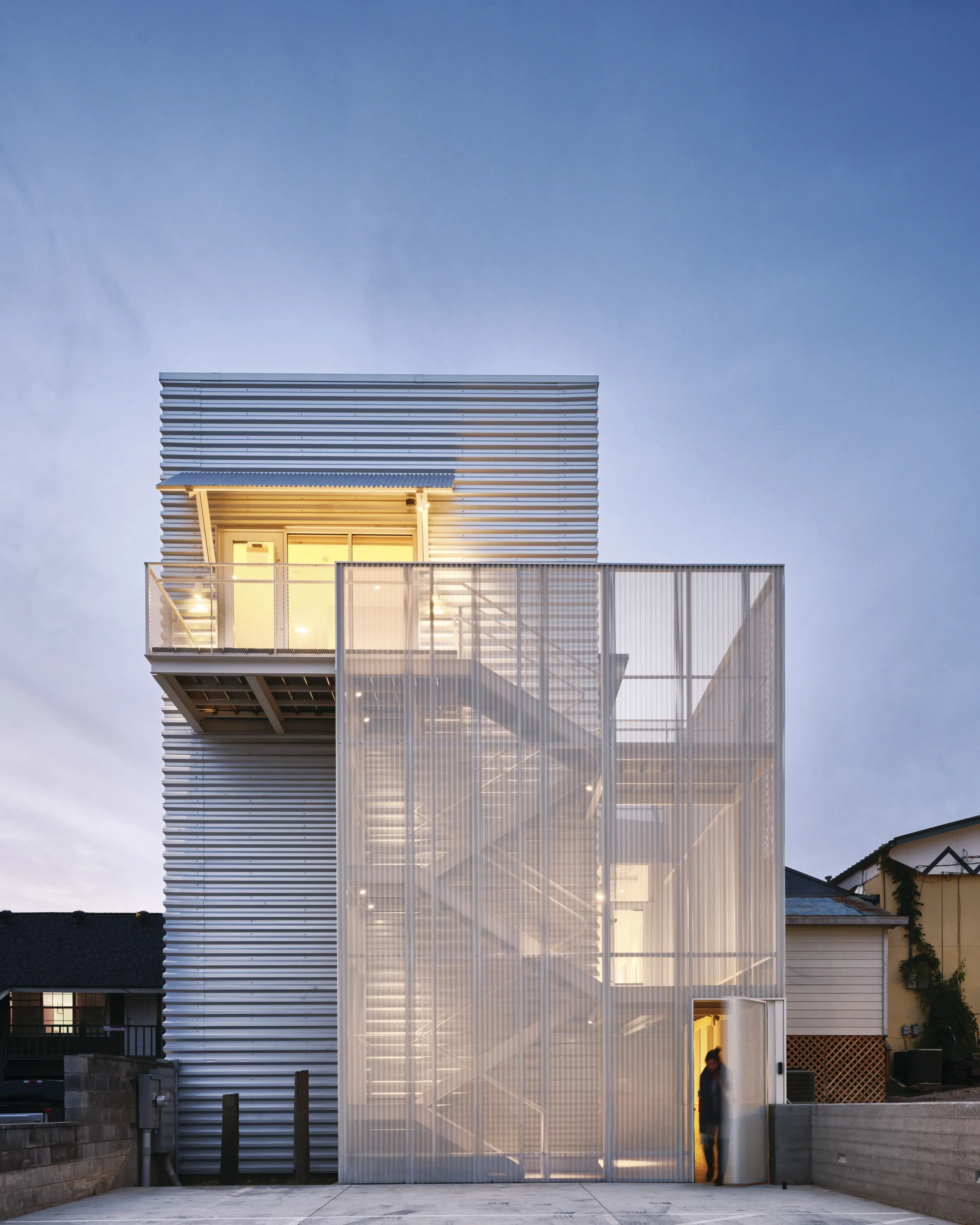
Designed by award-winning San Antonio– and Austin-based architecture firm Lake Flato, Arthouse doubles as both a functional office for Mickey’s ongoing business dealings and an exhibition space to display a rotating curation of the Kleins’ extensive personal collection. Officially opened on April 25, the understated, elegant building on Marble Falls’ historic downtown Main Street garnered national press.
The Kleins care less about generating buzz than giving Texans—particularly young ones—access to art that introduces them to new ideas and expands their understanding of the world. This capstone project to a lifetime of collecting world-class contemporary art intends to do just that.
Despite a desire to share their art, the Kleins did not have concrete plans to open an exhibit space until an office relocation set into motion what would become Arthouse.
After more than 40 years in Midland, Texas, two of Mickey’s longtime employees were ready for a new adventure. The Hill Country, with its plentiful lakes, rivers, and trees, seemed like an idyllic oasis, but it took time to work up the courage to ask if they could relocate the company office halfway across the state. But Mickey was happy to oblige. They settled on Marble Falls, only 58 miles from Austin, where the Kleins lived, with a population 20 times smaller than Midland.
At the prospect of a new office, Mickey and Jeanne sensed the opportunity for a project, to do what comes naturally for a pair of art collectors: Imbue a space with beauty and meaning. They turned to a longtime friend and the designer of their Austin lakeside residence, Ted Flato, Lake Flato co-founder with David Lake, BS ’77, Distinguished Alumnus. Like all Klein-directed designs, the office would showcase art, but for this project, they enlisted Flato to think bigger: What if they created a space that served a greater purpose and enriched the community of Marble Falls?
For a couple devoted to accessibility and service, the question resonated. Throughout their lives, they have championed both celebrated and lesser-known artists with equal passion and devoted significant resources to philanthropy, including financing the commission of “Stacked Waters,” the striking blue acrylic installation that spans the entrance of the Blanton Museum of Art. They support museums across the country, including the Whitney Museum of American Art in New York City; the Hirshhorn Museum in Washington, D.C.; the Museum of Fine Arts, Houston; Contemporary Arts Museum Houston; The Contemporary Austin; the Blanton; and SITE SANTA FE.
Mickey has served as chairman of the board of both The Contemporary Austin and Contemporary Arts Museum Houston, as a board member of the Hirshhorn Museum and the Chinati Foundation in Marfa, and as co-chair of the Whitney National Committee.
Their personal residences act as private galleries highlighting commissioned installations and rotating pieces of their remarkable collection, a testament to Jeanne’s belief that “the only way you can really get to know a piece of art is when you live with it, not when you buy it.”
“There’s a new piece of art that we just bought a few weeks ago,” she says. “Every time I pass it, I want to look at it really deeply because I think it’s going to be something I’m really going to love for a long time, but we’ll see. We’ve only had it hanging for two weeks.”
With art to share (“This wouldn’t be happening if we didn’t have a lot of art,” Jeanne says, to which Mickey interjects, “Too much art.”), the Marble Falls office relocation came at the right time for one last project with Flato and the chance to realize their mission of making art more accessible.
What makes the Kleins “marvelous collaborators,” Flato says, is their deep trust and reciprocal feedback. When they initially proposed a suburban, lakeside office space in 2022, he countered with a more urban location accessible by foot. They trusted his vision, and Flato set out to find a lot with a “very particular compass direction.”
“Art means natural light, and Texas means harsh natural light,” Flato says. “You cannot just use any light from Texas. You’ve got to use bounced light or north light, and then you’re worried about low-angled western sun and even low-angled eastern sun.”
On Main Street, he found an empty lot, “a missing tooth in the middle of urban Marble Falls,” flanked on one side by a post office building from 1910 protected as a Texas historical landmark and on the other by chiropractic and insurance offices. The infill lot was narrow but notably had the potential for perfect exhibition lighting.
Lake Flato senior associate Grace Boudewyns led the design, sensitive to the purpose of the space and the aesthetic of the neighboring buildings. The goal, Boudewyns says, was to develop a structure that felt like it had always belonged on the street, yet also invoked curiosity and a second glance from the passersby.
“We really believe in creating architecture that’s simple, elegant, and problem-solving,” Flato says. “If it had been aggressive and weird in a traditional main street, it would have done a disservice to the whole effort to make art accessible to many people. [The Kleins] believe that art can be transformative, and the more people who see it, the better the world will be.”
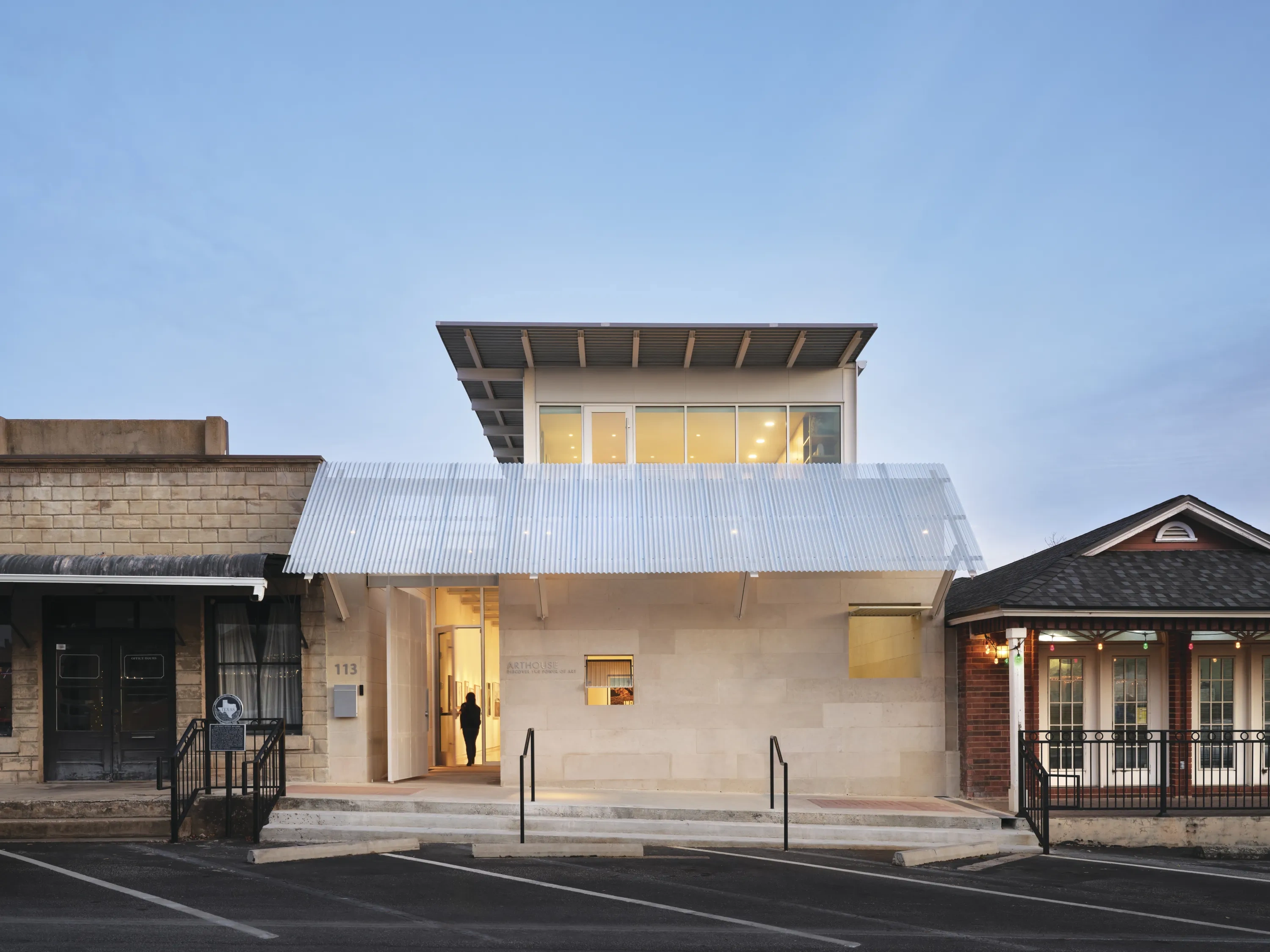
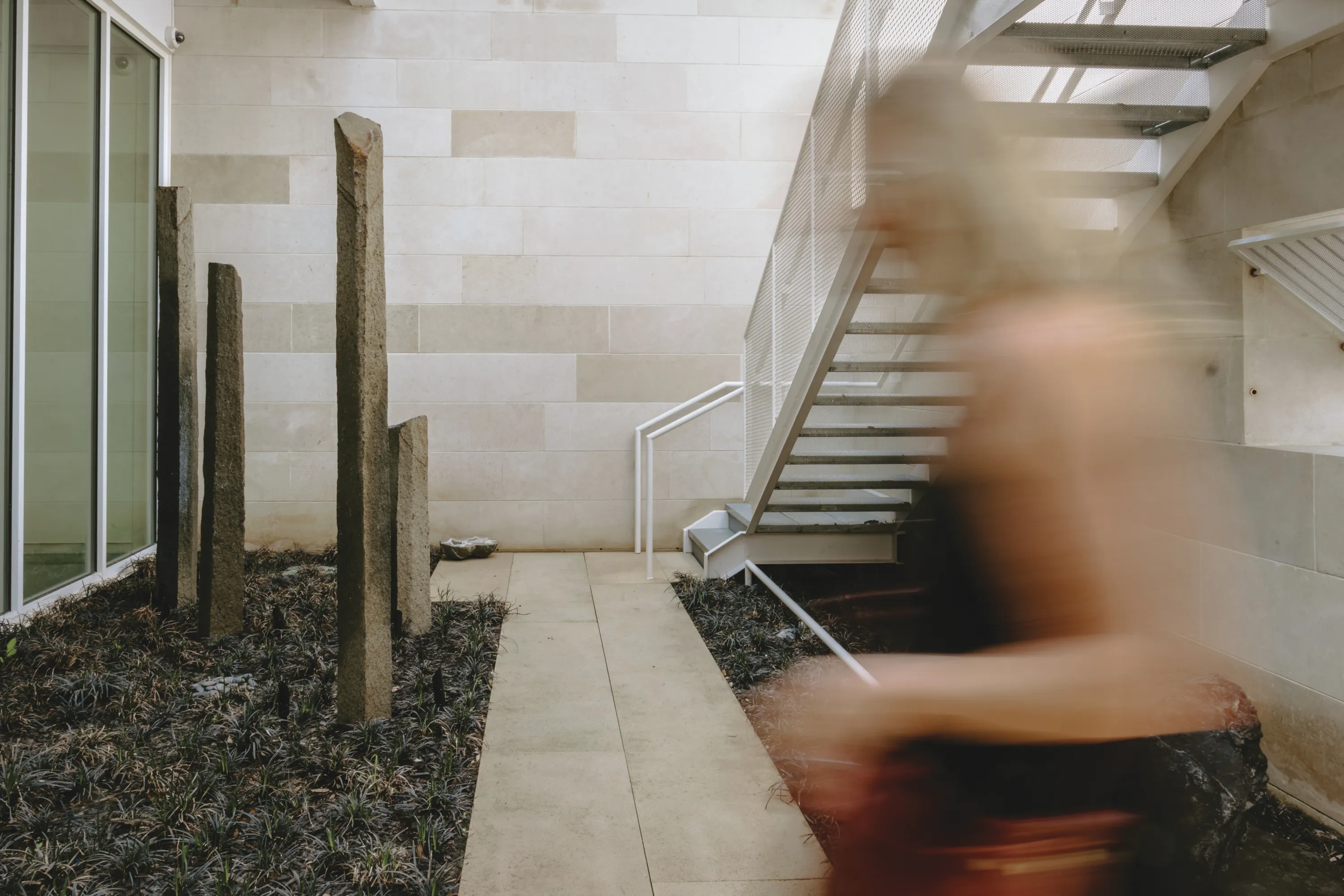
An unassuming facade of Lueders limestone extends the continuity of the neighboring buildings’ Central Texas heritage, while the overhanging corrugated roof interjects an unexpectedly modern flavor to the historic street. Upon entry, visitors are invited to pause in a modest courtyard designed by fourth-generation Japanese gardener Sadafumi Uchiyama—a landscaping collaboration directed by Mickey and his interest in Japanese gardens. The liminal space, reminiscent of Charleston garden entrances, is both functional and artistic, acting as an additional layer of security between the street and the art while offering intentional respite from the outside world before entering the exhibit.
Inside the 2,000-square-foot space, the art demands attention against sparse white walls, 12-foot ceilings, and a central skylight that washes the room in a soft glow. A moveable wall offers flexibility to tailor the space to the needs of each exhibit.
For the Kleins, Arthouse is a marriage of their two great loves: art and architecture. “The great architecture makes the art look better, and the great art makes the architecture look better,” Jeanne says.
Upstairs, out of sight, sits the three-unit office (and the employees) that inspired the entire project.
The exhibition space—open to the public Friday and Saturday—debuted with “Words Matter,” the inaugural exhibit that sets the tone for the purpose of the endeavor: education, curiosity, conversation.
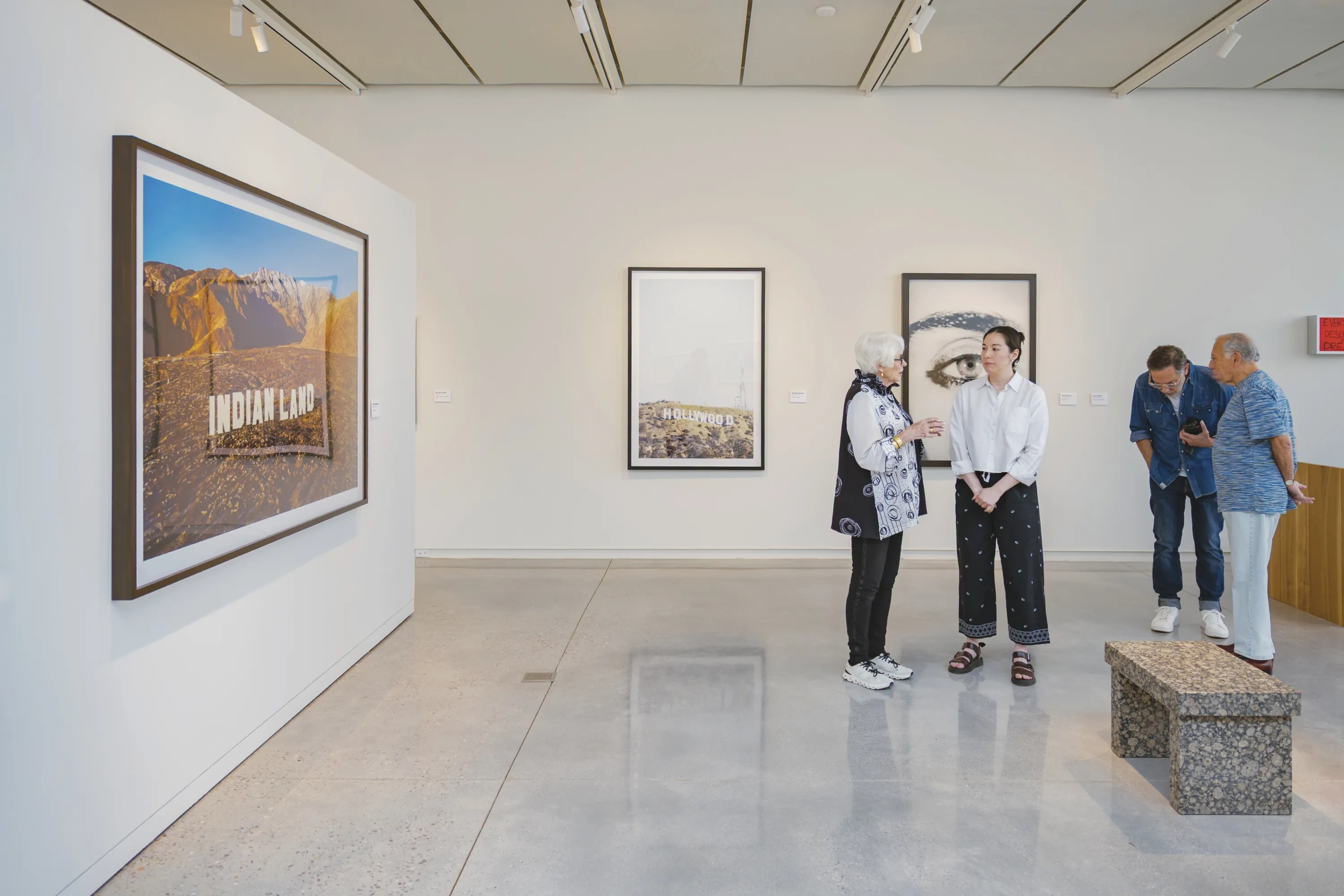
Curated from their personal collection, the Kleins selected works from a diverse range of artists and mediums with the shared theme of words, including provocative and politically charged pieces such as Indigenous artist Nicholas Galanin’s replica of the iconic Hollywood sign which instead reads INDIAN LAND, and legendary multimedia artist Faith Ringgold’s repeated phrase HATE IS A SIN stretched into the shape of a Confederate-style flag. A brightly colored blanket designed by Jeffrey Gibson, an Indigenous artist who represented the United States at the 60th Venice Biennale, hangs across one wall with the artist’s handwriting printed across: “I feel real when you hold me.”
“It’s very exciting to see my work in the context of iconic artists of our time,” says Mary Sloane, who has three photographs featured in the exhibit. “It’s the first time I’ve been in that kind of good company.”
Her images, part of an ongoing series she started in 2009, capture empty billboards towering over Western landscapes. In the wake of the 2008 recession, she was fascinated by these road trip emblems that once promised excitement ahead and now stood starkly blank. Unlike most of the adjacent art, the absence of words in Sloane’s work uniquely positions her within the exhibit’s theme. “You could almost imagine what the words might have been even though they’re not there,” she says.
Like many of the artists in their collection, Sloane has a personal relationship with the Kleins. She first met the couple when her husband served on a museum board with Jeanne. Sloane later served alongside Mickey on the board of the New Mexico School for the Arts, a public, tuition-free arts high school, both sharing a passion for arts education and accessibility. The couples became friends, and Sloane was “deeply honored” when Jeanne shared that her work would be featured in the inaugural Arthouse exhibit.
“One of the really nice things about the Kleins is they’re so supportive of artists and art and community and education,” says Sloane. “A lot of people buy art for investment, or they buy art for a particular kind of collection, but [the Kleins] get to know the people they’re collecting.”
The Kleins plan to feature three shows a year at Arthouse, with the next exhibit showcasing photography and a winter show featuring ceramics. “We’ll take it from there,” Mickey says.
Arthouse has already generated buzz in the art world, but the Kleins are characteristically modest about the project.
“A gallery implies that you’re in business to sell the art … and a museum implies that you’re a big deal,” says Mickey. “We’re not that big [of] a deal. We’re just a little space.”
To celebrate its opening, the Kleins have hosted multiple receptions—one for the Marble Falls community, another for their friends and art community in Austin. The response from the town, they said, was enthusiastic. (One skeptical neighbor complained the new structure didn’t fit in with the aesthetic of Main Street, but she hadn’t personally visited yet.)
Despite the warm reception from the art world, Mickey is the most interested in the response of his youngest visitors. He’s already given a personal tour to 30 Marble Falls High School students and instructed the space’s manager to contact every school in the area to extend similar invitations.
For Marble Falls High School art teacher Kim Thomas, who accompanied her students to Arthouse, the exhibition space is an invaluable opportunity to show her students that access to art doesn’t have to be exclusive to large cities.
“Experiencing art in real life is so much more valuable than viewing it on a screen, as many kids are used to,” she says. “Being able to stand next to a work and understand the scale, see the textures, and be present in a space with other people sharing in an experience, being able to talk about it, is such a healthy, fun, and unifying experience to have.”
Each student was drawn to a different piece, but Thomas says the collective favorite was “Breath as a Boundary” by Kenturah Davis, a text-based portrait of a woman in motion.
The field trip is already sparking new ideas in the classroom. “I brought back the idea of using words as value and line in art,” she says. “And I built an assignment where students created an artwork using words to give power and context to their works.”
This is exactly what the Kleins envisioned when they opened the space. They hope Arthouse offers to students what they both enjoyed at a young age and ultimately altered the trajectory of their lives and brought them together: access to art.
“Art opens your eyes,” Mickey says. “And what I’m hoping this [space] will do with every person that goes in there is open their eyes to different things that they’ve never seen.”
CREDIT: From top, Noel Hernandez; Andrea Calo (2); Noel Hernandez (2); Andrea Calo