The LBJ Presidential Library’s Major Renovation
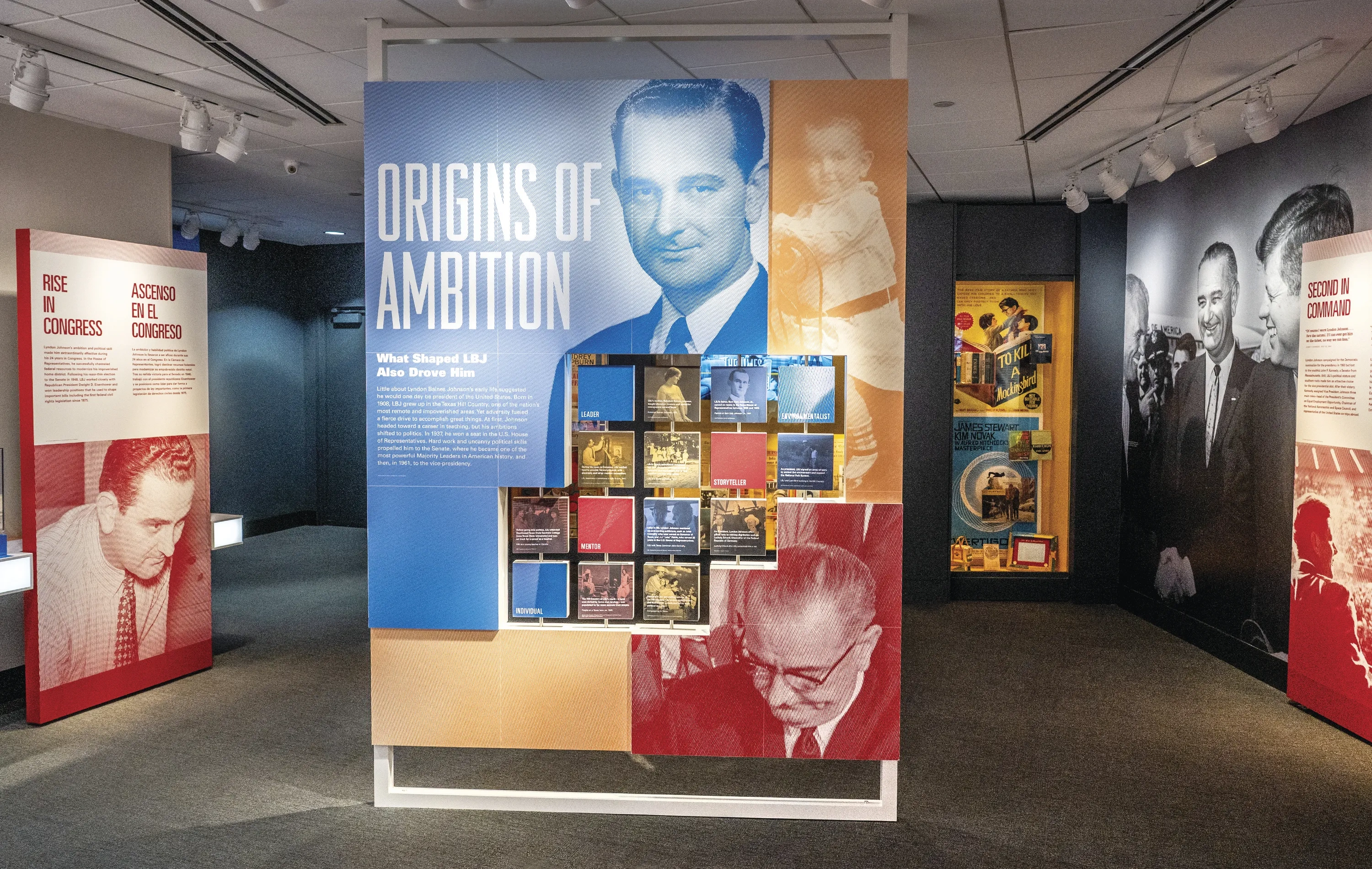
The LBJ Presidential Library has been a constant on the University of Texas at Austin campus since its 1971 dedication—when President Lyndon B. Johnson declared the institution’s purpose was to tell “the story of our time.”
That’s most evident in the fourth-floor exhibit that offers a retrospective look at LBJ’s life, chosen from a massive collection that includes 45 million pages of documents, 650,000
photos, and 5,000 hours of recordings from throughout LBJ’s career in politics.
President Johnson and First Lady, Lady Bird Johnson, BA ’33, BJ ’34, BL ’64, Life Member, Distinguished Alumna, donated a great deal of what is housed in the exhibit, but other contributors donated items to help tell the story of LBJ’s life.
Commencing in the Hill Country as he became a teacher and then a legislator, and peaking with a presidency that included epic advances in space exploration, the exhibit highlights an array of achievements borne of his Great Society campaign, and the Vietnam War and all its attendant controversy. The audience coming to learn “the story of our time,” however, has not stayed constant, and while it still aims to do what LBJ wanted it to do 55 years ago, the understanding of what constitutes “our time” has changed drastically.
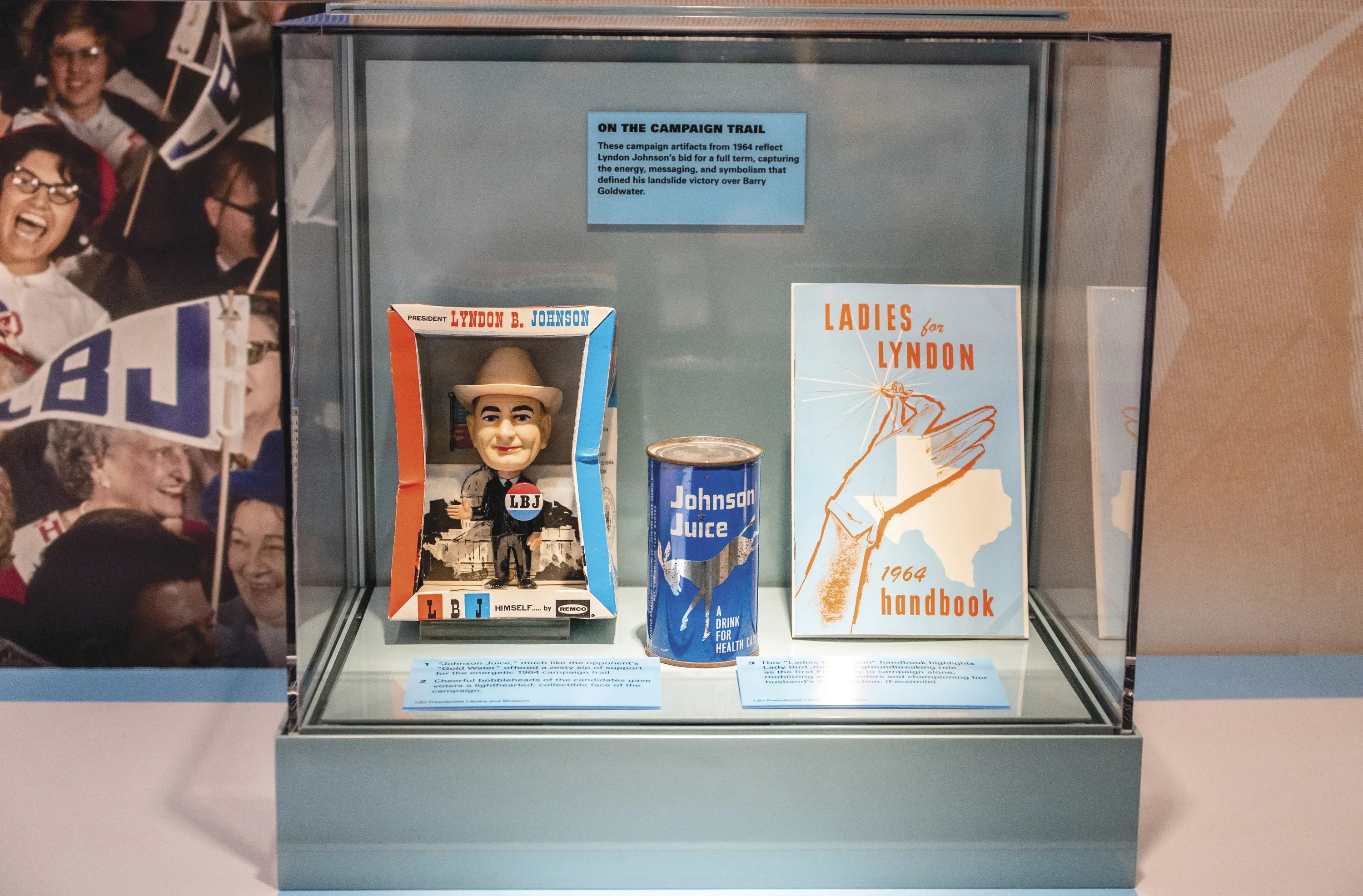
“Our audience used to be one that had lived through the ’60s,” LBJ museum curator Lara Hall says, noting that the pop culture mélange of items from that decade appearing in the exhibit brought a nostalgic element to visitors recalling the time in which Johnson served.
“People love this sort of nostalgia and cultural history, and so we’ve left those in,” Hall says.
As the library’s audience becomes younger and therefore further removed from that tumultuous decade, she acknowledges, LBJ is more a figure to be learned about and discovered rather than remembered—as she herself is part of the growing number of people whose timeline didn’t overlap with his. “I’ve got nine months between his death and my birth,” she notes.
Hall oversaw the five months of renovation to the Library’s core fourth-floor exhibit prior to its March relaunch, to modernize its retrospective look at LBJ’s life. The project reorganized the presentation of around 500 artifacts, infusing more vibrant colors, radiant lighting, and interactive elements to make learning about LBJ more tangible and experiential than it was prior.
The exhibit still takes visitors through LBJ’s life chronologically, including a section that delicately and somberly reviews the assassination of President John F. Kennedy that led to LBJ assuming the presidency, through his and Lady Bird’s vantage point. That most poignantly includes his abbreviated address to the nation with handwritten edits, closing with, “I only ask for your help—and God’s.”
That section then transitions into a bright room heralding the LBJ presidency at its most optimistic early years, highlighted by five lit pillars, each with an adjective to describe qualities of his leadership and his personal style: compassionate, relentless, persuasive, collaborative, and practical.
“From a planning perspective, this took us hours,” Hall says, adding that the team assembled included representatives from every department in the building to make sure myriad perspectives were included. “We debated what words were the right words and, really, what was it that made him the right man for the job.”
This room also features one of the flashier elements of the remodel: two letters sent to President Johnson, digitized into short films that play when a physical representation of the letter is placed into a holder that activates the projector. That’s part of a larger nod to interactivity throughout the exhibit, including drawers containing artifacts that visitors are invited to open and peruse.
“For the interactive stuff, one of the big things that we wanted to encourage was people to get curious in the space and find information on their own,” she says. “It’s this idea that if you’re looking for things, that you are going to pay more attention.”
She notes that this is a trend toward which more museums are moving, and which in part motivated the remodel. In preparation for the project, Hall turned to the Harry S. Truman Presidential Library and Museum in Independence, Missouri, which did a 2022 remodel with the design firm she ended up engaging for the LBJ Museum.
One of the most intriguing items in the exhibit exemplifies NASA’s influence on the decade. On long-term loan from the agency is a piece of moonrock. “It was in the previous exhibit, but it was always kind of hidden,” Hall notes. “It sat in the corner right there, and people would walk right by it ... We made sure it got a prominent place [in the renovation].”
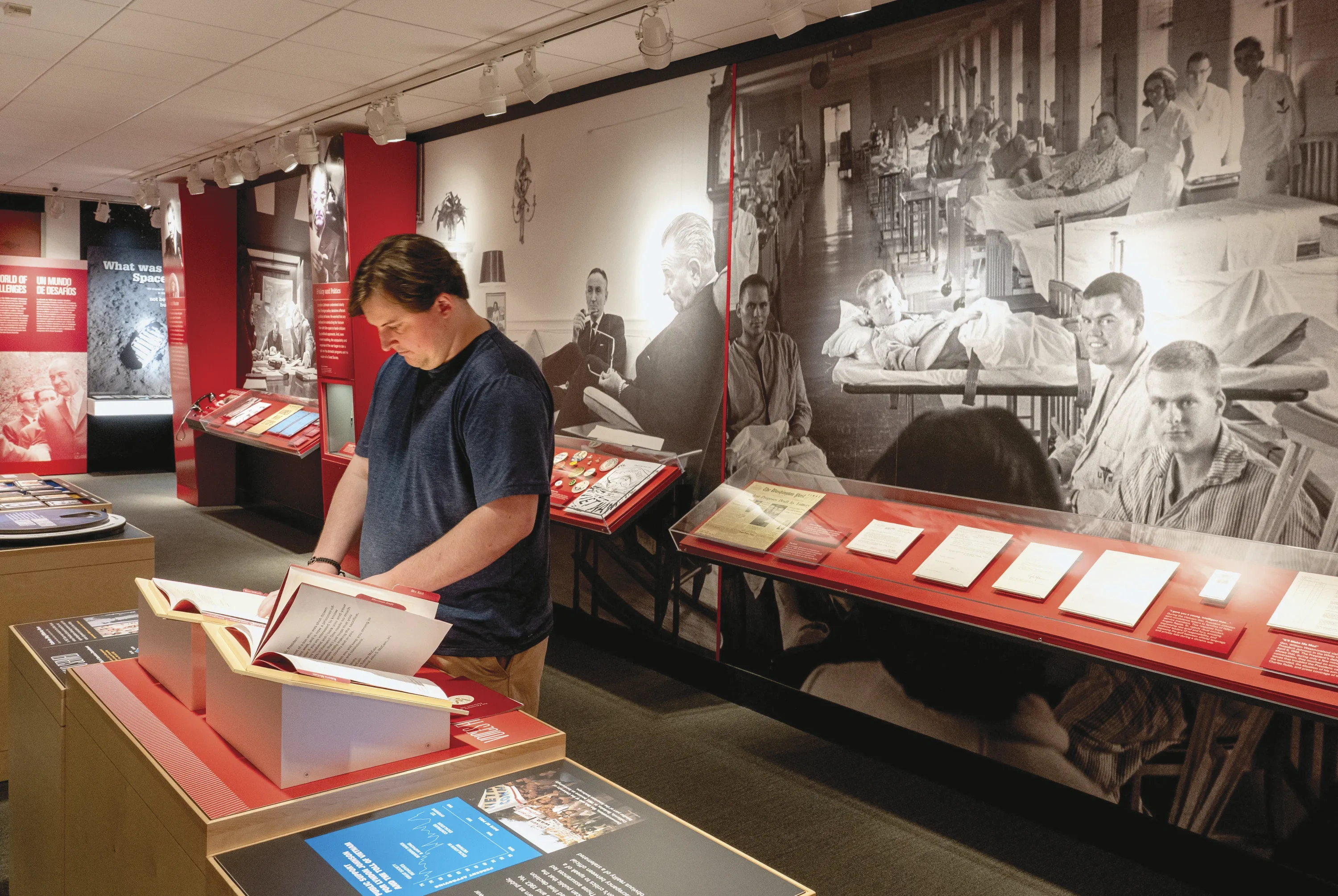
The exhibit does have a different ending than before. Now, the visitors’ experience extends into a final room that looks at post-LBJ presidencies as well as what Hall calls a “legacy film,” featuring distinguished voices expounding on LBJ’s lasting impact on American life and politics.
For Hall, the film places LBJ’s work in an important historical context in what is a particularly historic year, given that the United States turns 250 this Independence Day. That context helps visitors understand not just what LBJ’s presidency meant when the Beatles were a pop music force and rotary telephones required wires and nimble dialing fingers, but how legislative efforts such as the Civil Rights Act, Voting Rights Act, guaranteed student loans, and public broadcasting shaped generations following his and into the present.
“I’m proudest of the way it helps our visitors put themselves into the time and space of the administration, and helps them make that connection with today,” Hall says of the exhibit. “So if they can go from, ‘This is what LBJ was facing, and here were some of the solutions they came up with,’ then, if we’re facing these same issues, what can we take away from this to help where we are today?
CREDIT: LBJ Presidential Library (3)