The Business of Sports Institute Helps Chart Careers in a Booming Industry

An unforgettable moment of clarity happens early in Moneyball—and it does not involve Brad Pitt. In fact, it’s omitted entirely from the 2011 movie adaptation of Michael Lewis’ seminal book.
It occurs somewhere off the field in the 1980s, when an unknown company called Stats, Inc. decides to split the baseball diamond into 26 pieces and start quantifying the sport in a way never done before.
Basic statistics weren’t telling the whole story. In response, a group of outsiders helped pioneer the concept of advanced stats, also known as analytics. And when Moneyball hit the shelves in 2003, their ideas became ingrained in the culture.
The book left a blueprint for non-athletes to get into the game. But even as the industries surrounding sports continue to expand, finding an entry point remains the biggest hurdle. Even Stats, Inc. was turned away by Major League Baseball, before finding a new market in fantasy sports.
A more direct path now exists. For anyone looking to build a career, the Business of Sports Institute, housed within the McCombs School of Business at UT Austin, offers a specialized minor to all students, and a variety of graduate-level classes. But coursework is just the beginning.
The institute stands apart as a research hub, where industry leaders bring emerging problems onto campus for students to solve. It’s tied together with events that provide direct access to professional teams, athletes, agents, and major companies.
“One of the key reasons we launched the Business of Sports Institute is to demystify pathways into the sports world,” co-founder Kirk Goldsberry said when the center launched in 2022. “For decades, these career paths have been impossible to uncover. We are really trying to change that at UT Austin.”
Goldsberry is more than just the executive director of the institute. His groundbreaking insights and frequent media appearances have turned him into something of a folk hero in the field of sports analytics.
Before that, he was simply a geography professor whose background let him see the game in a different way.

This guy’s quest to track every shot in the NBA changed basketball,” declares Nate Silver on the cover of Goldsberry’s 2019 New York Times bestseller, Sprawlball.
Goldsberry had never written about sports before he submitted a paper and was invited to Boston to speak at the 2012 Sloan Sports Analytics Conference. Organized by students from the MIT Sloan School of Management, the conference was in its sixth year and had earned its reputation as the leading event in the sports analytics industry.
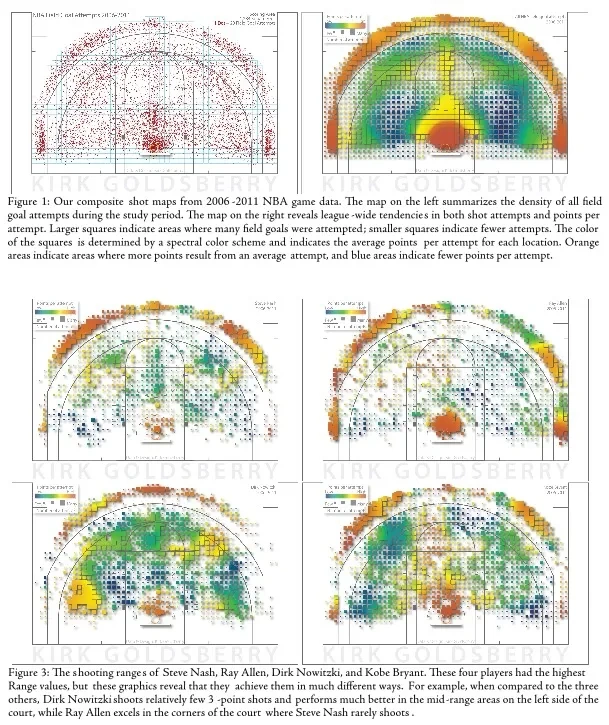
Drawing on his geography training at Penn State and UC Santa Barbara, as well as experience as a cartographer for FEMA, Goldsberry compiled five years’ worth of shot charts to use as the basis for a series of colorful heat maps that vividly displayed the on-court tendencies of the NBA’s best players. It was a stunning presentation that kickstarted the analytics revolution in basketball.
“I arrived as a geography professor, and I left as a basketball analytics guy,” Goldsberry told The Ringer in March. “That day changed my life forever.”
He was approached by Dallas Mavericks owner Mark Cuban and San Antonio Spurs general manager R.C. Buford, both eager to learn more. An executive from Stats, Inc., was on hand to offer a trove of precise data from their new technology, SportVU. Media personalities introduced themselves, including Bill Simmons, who dubbed the Sloan Conference “Dorkapalooza” in 2009 while blogging as The Sports Guy for ESPN.
When Goldsberry returned to speak at Sloan the following year, the room was packed with NBA executives. By 2015, he joined the Spurs as vice president of strategic research, then helped bring home gold from the 2016 Rio Olympics as lead analyst for Team USA. “The conference launched my career,” Goldsberry said, “and I was by no means alone in saying that.”
Formerly a teacher at UCSB, Michigan State, and Harvard, he arrived at the McCombs School in 2019 to teach Performance and Sports Analytics. His program now sits as a flagship offering within UT’s Business of Sports Institute.
And yes, Moneyball is part of the curriculum. “It’s a masterpiece,” Goldsberry told PBS in 2024. “One of the few books we can point to and say, ‘That book started a movement. That book changed something really significant in American sports culture.’”
In addition, Texas now hosts its own annual event: the Business of Sports Summit, a student-led assembly which bears a striking resemblance to a certain star-making conference back in Boston.
It took a newcomer with a different perspective—a mapmaker—to help plot the course.
Sarah Graves started playing basketball as a high school freshman in Keller, just outside of Fort Worth. She gave it up by the time she graduated.
“I had to call coaches and say no to D1 offers,” Graves, BBA ’26, says. “Everyone thought it was an awful decision. I’m quitting basketball.” It wouldn’t last long.
With the opportunity to study finance at McCombs, she arrived in Austin in 2022 fully committed to her major, but soon realized something was missing.
It wasn’t long before she found herself in 6 a.m. sessions at Gregory Gym, where practice players for the Longhorns women’s basketball team were quick to suggest she try walking on. “I didn’t even know what a walk-on was at that point,” Graves says. She made the team after an official tryout and was offered a full ride the following year. Her work ethic stood out.
“I started making all of our players shoot 100 free throws,” Graves says. “It became this entire project.”
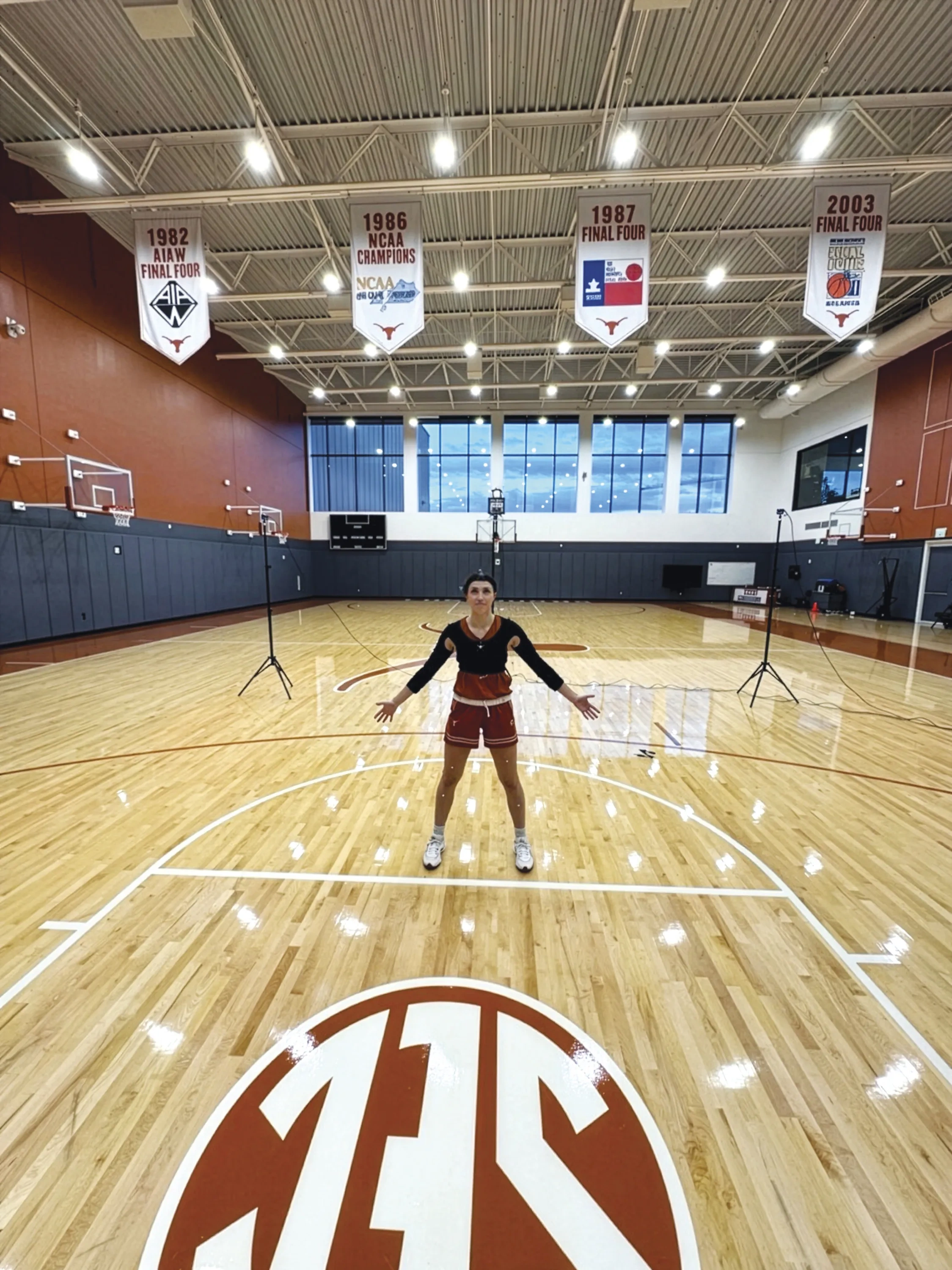
Texas utilizes a tool now standard at the sport’s highest levels: the Noah machine. By using an array of cameras, it measures shot arc and gives audio feedback after each attempt. One day after practice, Goldsberry noticed Graves working with the machine. “I’m a nerd, and he’s a nerd, so we both just immediately meshed,” she says.
With the sports institute still in its early semesters, she collaborated with Goldsberry to expand their vision of “companies giving real-world cases and projects to students, getting their insight, and then students having real portfolios and proof of work in these industries,” Graves says.
It all made her an obvious choice in 2025 for the institute’s inaugural advisory board, a 29-member group of luminaries that includes Buford, Silver, and Kevin Durant, among others.
“The advisory board has changed my life genuinely,” Graves says. “Mentorship, learning from them, and being able to reverse-engineer their careers. I had an internship with RedBird, which was a partner on our board. It’s the greatest pressure you can put on yourself, to present in front of CEOs of major sports companies as a 20-year-old who has no idea what you’re talking about.”
Graves’ final minutes for Texas came in an Elite Eight victory in front of a Fort Worth crowd chanting her name. Still, she views sports business as open to far more than just former athletes.
“If we can get students to build projects and portfolios that make them stand out, we give Texas an advantage. We grow the business of sports, and the whole ecosystem gets better,” Graves says. “We have a bunch of curious students. Whether they’re from a technical background, with computer science, or business, or maybe more entrepreneurial, they’re finding different ways to apply it.”
FanDuel came to McCombs with a common problem: how to make more money. Ratings and engagement had declined at the start of the NBA season.
“What would you do if you were us?” Goldsberry says, recalling the charge of the meeting. “[Graduate student] Tom Lee specifically looked at it. He found that betting data and engagement were lower on days when there were college football and NFL games.”
“It was a half-semester project, and we broke into teams,” Lee, MBA ’26, says. “Our entire thesis was around changing the schedule for the NBA, so that they didn’t have to compete with football. We pressure-tested it in the class.”

With several months of overlap between the football and basketball seasons, their findings were significant. “They estimated how much more handle FanDuel would get on NBA betting with this revised schedule,” Goldsberry says, “and it was eight or nine figures.”
“[Executives] don’t necessarily care about the analytics,” Lee says. “They care about what we can do to solve the problems that we’re presented with. You have to boil those problems down to something succinct and actually manageable.”
Lee’s parents were born in China and earned degrees at UCLA. “My dad always told me, when he came to the U.S., he knew no English whatsoever, but math is a universal language,” Lee says.
A graduate of Bryant University, Lee matured at a start-up job in his native Boston but left to open more doors with a degree from McCombs. Within a year, he was speaking to an audience that included NBA Hall of Famer Chris Bosh and Disney CEO Bob Iger.
“Executives at FanDuel, as well as Bill Simmons and a lot of his staff writers came in,” Lee says. “Because [the project] got in the national media, the NBA invited Kirk and a couple other sponsors in. They started to discuss the actual solution.”
“That one sticks with me because it exemplifies what I’m trying to do,” Goldsberry says. “Get a contemporary problem from sports business leaders who are on our board. Bring it to my students to see. They bring it back to the company who’s so compelled by this. They say, ‘What if we brought this to the league?’ That’s perfect. And then they offer [the students] jobs.”
In August, the NBA will release next season’s schedule, and the group will see whether their project made an impact. Regardless, the industry is opening up more than ever, and an outsider’s way of thinking can even be an advantage.
“That’s cool to think about,” Lee says. “This is the brainchild of just us at McCombs, and you have the NBA commissioner talking about it. It’s a pretty cool feeling.”
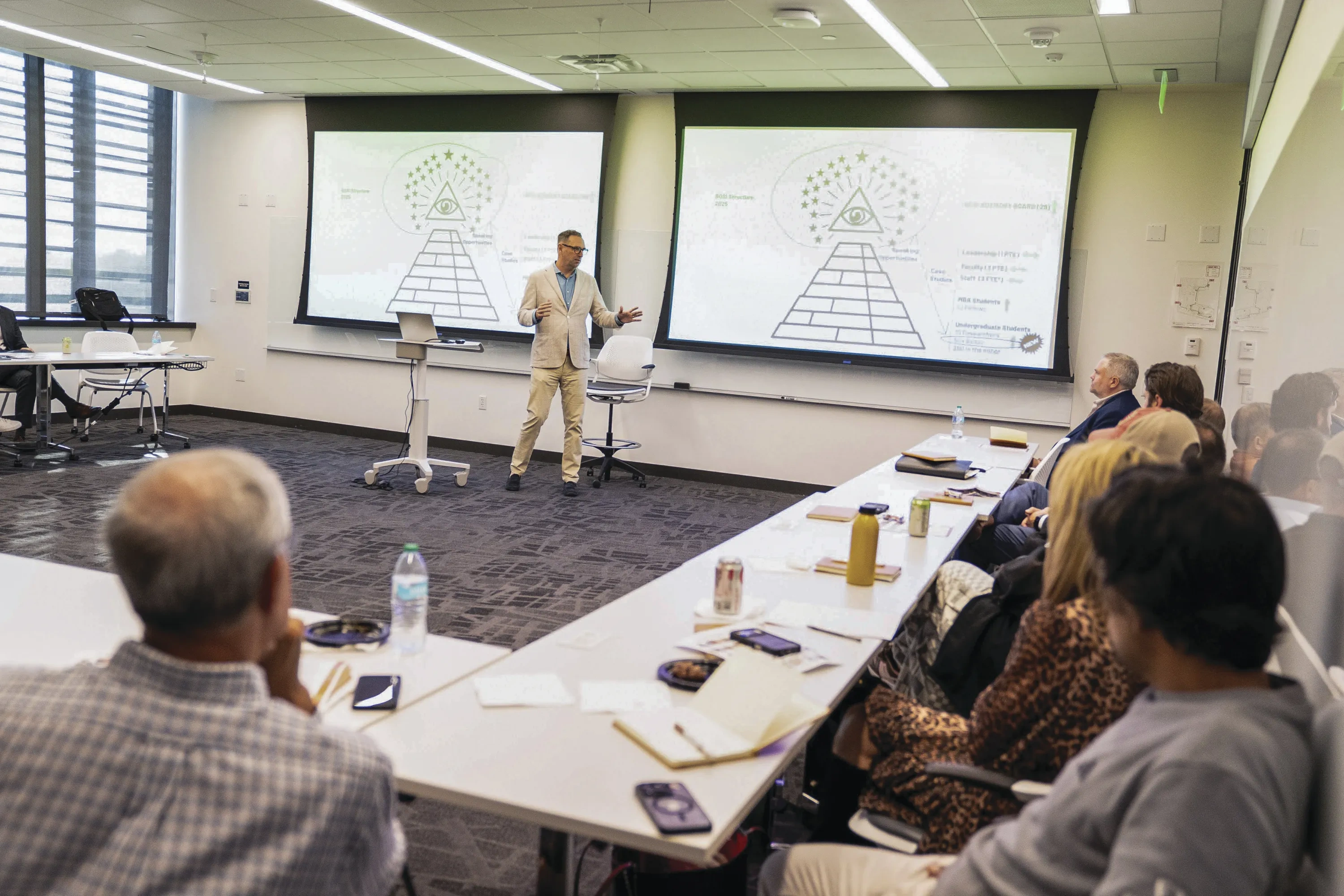
Kirk’s been great at connecting us with companies,” says Ale Merodio, BA ’26, who served as an operations lead for the Business of Sports Summit. “Every Monday we have something called the Business of Sports Leaders Lectures,” she says, describing still just a fraction of the opportunities inside Rowling Hall.
A former intern at Austin FC, Merodio organized a recent lecture with members from different parts of the local pro soccer club, such as operations, events, and law. “We had students ask them questions, network with them. We’re providing that first step for a lot of students. If you want to get into sports but don’t know how, here are four people who work in sports, in four different roles.”
Merodio was a big sports fan growing up in Mexico, but wondered where she could fit in, like many young undergraduates. “I couldn’t find the community. If I want to know more about this, where do I go? Where do I talk to more students who are interested?” she says. “So I talked to Kirk after class. ‘Hey, is there a community or an organization that I can join?’ He said, ‘No, but you can start one.’”
Merodio and a group of like-minded students co-founded the Business of Sports Student Organization in 2025. The club quickly surpassed 100 members, and (again) the meetings are just the beginning.
“We have a great reputation with Austin FC, and my connection to them [from my internship] led them to hiring someone within the org,” Merodio says. “They’re not just going to gift you an opportunity. You have to work, take the initiative, and ask questions. But I think we’re creating that community for making it easier for students to speak up.”
In an industry where relationships are key, the tent has expanded. There’s room for everyone, from curious freshmen to alumni looking to get involved through mentorship opportunities and projects of their own.
“Numbers are numbers until they apply to something a client or team or organization cares about,” Merodio says. “I don’t come from an analytics background, but I think you can approach analytics in so many different ways. It’s hard to see at first, but if you put the numbers clearly to see, you can tell a story.”
CREDITS: From top, illustration by Tommy Parker (2); Kirk Goldsberry/MIT Sloan Sports Analytics Conference; courtesy of Sarah Graves; illustration by Tommy Parker; courtesy of the University