A Longhorn is Preserving the Musical Legacy of East Austin
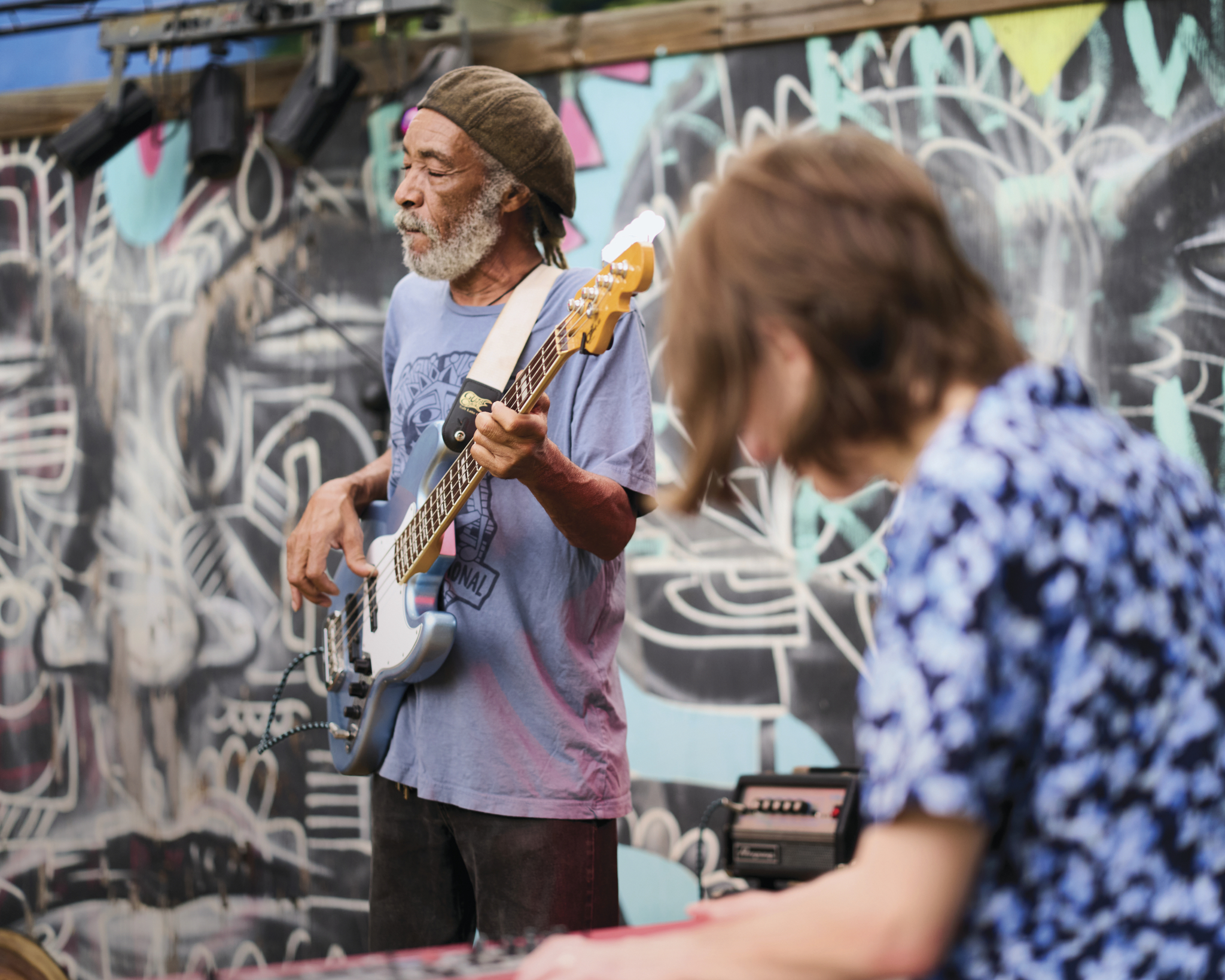
Everyone wants to talk to Harold McMillan.
He stealthily ducks through clusters of familiar faces. At least four people snag his attention for a second—to hand him a drink, offer a handshake or a friendly greeting. He’s charming even as he wriggles his way out of the social obligations of playing host.
It’s Monday night, and the often-busy corridor lined with trendy restaurants and bars primed for hopping is quiet but for the steady pulse of blues music emanating from the small stage situated in the far corner of an undeveloped lot. Vibrant portraits of East Austin legends encircle the slightly overgrown lawn, strewn with colorful patio furniture. The space slowly fills with a warm, gregarious coterie of local musicians and fans arriving for the weekly Blue Monday Blues Jam at Kenny Dorham’s Backyard, a weekly open invitation for spontaneous collaboration in the foundational musical tradition. Eventually McMillan escapes the fenced-in lot on East 11th Street, and I follow close behind. We steal a seat at Tony’s Jamaican Food, the food truck adjacent to Kenny Dorham’s Backyard. Even here he’s not unseen—the dim streetlights are enough for the eponymous Tony to spot us and call out a hello.
McMillan, MA ’92, carries himself with the loose-but-steady, confident-but-understated energy earned from years spent in the pocket. The musician and well-known community activist just had a tooth pulled. He pokes his tongue through the newly formed gap like a kid showing off to schoolmates. Except this kid is lighting a cigarette loosely hanging from his lips with a matchbook from the dive bar across the street.

The twang of a harmonica cuts through the night, a reminder of what we are here to discuss.
Once a stronghold of Austin’s Black cultural life, East 11th Street and the greater East Austin community have seen decades of displacement and change. Kenny Dorham’s Backyard remains an active space, where East Austin’s musical legacy is not just remembered, but lived.
The outdoor music venue, located squarely in Austin’s African American Cultural Heritage District, is McMillan’s brainchild. Named after McKinley Howard “Kenny” Dorham, a prolific jazz trumpeter who called East Austin home, the community space and the weekly Blue Monday Blues Jam hosted here are part of McMillan’s decades-long cultural preservation work. While the old cats may no longer run the street, the tradition—25 years in the making—keeps East Austin’s deep ties to blues and jazz music at the forefront of the community’s collective memory.
After graduating from East Texas State University (now called East Texas A&M University) with a degree in sociology, the Northeast Texas native enrolled at The University of Texas at Austin as a graduate student in the School of Social Work in the fall of 1979. It was during his time in this program, McMillan recalls, that he discovered what he did not want to do.
“I should not focus on pathology, but focus on celebration and preservation,” McMillan says. “A lot of social work is about race and economics and social justice. And I’m up in all of that, but I just decided that I didn’t want to deal with sickness—societal sickness specifically—all the time and that I could do the same kind of work with arts and culture.”
McMillan ultimately left that graduate program and began gigging as a bassist and working as a booker and festival organizer, focusing on Black musical traditions. He later returned to UT to get his master’s in American Civilization. “I was able to design my program to have points of intersection for the fields of study I wanted to connect: 20th century African American art, culture, and music, and the cultural and intellectual history around it,” McMillan says.
By the early 2000s, McMillan established Kenny Dorham’s, turning an empty 2-acre lot into a community hub that has connected East Austin’s musical legacy to today.
UT Austin faculty member Gregory Salmieri is a blues guitarist and regular participant in the weekly blues jam. When Salmieri moved to Austin in 2020, he tried several regular jams to find a new musical home. He notes that this one has given him a sense of the history and culture of East Austin.
“There’s a quality of indigenousness to it,” Salmieri says. Many of the regular players have deep connections to the historical blues scene. “They bring a lot of that memory and have stories to tell about seeing B.B. King in segregated clubs back in the ’50s.”
The jam is populated by not just legacy musicians, but by many young musicians too. McMillan relishes the chance to introduce the rising players to the art form in context by passing along memories, recommending books, and sharing key records. “Blues for me is not just a musical form; it’s not just the blues. The history of the blues in the United States is a soundtrack of the Black experience in America.”
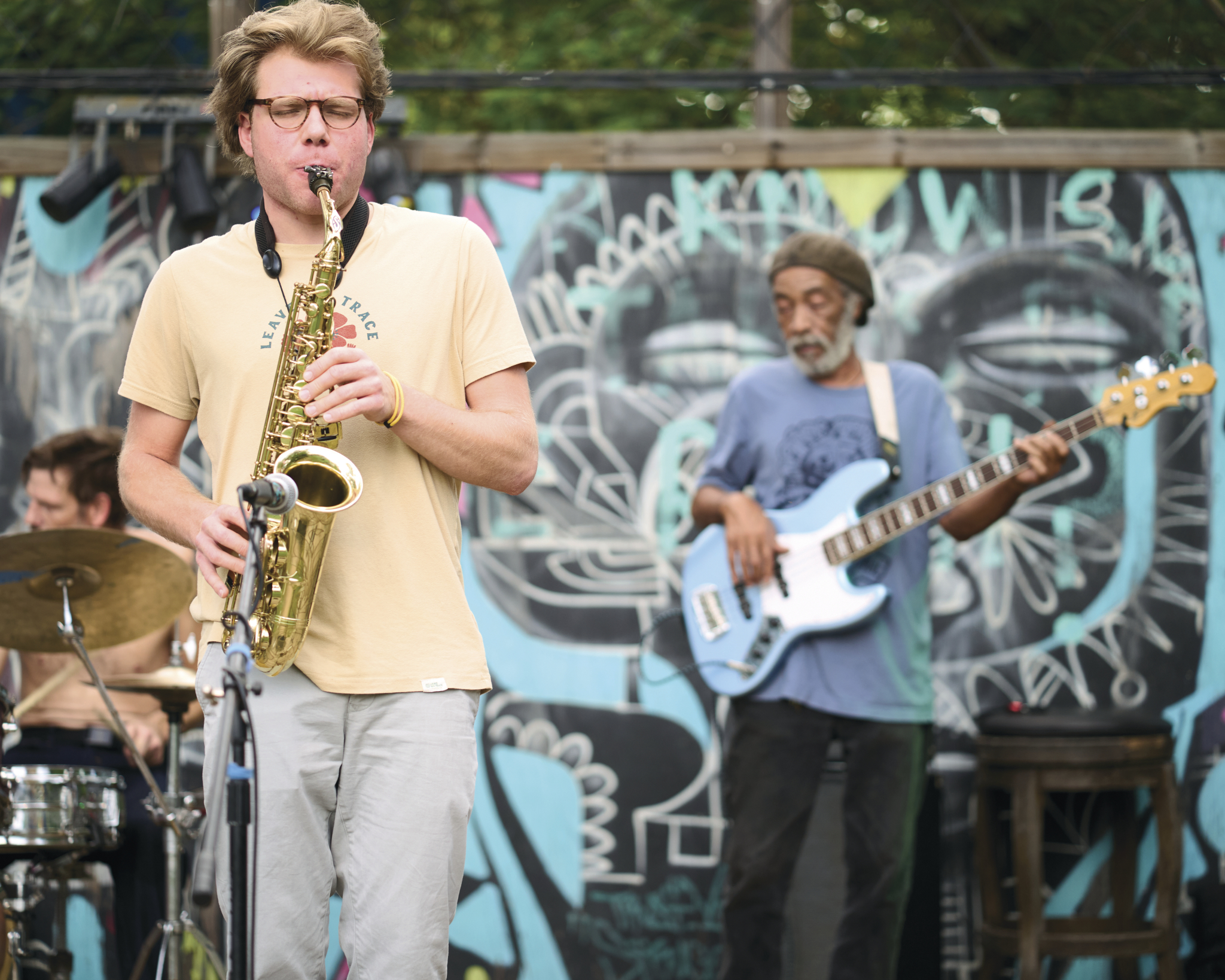
Patrick Hanks has been coming to the jam since 2012. Though he lives south of the city limits, he makes the 40-minute drive nearly every week. Since the recent closure of Skylark Lounge, another East Austin bastion of soul and blues, Kenny Dorham’s has felt even more vital. “This place is like home,” Hanks says. “Sundays are for the Lord, but Mondays are for us.”
For some, the connection is newer but just as deep. Vicki Osborne, a regular for the past five years, takes the bus 30 minutes from South Lamar. “I love the music,” she says. “It’s like family.”
Others have built entire chapters of their lives around the blues jam. Stacie Williams just recently retired after seven years as Kenny Dorham’s stage manager. Her daughter, now 12, grew up in the crowd. “Harold’s sincerity and dedication,” she says, “keep the place alive.”
McMillan applauds Williams’ contributions to the organization, noting she is the one who coined the venue’s commonly used hashtag, #LoveRunsThisPlace. Williams stands amongst dozens of contributors who have come together through the years to keep Harold’s vision running smoothly. “It’s an extended family that with some folks goes back years—years and years. And that extended family is multigenerational now,” McMillan says.
CREDITS: MATT WRIGHT-STEEL