Longhorns Find Their Way and Make Memories on the UT Shuttle
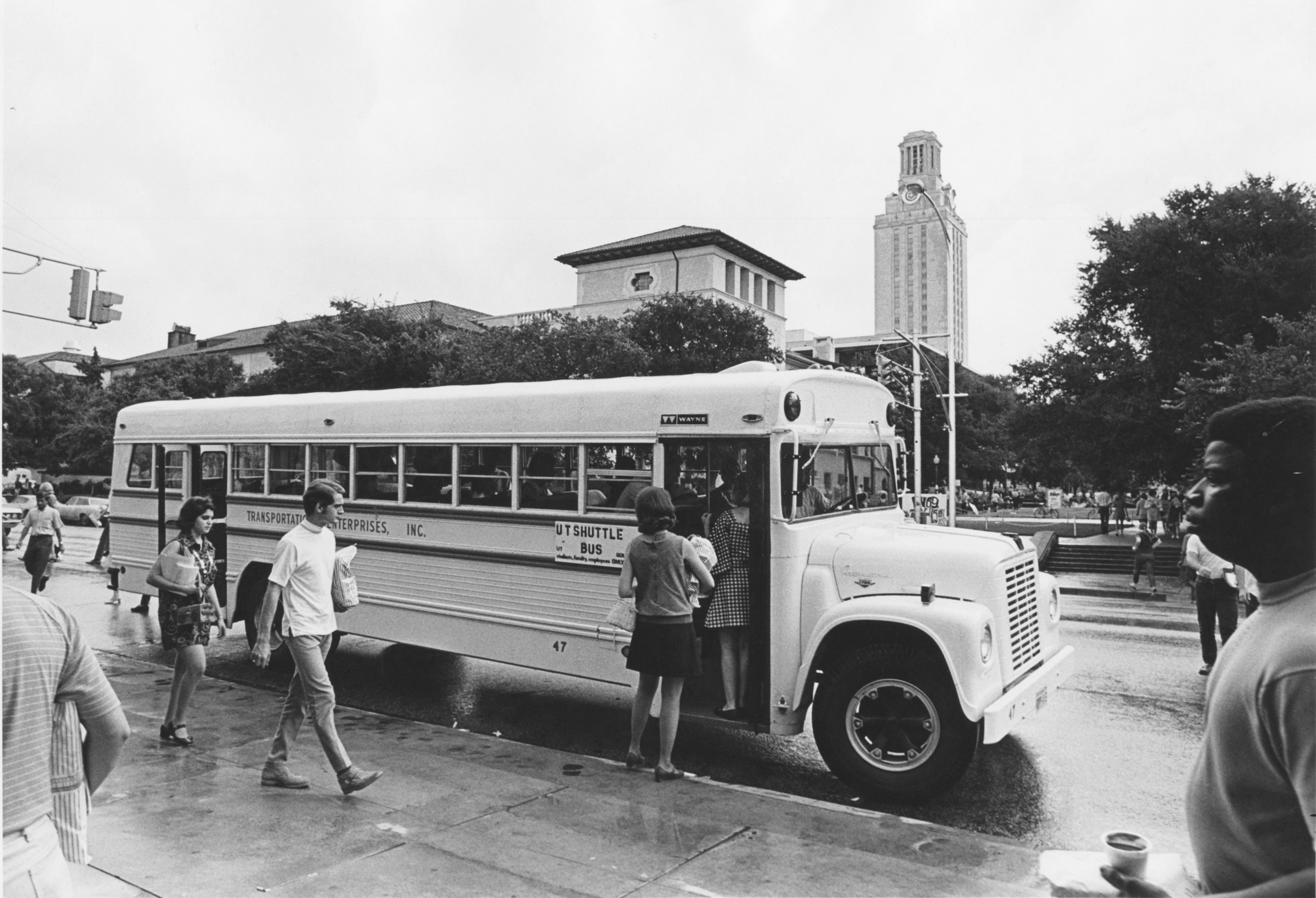
Many of us likely remember our school bus days, waiting half-asleep at the end of the block every morning. We memorized the potholes on the route so that we could finish homework, scrawling on notebooks balanced on knees. The image of a yellow bus start-stopping its way down the street rekindles memories of a simple and reasonably safe path from home to school, and back again.
For Longhorns, another rolling repository of nostalgia picks up where the old school bus left off: the UT shuttle bus. With a backstory spanning almost 70 years, the shuttle serves as a lifeline for students and staff, winding through the Forty Acres and between apartment hubs from East Riverside Drive to Far West Boulevard. As it exists today, the seven-route UT shuttle system carries more than 3 million passengers each year, making it one of the largest university shuttle systems in the country.
In anticipation of students repopulating the Forty Acres to kick off another fall semester, the Alcalde took a deep dive into UT shuttle bus lore, mining social media conversations, subreddits, and old Cactus yearbooks—and y’all didn’t disappoint.
FOUR THINGS WE LEARNED ABOUT SHUTTLE CULTURE
1. Life is a Journey, Not a Destination: Admittedly, Ralph Waldo Emerson never rode a UT shuttle bus, but if he had, we think he would have recognized that the adage he coined was never more true. The shuttle bus is like a Choose Your Own Adventure book. In the early years, air conditioning and heating and shock absorbers were flights of wild imagination, and going downhill was an experiment with terminal velocity that felt like it should have earned you a physics credit.
Before the advent of modern amenities, passengers had to yell “next stop” as their desired destination approached. Some shy former students described how they hoped other riders would yell out at the appropriate time so they wouldn’t have to.
“I’m old enough to remember the old orange and white shuttle buses,” Larry Warner, BA ’92, recalls. “No A/C, but you could smoke if you sat in the back.” Only to be one-upped by Frank Walker Wilson’s story: “I remember a couple of drag queens in hostess uniforms boarded a shuttle bus and served the riders coffee. This was probably around 1971,” Wilson, BBA ’71, wrote.
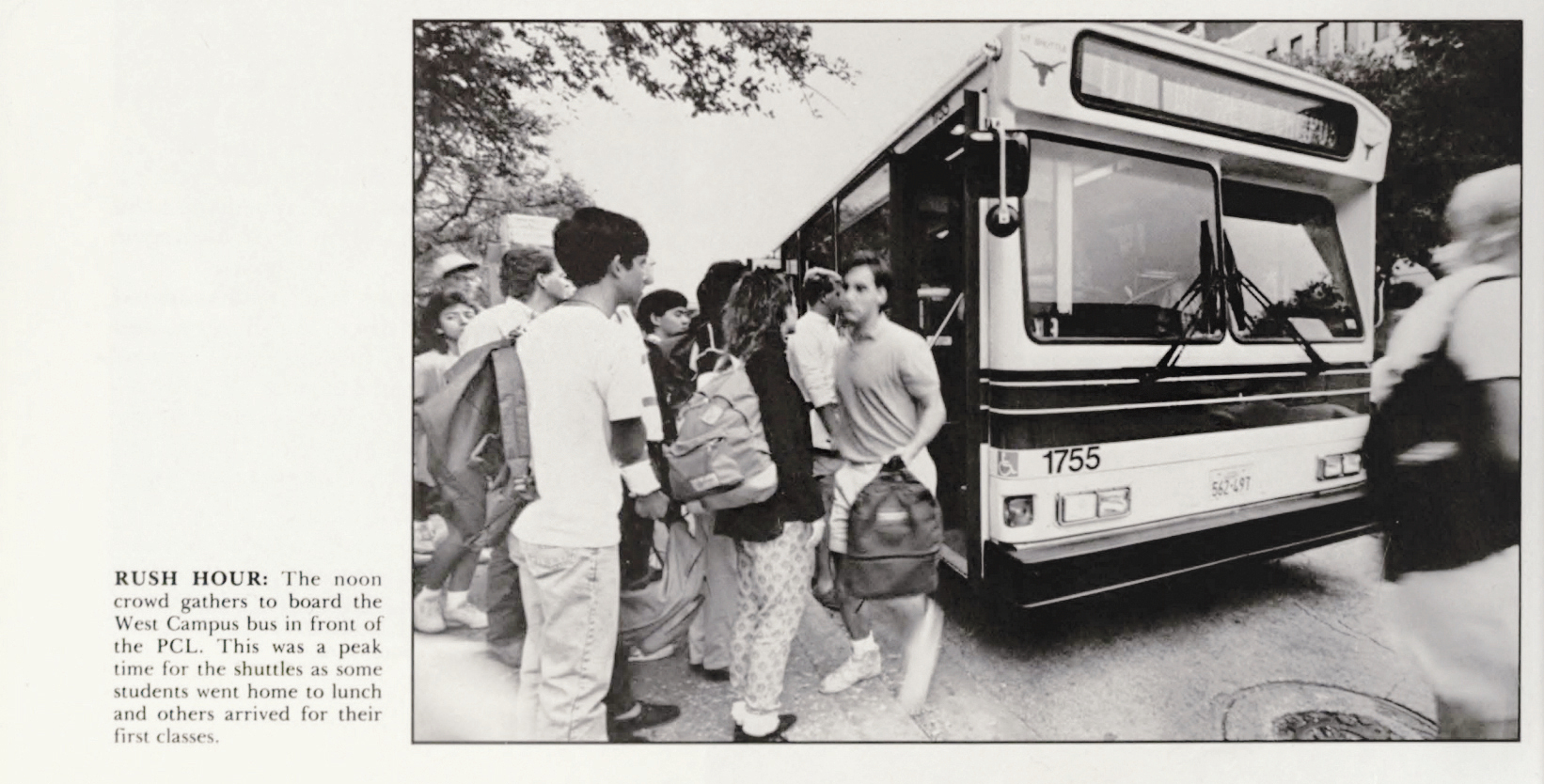
2. A Tale of Two Oranges: There were two versions of the orange-and-white bus exterior, though our memories tend to conflate these historically distinct fleets. The color scheme of the Laidlaw buses operating in the 1980s inspired debate about whether those buses resembled Whataburger, while the buses introduced by the city’s public transit provider, CapMetro, in the 1990s more accurately embraced UT’s iconic burnt-orange palette.
3. Old School UT Shuttle Drivers Are the Stuff of Legend: Longhorns remember them as a cross between rolling ringmasters, amateur therapists, and action film stars. Apparently, boom boxes were commonplace, so drivers could DJ their own shifts. Copies of The Daily Texan were once distributed aboard, possibly to distract riders from particularly creative driving maneuvers.
One former driver attributed slippery steering wheels during his shift to the likelihood that the previous driver had eaten fried chicken while navigating the route. Another Texas Ex would neither confirm nor deny that a shuttle was repurposed immediately after the 1996 Longhorns team upset Nebraska in the inaugural Big 12 Championship Game, commandeered into party bus status. (Police allegedly found the shuttle the following day, empty and unattended.)
“I rode the 1969–76 UT shuttle,” Jesse Airaudi, MA ’70, PhD ’76, remembers. “My stop was Woodward Street and I-35, and the hippie drivers of the old bare-bones school buses were the entertainment, especially as holiday breaks were approaching, sometimes aided by a keg of beer set up in the back. Shiner, as I recall, the old Post Toasties tasting stuff as Bock wasn’t around back then.”
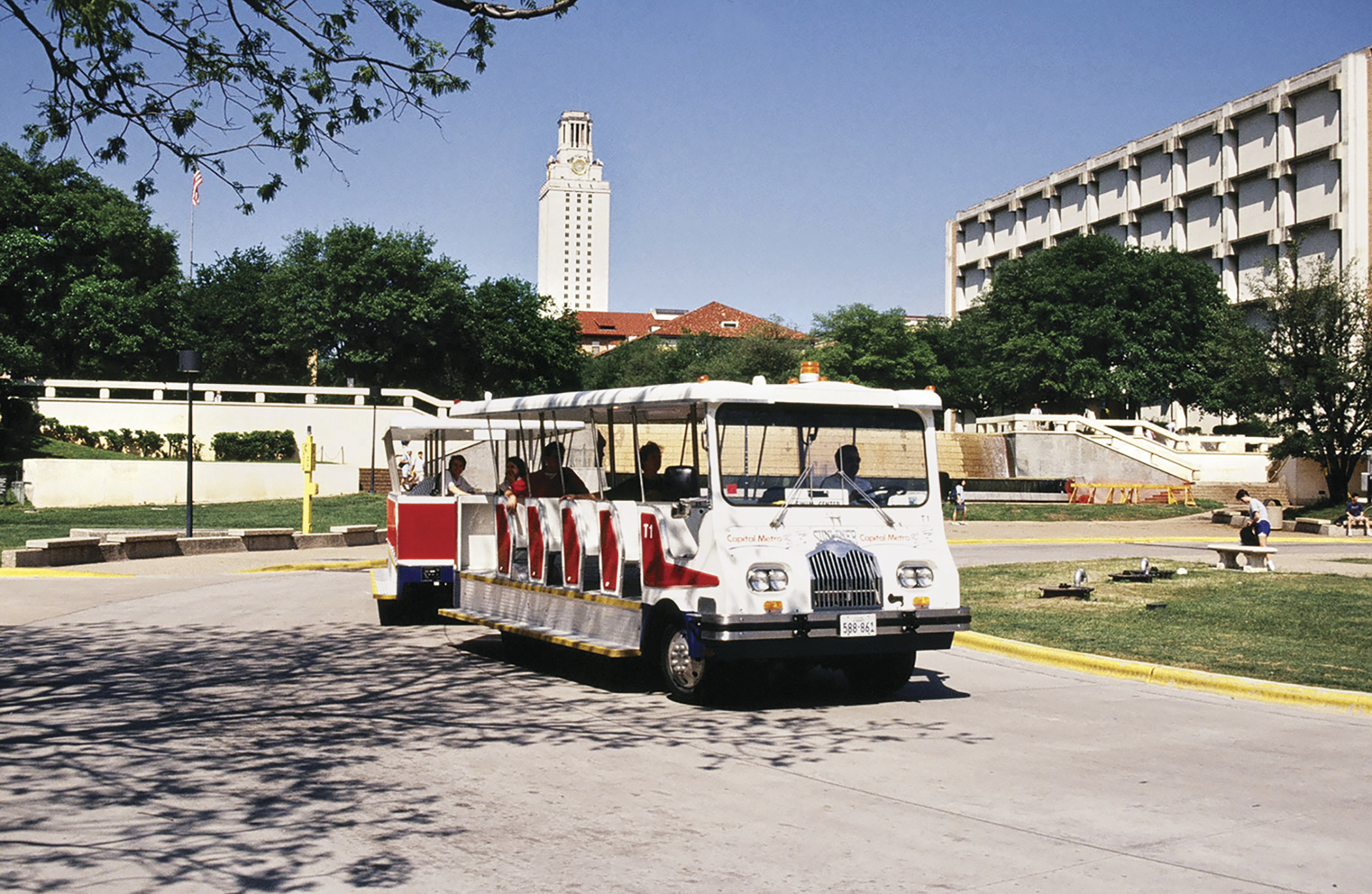
4. Longhorns Love the Bus: The shuttle bus abides as an undeniably essential aspect of campus life. Contemporary routes are now operated by CapMetro, from the 640, which runs clockwise around the Forty Acres, to the 656 running north and south on Speedway from the Intramural Fields. More than just logistics and history, there’s a mythology here. Humans learn and retell a collective narrative that expresses our shared experience, and the shuttle bus is a character in our story.
The bus is where we meet, seatmates turning into friends, and maybe even spouses. We learn in a moment what it feels like to be seen when our driver recognizes us from a distance and pulls over. The restaurants and the football coaches and the news of the day may change, but we all know our shuttle route, and we always will.
An Incomplete and Highly Selective Timeline of UT Shuttle History
1957 Phi Kappa Psi fraternity launches the first UT shuttles, offering only a handful of buses and routes. A pass costs $6 per month.
1969 As increasing numbers of students seek housing off campus, the UT shuttle system begins in earnest. The Board of Regents outsources operations, awarding the first contract to Transportation Enterprises Inc., and later to Laidlaw Transit, Inc., which was primarily a school bus company.
1988 CapMetro takes over the contract, launching a two-decade run for the now legendary orange-and-white paint jobs on UT shuttles.
2002 Cap Metro introduces the E-Bus (Entertainment Bus) as a partnership with UT and the Austin Police Department, designed to provide safe transportation for students to and from Sixth Street. Offering late night routes Thursday through Saturday until 3 a.m., the service becomes predictably popular, with some nights approaching 600 passenger trips. Despite earning a colorful reputation for overcrowding and rowdy behavior, the E-Bus accomplishes its original mission: giving thousands of students a safe ride home.
2016 Cap Metro retires the burnt-orange shuttle buses, replacing the existing fleet with modernized inventory.