A UT Anthropologist Examines Humanity Through the Eyes of Chimpanzees
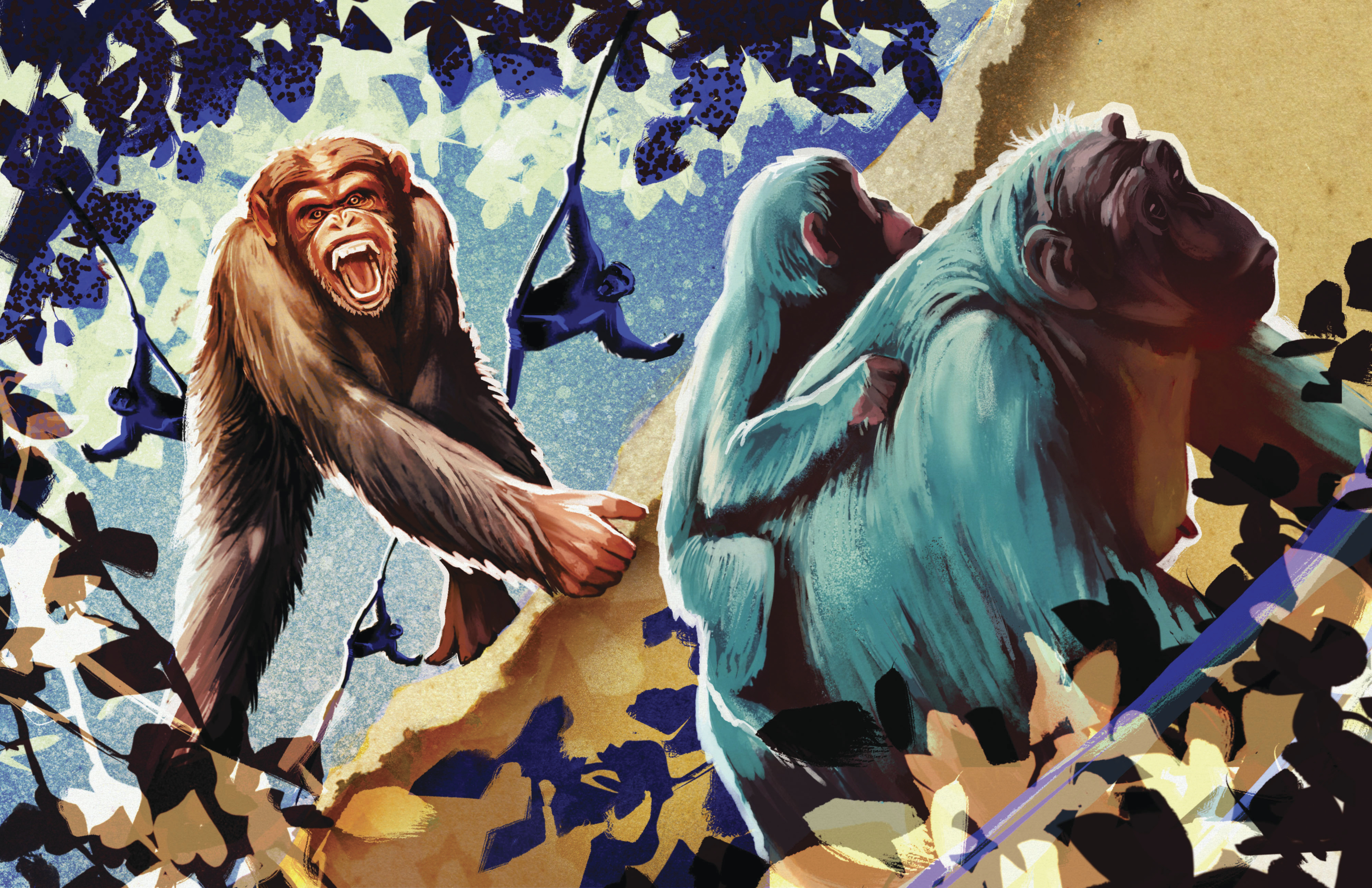
Aaron Sandel spent years sitting in Uganda’s Kibale National Park watching a society of nearly 200 chimpanzees live their lives. They raised their young. They hunted in the forest and fed each other. They formed friendships. Studied consistently since the mid-1990s, the Ngogo chimpanzees were the largest known community of wild chimps in the world. Then, in 2015, something changed.
Researchers witnessed the Ngogo chimps splitting into two socially isolated groups, forming distinct neighborhoods among the fig trees of Kibale. As time passed, the chimps demonstrated shifts in behavioral patterns, indicating escalating tensions and weakening social bonds. In January of 2018, chimpanzees from the Western faction killed a young adult male from the Central group, signaling the beginning of an era of violence between the two chimp clusters. Dozens of attacks and at least 24 deaths cast a long shadow over the next seven years, more Planet of the Apes than Animal Planet.
Global interest in Ngogo chimp life skyrocketed. Their story was extracted from the primitive isolation of the Ugandan wilds to become the stuff of late-night Netflix binges by the documentary series Chimp Empire. Widespread media coverage of the conflict—colloquially dubbed the “Chimp Civil War”—spanned sources from The New York Times to the BBC, and even inspired a send-up on The Late Show with Stephen Colbert, narrated by John Lithgow.
While Sandel appreciates the parody, the change in the chimps’ social dynamic is more than monkey business. “In a few cases, maternal brothers ended up on opposing sides. We saw group identities shift. Friends turned to enemies,” he says. “It tapped into something at the heart of what it means to be a chimp. And what it means to be human.”
Aaron Sandel knows chimps. In addition to serving as co-director of the Ngogo Chimpanzee Project, he directs the Primate Ethology & Endocrinology lab in UT’s Department of Anthropology and was the lead author of a new research study focused on the Ngogo chimps released earlier this year. He has decades under his belt observing primates in their natural habitats. When he’s not in the field, he even recorded an EP of ape-positive songs with titles such as “Primate Dream” and “Bipedal Maybe.” It’s available to stream on Spotify.
“[The chimps] are one of our closest living relatives,” Sandel explains. “Seeing these complex dynamics, we can identify some of the mechanisms that might also be relevant in human behavior.”
The splitting up of communities in the animal kingdom is not unheard of. From feral cats to prairie dogs, groups of animals sometimes splinter to decrease competition for resources. The benefits of living together—such as defending the pack against predators or increasing opportunities to mate—are often outweighed by the need for sustainable sources of food and water.
Chimpanzees, however, form what are known as “fission-fusion societies,” for their interchangeability. Individuals within the larger body spend periods of time in various combinations or subgroups that disperse and reinvent themselves on a frequent basis, while the larger organization stays intact. The social dynamics change constantly, but the group remains the group.
Sandel posits multiple parallels between chimp life and our habits as humans, as we move through different social hierarchies. “Throughout the day, you’re with different individuals, your partner or roommate,” he says. “You go to a coffee shop. You may see regulars at the coffee shop. Who is at the table with you? Who are you talking to? Chimps might ask, who is grooming whom?”
The Ngogo chimps followed these time-tested patterns of organization and reorganization for 20 closely observed years without signs of a split. So what happened in 2015 that fractured their relationship-based culture into a simian version of West Side Story?
The jury is still out. Sandel cautions against attributing the schism to any singular cause, part of his continuing aim to analyze the data and explore the bigger picture.
“It’s a rare chance to see chimps that had been together for decades, and hunted and groomed each other and shared meals, [and] they’re now on opposing sides,” Sandel says. “They’re even killing each other. It’s opening the door to a lot of other questions. What caused the split? What is the nature of friendship? How do social bonds break? How do new group identities form?”
The grander question woven into the fabric of Sandel’s exploration remains: What can we learn about human interactions from our examination of these now-Netflix-searchable chimpanzees? Sandel believes that the keys to navigating the dizzying intricacies of modern life may be discovered in the jungles of Uganda.
“They are able to display complex dynamics ... without language, without religion, without ethnicity,” he says, “which to me raises that possibility within humans as well. [Human disagreement] may not always be about religious differences, class differences. It may be about subtler aspects of relationships that can escalate and lead to larger conflicts.”
The research continues. Sandel collaborates with fellow UT professors, staff, and PhD students in an ongoing endeavor to identify and understand the catalysts that cracked the social bonds of the Ngogo chimpanzees. And the story continues to write itself, as the Western group of chimps maintains its push to the east, inspiring Sandel to contemplate another arcane topic: chimp emotions.
“What’s motivating these chimps to reconcile in some cases, and kill in others?” Sandel asks. “These are probably emotional decisions that are occurring. The job of an anthropologist or animal behavior researcher is really to articulate the vibe, so to speak. It’s a challenge, but it’s an exciting area for research and interventions for peace.”
CREDIT: DEENA SO ’OTEH