'When I Rise' Makes Emotional Impact At South By Southwest
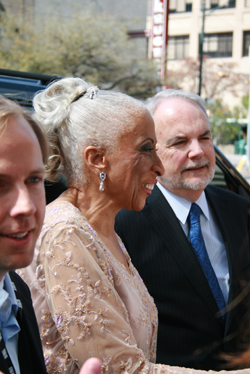
If the audience that closed Sunday's premiere of the documentary When I Rise with a standing ovation had its way, the UT community and the entire United States would be seeing this film.
"What are the plans to get this wonderful film shown around the country?" one viewer asked after the long applause had finally, reluctantly ended and director Mat Hames, producer Don Carleton, and star Barbara Smith Conrad had come onstage for a question-and-answer session.
When I Rise tells an important civil rights story — of not just 1950s wrongs, but also of the social change and personal reckoning that took place gradually over the following decades.
The larger issues are brought into focus through the experience of opera singer Barbara Smith Conrad, BM '59.
An African American who came to The University of Texas not long after it integrated, Conrad faced racism on campus but went on to achieve great success — and to fully forgive the University community by restoring her relationship with it.
"I'm overwhelmed by the love you've shown me," a visibly moved Conrad said Sunday. "I needed this healing, dear friends. I needed to know that everything I've done in a positive way has made a difference."
Conrad, a gifted mezzo-soprano, was cast as Dido in the opera Dido and Aeneas while she was a UT student.
When state legislators found out she was to play the role opposite a young white man, though, they pressured UT administrators to remove her, threatening to cut UT's appropriations.
The film includes footage that elicited gasps from Sunday's audience: Barbara describing how a man walked up and spat on her face one day on campus, for instance, and female African-American students telling of how they were threatened with rape.
Conrad's own state representative, Joe Chapman, appears in footage from the time, proclaiming Conrad as Dido "a role that is not traditionally, socially acceptable to the people of Texas."
Conrad left Austin for New York immediately after graduating, and opera took her to glamorous destinations like Hamburg, Paris, and Caracas.
She blocked UT from her mind, she said on camera, until, in 1985, a letter from the Ex-Students' Association told her she'd been named a Distinguished Alumna of the University.
The trip back to receive the award was a start. "Things changed, but it was not completely resolved, because it was still only a symbol," Conrad said. "How do you ever really find peace? A part of me was holding a spot for that healing to happen."

It took more experiences in Austin over the next 25 years — teaching master classes, re-reading letters from that time, and being honored at the State Capitol last spring — to help her come to terms with the past.
When the film showed the Texas Legislature passing a resolution in Conrad's honor, and lawmakers clapping, Sunday's audience clapped too.
The premiere was a definite triumph at the Paramount Theater, where When I Rise had its first showing as part of the South by Southwest Film Festival.
The irony of the historic, once-segregated location was not lost on director Hames, who told the mixed-race crowd at the start, "It's amazing to be premiering this film in the Paramount Theater, so close to where the events in this film took place. In 1956, many of you who are in this theater wouldn't have been allowed to be in this theater."
As for the audience member's question about where When I Rise will be shown, stay tuned. Alpheus Media and the Dolph Briscoe Center for American History, which made the film possible, plan to have the film screened on campus and are searching for a broadcast outlet to show it to a wider audience.